

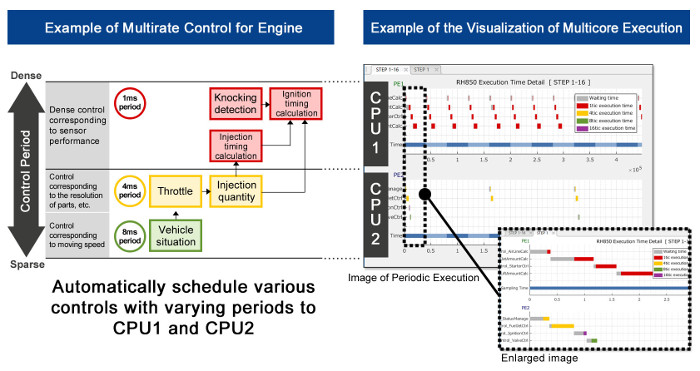
The previous development environment, based on the Renesas RH850 multicore model, automatically assigned software to multiple cores. While performance verification was possible, in complex systems involving multirate control, everything, including the RTOS and device drivers, had to be implemented manually. Now, to meet the ever-increasing demands for engine and vehicle performance while simultaneously shortening product development time, this development environment has been made to support multirate control. This allows for the direct generation of multi-core software code from the multirate control model. This enables the evaluation of execution performance in simulation. Not only does this allow for estimating execution performance from the earliest stages of software development, but it also facilitates feedback of verification results within the model itself. This improves the integrity of system development from the outset, and the burden of developing increasingly large and complex software systems can be significantly reduced. Renesas is accelerating the practical utility of model-based development environments in software development for multi-core processors and is leading the evolution of eco-friendly electric vehicles as proposed in Renesas' Autonomy™ concept.
Renesas will provide the updated model-based development environment "Embedded Target for RH850Multicore" starting in the fall of 2018. In preparation for that release, Renesas will present a demonstration of this development environment on Tuesday, July 3, 2018, at the MathWorks Automotive Conference 2018, which will be held at the Tokyo Conference Centre Shinagawa.
Key Features of the Updated "Embedded Target for RH850 Multicore" Model-Based Development Environment
: • Support for multirate control significantly reduces the burden of multicore software development.
Developing control functions requires multirate control, such as the intake/exhaust period in engine control, the fuel injection and ignition period, and the period at which the vehicle's status is checked. These are all different periods. By applying the technology that generates RH850 multicore code from Simulink® control mode to multirate control, it has become possible to directly generate multicore code, even from models that include multiple periods, such as engine control. Renesas also offers an option for the Integrated Development Environment CS+ for the RH850, a cycle-precision simulator that can measure timing with accuracy comparable to that of real-world systems. Using this option, it is possible to estimate the execution performance of a multicore MCU model in the early stages of software development. This can significantly reduce the software development period.
• Complies with the de facto JMAAB standards on control modeling guidelines for model-based automotive development.
The JMAAB (Japan MBD Automotive Advisory Board), an organization that promotes model-based development for automotive control systems, recommends several control models from the JMAAB control modeling guidelines. Of these, Renesas is providing the Simulink® Scheduler Block in this update, which conforms to type (alpha) providing a scheduler layer in the top layer. This allows for single-task multirate operation without an operating system, expressing the main specifications and timing in the Simulink® model, and automatically generating multi-core code for the RH850 to implement deterministic operations.
• General operational verification of an ECU integrating multiple systems is also possible.
Along with the advancements in the degree of electronic control in today's cars, integration is also progressing in ECUs (electronic control units), which are comparatively small-scale systems. By supporting multirate control, which facilitates the operation of small-scale systems with varying control periods using a multicore microcontroller, it is now possible to verify the operation of a complete ECU integrating multiple systems.
The updated model-based development environment is planned to support Renesas's two-core RH850/P1H-C MCU this fall, and support for the RH850/E2x series of MCUs, which include up to six cores, is also planned. Furthermore, Renesas plans to deploy this development environment across the entire Renesas Autonomy Platform, including the "R-Car" SoC family. Renesas is also continuing to work on further improving the efficiency of model-based software development, including model-based parallelization tools from partner companies and strengthening the estimation of execution performance for related multirate control support, including the operating system. In the future, Renesas plans to apply the model-based design expertise fostered in its automotive development efforts to the continuously growing RX family in the industrial area, which is seeing continued increases in both complexity and scale.