More and more companies are decentralizing their computing to bring it closer to the point of action. This process, known as edge computing, reduces network latency, avoids overloads, and improves application performance. However, depending on the use case and device location, the requirements of edge servers in OT applications are more individualized and higher than those of server IT hardware in a fully climate-controlled cloud data center.
 Reliability Planning for Edge Server Designs:
Systems installed on a factory production line, or outdoors where there is no air conditioning, must be more resistant to shock and vibration and capable of operating in industrial temperature ranges. When edge servers are deployed in the medical or test and measurement instrumentation sectors, compliance with EMC/ERP directives can play a significant role, while critical infrastructures, such as power and water supply or the transportation and traffic sectors, often require additional industry-specific certifications for functional safety, as well as a customized design to provide failover and real-time capability.
Developers looking to design and deploy these future-proof OT servers need server processors available as embedded SKUs with extended availability of at least five years (or more) compared to standard IT components. This is due to the extra time required to develop and certify these custom systems, as deployment is also typically longer. Original equipment manufacturers (OEMs) are reluctant to replace system components within the same product generation, as this would require restarting development and certification efforts. Maintenance is also more complex when multiple systems are in use. However, aside from these requirements, there is no significant difference between OT and IT servers.
Embedded CPUs for Specific Applications:
Edge data centers have a significant need for a generous selection of I/O interfaces to connect GPGPUs for artificial intelligence and machine learning using neural networks, fast solid-state storage using NVMe, and high-speed network connectivity. The storage industry is following the same trend. Software-defined storage solutions are being deployed to move SAN storage clusters and their connected NAS systems to the network edge, for example, to support critical applications and data locally and minimize downtime. By running as virtual SANs across multiple virtual machines (VMs), they enable customized storage solutions that can provide scalable data and application security across multiple physical locations. However, this also increases security requirements.
Embedded security
is one of the reasons why high-performance applications and server systems deployed at the cloud edge require hardware-integrated security features, including the ability to individually encrypt multiple VMs on the processor and their dedicated RAM. Secure migration of virtual machines and containers between distributed systems is another increasingly important factor in modern network and storage infrastructures. By adding or expanding a vSAN cluster, it's possible to securely migrate VMs to additional physical locations without disrupting running services.
The transition between ensuring data security and the continuity of the services that manage and process it is seamless and, therefore, must adapt to customer needs. This is one of the main reasons why system integrators demand long-term available CPU components that are as compatible as possible with the design of a range of processors, so that a single design can meet the requirements of different performance classes and price levels.
Zen microarchitecture
addresses these demands with its AMD Embedded EPYC processor families. The entire EPYC series is based on the Zen microarchitecture, which AMD first introduced in 2017. Utilizing low-power FinFET transistor technology, it delivers higher performance per watt and footprint. Along with the Zen microarchitecture, AMD also introduced Infinity Fabric, which integrates all components onto a single system-on-a-chip to achieve lower latency and higher bandwidth. Specifically, it includes the CPU cores, memory controller, I/O and system hubs (for example, for PCIe and Ethernet), and graphics cores. However, the graphics cores are not present in EPYC processors.
Figure 1: Unlike the four-chip design of the EPYC 7001 series (left) with up to 32 cores, the AMD EPYC 7002 processors (right) feature up to 64 cores - divided into 8 blocks of 8 cores each - resulting in higher computing performance and better cache management.
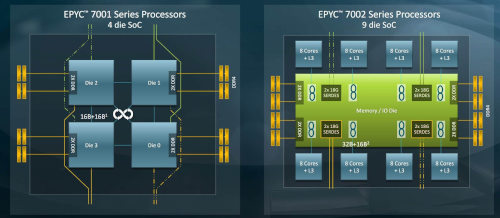
This integration is available not only on a single die but also on multiple CPU dies. Infinity Fabric also controls the interconnect between CPUs operating in dual-socket configurations. This high-bandwidth interconnect, along with the CPU's modular architecture, is behind the high scalability of all AMD processors with the Zen microarchitecture.
The new Zen microarchitecture also introduces Core Complexes (CCXs) to group multiple CPU cores. Each core within a CCX has the same low-latency access to 512 KB of L2 cache per core and 8 MB of shared L3 cache. Several CCXs are then combined into a Core Complex Die (CCD), or chiplet. Several of these chiplets are connected via Infinity Fabric to form the actual processor, which is designed as a Multi-Chip Module (MCM).
AMD EPYC Embedded processors with 32 cores feature two complex chips (CCDs) with 4 CCXs and 4 cores each per package. The two CCDs use Infinity Fabric to communicate with each other and to address memory and PCIe controllers.
EPYC Embedded 3000: Ultra-Robust and Long-Term Availability.
The AMD EPYC Embedded 3000 series processors offer up to 16 CPU cores with 32 threads in this architecture, supporting up to 1 TB of DDR4-2666MHz RAM across four memory channels. Sixty-four PCIe 3.0 lanes provide extensive I/O connectivity. AMD offers seven model variants with varying core counts (4, 8, 12, or 16 cores), CPU clock speeds (from 2.1 to 3.0 GHz maximum boost), and power consumption (from 30 to 100 watts TDP). They also feature eight 10Gb Ethernet ports and 16 SATA ports. All variants are fully pin-compatible and soldered onto the motherboards using BGA technology. This results in extremely robust designs, making them ideal for use in harsh environments. They can even be used in an extended temperature range from -40°C to 85°C. The fact that AMD processors are offered with a long-term availability of up to 10 years makes them an ideal platform for compact and highly robust edge servers for telecommunications and industrial applications. Therefore, they are also compatible with a variety of different board form factors, including µ-ITX, Mini-ITX, and COM-Express Type 7 Server-on-Modules.
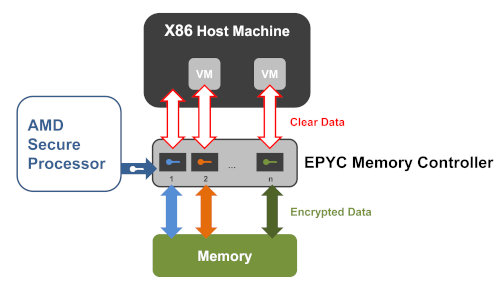
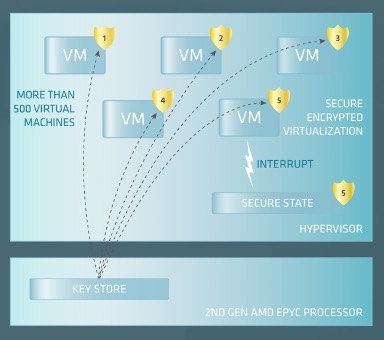 Figure 2: Secure Encrypted Virtualization (SEV) is used to encrypt each virtual machine (VM) with a unique AES-128 key known only to the hardware-isolated secure processor. This security technology, originally introduced in Zen 1 CPUs, allows for the encryption of more than 500 virtual machines in the newer EPYC Zen 2 and Zen 3 generations.
AMD has also introduced Secure Encryption Virtualization (SEV) for the first time on its EPYC Embedded 3000 CPUs. SEV allows virtual machines to be encrypted at the hardware level and isolated from the hypervisor. A separate security processor provides a unique 128-bit AES key for each virtual machine to be protected. This key also encrypts all user data in the VM's RAM (Secure Memory Encryption) to prevent that data from being read through the hypervisor.
EPYC 7002 processor family,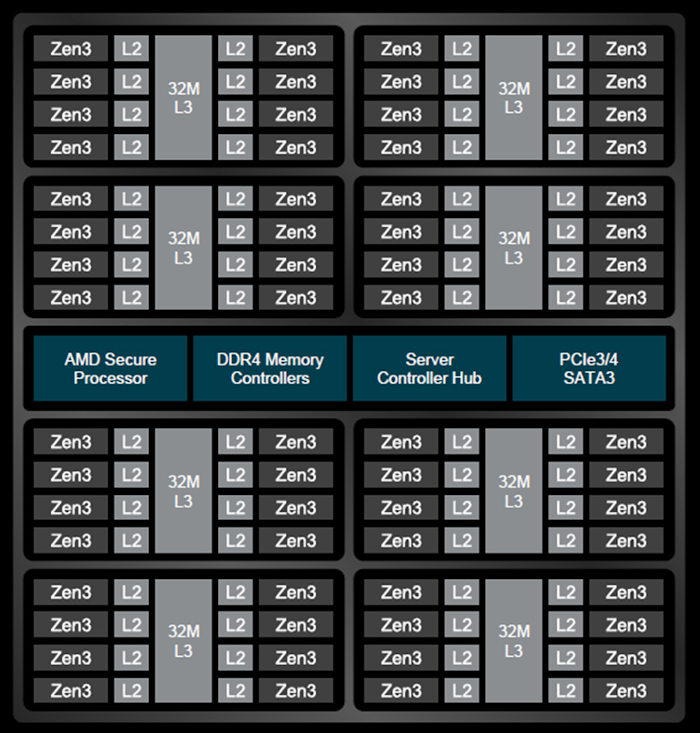
based on the Zen 2 microarchitecture, features a central I/O die that significantly simplifies off-chip CCD communication compared to the first generation of EPYC processors. Because the EPYC 7002 CCDs are manufactured using a 7nm process, they offer up to 64 cores. While the Zen 1 design had four CCDs, the number of multi-core blocks in Roma has increased to eight. Furthermore, the processor's integrated L3 cache has quadrupled in size, increasing from 64 MB in Zen 1 to up to 256 MB today; the cache is also more efficiently distributed among the cores. The up to four cores in a CCX now share 16 MB of L3 cache instead of the previous 8 MB per CCX.
The number of PCIe lanes on the I/O die remains unchanged, but the 128 lanes now connect via fourth-generation PCIe, and the eight memory lanes now support up to 4TB of DDR4 RAM with a faster clock speed of up to 3200MHz. This translates to significant performance improvements between the first and second generation AMD EPYC Embedded processors and significantly greater scalability for memory-intensive workloads.
Developers can choose from 19 model specifications, differing in the number of cores (8, 12, 16, 24, 32, or 64 cores) and clock speed. Fourteen of the 19 model variants (those without the "P" suffix) can also function as dual-socket solutions with up to 128 cores. The TDP of the AMD EPYC 7002 family ranges from 85 to 280 watts. AMD offers nine processor variants with a five-year long-term availability. This allows embedded edge server designs to access the same exceptional performance otherwise found only in traditional data centers with shorter refresh cycles.
 Table: The powerful AMD Embedded EPYC 7002 processors with a 5-year long-term availability come in 9 variants that scale from 8 cores to a maximum of 64 cores with 128 threads.
AMD has also enhanced security. For example, AMD EPYC 7002 series processors can enable an additional module to encrypt the register that the hypervisor allocates to a virtual machine. This feature prevents the disclosure of CPU register information to other software components, such as the hypervisor. This means that even if the hypervisor itself is compromised, it cannot access the contents of the VM's memory, as the GHCB (Global Hub Controller) located between them only shares the encrypted content in response to requests. This provides additional security for embedded systems at the edge.
Third Generation of EPYC Embedded (Zen 3)
CPUs: Next up are the new AMD EYPC 7003 CPUs (reference name Milan). They feature the new Zen 3 microarchitecture, which also utilizes the ultra-power-efficient 7nm process technology and maintains the basic design with CCX, CCD, and multi-chip module. With 19% higher IPC than Zen 2, the new Zen 3 cores can execute more instructions per clock cycle, thanks in part to a higher number of CPU cores per CCX—eight instead of the previous four. This doubles the available L3 cache on the CCX, increasing from 16MB (Zen 2) to 32MB. At the same time, AMD has overclocked the Infinity Fabric to 1600MHz. This enables synchronous connection of the faster DDR4-3200MHz memory, resulting in even lower latency.
AMD has also enhanced security features with secure nested paging. This feature allows processors to cryptographically isolate and secure more than 500 virtual machines per server, especially now that the necessary computing power is also available. This addresses the growing security demands at the network edge and in embedded solutions.
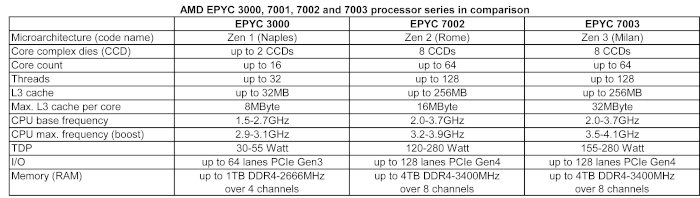 Table: This table-based overview compares several AMD EPYC processor series, revealing hardware differences and similarities.
Figure 1: Unlike the four-chip design of the EPYC 7001 series (left) with up to 32 cores, the AMD EPYC 7002 processors (right) feature up to 64 cores - divided into 8 blocks of 8 cores each - resulting in higher computing performance and better cache management.