

In the virtual domain, it is now possible not only to analyze the frequency capabilities and noise levels of mixed-signal circuits, but also to evaluate their electromagnetic compatibility before placing any integrated circuit on a printed circuit board. These simulations can provide a high degree of confidence in the design without the need to invest in high-performance testing equipment to thoroughly analyze a circuit design. Simulation can help ensure that circuit layout errors are avoided, so that final testing can be performed quickly and easily using rented facilities.
Affordable tools, such as those offered by National Instruments' Altium and LabVIEW, are useful not only for performing SPICE simulations, which are vital for evaluating the analog performance of a basic circuit, but also for tasks that determine the performance of a design once it is laid out and assembled. For example, PCB stacking calculators can identify parasitic traces associated with routed traces, and signal integrity analyzers can indicate potential crosstalk and noise problems.
Hardware Prototypes and Low-Volume Production
Despite the simulation capabilities available today, a hardware prototype is often the only suitable solution. The team may need hardware implementations to test assumptions that are too difficult or time-consuming to perform in a virtual environment. For example, a software-programmed control loop designed to run on a microcontroller might need to be evaluated against real-world signals in real time to determine its stability under a range of possible conditions. A software instruction set simulator might simply not be able to deliver results in a timely manner or be governed by realistic input data. On the other hand, when evaluating the performance of different antennas in a radio frequency (RF) design, this can often be best accomplished by testing different configurations coupled to a hardware prototype.
It's also possible that the project has reached the point where it requires field testing and customer acceptance. In the context of the Internet of Things (IoT) in particular, it's important to see how the multiple networked devices work with each other and with the cloud. At this point, the team should consider prototyping options and possibly low-volume production to provide enough hardware for a successful field test.
The team has several options. The best one will depend on a number of factors. Options range from adding custom I/O daughterboards to an existing single-board computer to outsourcing small-batch production to a subcontractor. If the goal is to ensure the software will function as expected in a looped hardware test of the core functions, it makes sense to use a compatible single-board computer and order a prototype I/O board if the available board lacks the necessary interfaces or if those interfaces don't perform adequately. Even if the final design requires a custom printed circuit board, possibly using a different variant of the on-board microcontroller, the prototype will yield enough useful information to justify its use and minimize the software changes required for the production version. By isolating the custom I/O on a daughterboard, the team can minimize the time and cost required to build a workable prototype.
 Custom-Designed Prototypes:
There will be cases where using a combination of standard hardware with custom I/O will not achieve the same level of performance as a custom-designed prototype. Testing hypotheses about signal integrity may require a printed circuit board design as close as possible to the final production model. Field testing often demands hardware that fits a very limited physical form factor or power consumption. The decision then comes down to two options: the capabilities of an in-house lab to build a working prototype or the timelines and cost of having hardware fully assembled by a subcontractor.
If the hardware complexity is relatively low, a breadboard-based option may be viable. This can be suitable when combining a single-board computer with a custom I/O daughterboard, as the number of components to be mounted on the breadboard will be relatively small. If the components are mostly discrete, it is easier to source embedded devices that are compatible with breadboard platforms. Experienced distributors can advise on package options from a design team for prototype development and support the transition to surface-mount components for final production.
The Importance of Packaging:
Packaging options are a key factor in determining whether it's better to order fully assembled prototypes from a subcontractor or to perform some assembly in the design team's own lab. A common approach involves using tools like those from Altium and Autodesk to design a printed circuit board as a prototype and then assembling the necessary components in the lab. This requires a combination of design expertise and access to low-cost lab and testing equipment.
Unlike the breadboard option, designers can choose to use not only components in push-in packages but also those designed for surface mounting. However, there are practical limitations on what can realistically be assembled and soldered in a lab environment. This is simply due to the different levels of accuracy between the human hand and automated pick-and-place equipment, which can place tiny components with sub-millimeter accuracy. To some extent, the surface tension of a hot solder (assuming it is deposited reasonably accurately onto the surface of a printed circuit board) will help position small discrete components. However, it is obviously easier to hand-mount discrete components supplied in larger surface-mount packages or push-in versions than 0402 or smaller surface-mount devices.
Similarly, surface-mount devices with pins around the perimeter, such as quad flat-pack (QFP) packages, are easier to position and solder in a lab environment than ball-grid array (BGA) packages because the engineer can verify pin alignment before soldering. Many surface-mount integrated circuits are available in various packages, so the QFP version can be used for small-run production and prototyping, while BGA or CSP packages are used in production. Distributors with design support experience can advise on which components are suitable for a dual-pack approach, where the prototype uses one format and the final board uses the lower-cost or more compact version. Simulation tools will help identify any potential changes in signal integrity or I/O routing that may be necessary to accommodate the transition from prototype to production.
Benchtop Tools to Facilitate Assembly in the Lab:
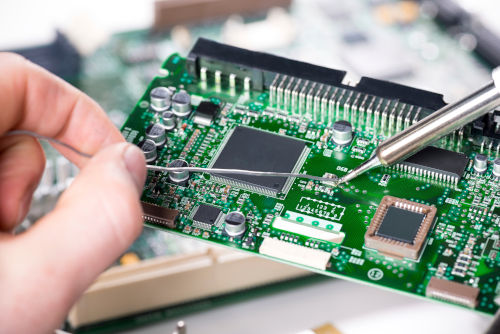
Several everyday benchtop tools, such as fine-tipped soldering irons, facilitate assembly in the lab. Today, a microscope is an essential aid for assembling fine-pitch devices on bare circuit boards. A stereoscopic zoom microscope typically provides ring illumination to assist with precise component placement and post-reflow inspection. Solder paste injection is another important tool. Compressed air is usually used to apply controlled amounts of solder paste to the board repeatedly. The high level of control over dispensing greatly simplifies the assembly of packages, such as QFPs, with a large number of pins closely spaced together.
For the reflow soldering operation itself, an engineer can use a reflow hot plate designed to reflow small portions of the board at a time. Alternatively, all components can be assembled before being transferred to a benchtop reflow oven.
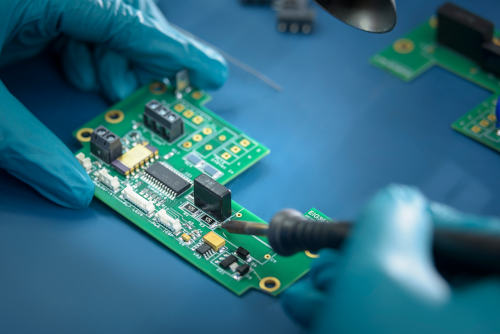
Since a certain level of solder failure is inevitable (except for the most experienced engineers), testing and refurbishment tools are essential. Hot plates and hot air tools help remove misaligned or defective components to prepare them for resoldering. A multimeter is an important testing tool, as it can be used to probe any visible terminals and surface traces when checking connectivity. Farnell stocks a wide range of laboratory tools manufactured by specialists such as Metcal and Weller and has in-house expertise to advise you on your prototyping and refurbishment capabilities.
Conclusion:
Design teams have many options and choices when creating and using prototypes during product development. Experienced distributors can offer valuable advice on the availability of suitable components for lab assembly and the best delivery methods to subcontractors, as well as on how to modify packaging and supply options to suit final production. They can also guide teams on the best tools to use in the lab when in-house assembly is the best option. All that is needed now is an engineer's imagination and skill to bring a product idea to life.
By Simon Meadmore, Global Head of IP&E at Farnell – www.farnell.com -