

Another crucial topic is efficient battery monitoring, which can optimize battery performance and extend battery life, thereby minimizing unnecessary waste and preserving valuable resources. This article will provide a brief overview of some of the important metrics used to improve battery efficiency and a guide to key considerations when selecting battery management systems for these applications.
Introduction
Choosing the right battery and its accompanying battery management system (BMS) is a critical decision in the design of an autonomous mobile robot (AMR), as shown in Figure 1. In tightly integrated environments such as factories and warehouses, where every second of operation matters, ensuring the safe and reliable operation of all components is paramount.
BMS solutions can provide accurate measurements of battery charging and discharging, maximizing usable capacity. Furthermore, precise measurements enable accurate calculation of the state of charge (SoC) and depth of discharge (DoD), which are essential parameters for enabling smarter mobile robot workflows. Equally important are the safety aspects of these systems, and it is crucial to consider BMS technologies that provide both overcharge protection and overcurrent detection when selecting systems for these applications.

Figure 1. An AMR diagram.
What are battery management systems?
A BMS is an electronic system that can be used to closely monitor various parameters of a battery pack and/or its individual cells. It is essential for achieving maximum usable battery capacity while ensuring safe and reliable operation. An efficient system can not only safely optimize usable battery capacity but also provide engineers with valuable parameters such as cell voltage, state of charge (SoC), state of discharge (DoD), state of health (SoH), temperature, and current—all of which can be used to obtain the best system performance.
What are SoC, DoD, and SoH, and why are they important for automated guided vehicles (AGVs) and AMRs?
SoC, DoD, and SoH are some of the common parameters used in BMS to determine if the system is in good condition, for early fault detection, cell aging, and remaining operating time.

SoC stands for state of charge and can be defined as the charge level of a battery relative to its total capacity. SoC is typically expressed as a percentage, where 0% = empty and 100% = full.
The SoH or state of health can be defined by the maximum capacity (Cmax.) of the battery that can be released in relation to its nominal capacity (Cnom.).

The DoD or depth of discharge is the opposite metric to the SoC and is defined by the percentage of the battery that has been discharged (Cliberated) in relation to its nominal capacity (Cnom.).
How are they relevant to an AMR solution?
A battery's System of Components (SoC) varies depending on the battery architecture; however, an accurate system for measuring a battery's health is essential. Two main types of commonly used batteries are lithium-ion and lead-acid. Each has its pros and cons, with several subcategories. In general, lithium-ion batteries are considered a better choice for robots because they offer:
► Higher energy density, which can be 8 to 10 times that of a lead-acid battery.
► Lithium-ion batteries are lighter than lead-acid batteries of the same capacity.
► Charging a lead-acid battery takes longer than charging a lithium-ion battery.
► Lithium-ion batteries offer a longer cycle life, allowing for a significantly greater number of charge cycles.
However, these advantages come at a higher cost and present certain challenges that must be addressed to fully realize their performance benefits.
To better illustrate this in a real-world application, consider the graph in Figure 2, which compares the depth of discharge (DoD) of a lead-acid battery and a lithium-ion battery. You can see that the battery pack voltage varies minimally for a lithium-ion battery when moving from 0% DoD to 80% DoD. 80% DoD is typically the lower limit for lithium-ion batteries, and anything below this can be considered dangerous.
However, because the lithium-ion battery voltage changes only minimally across the usable range, even a small measurement error could lead to a substantial decrease in performance.
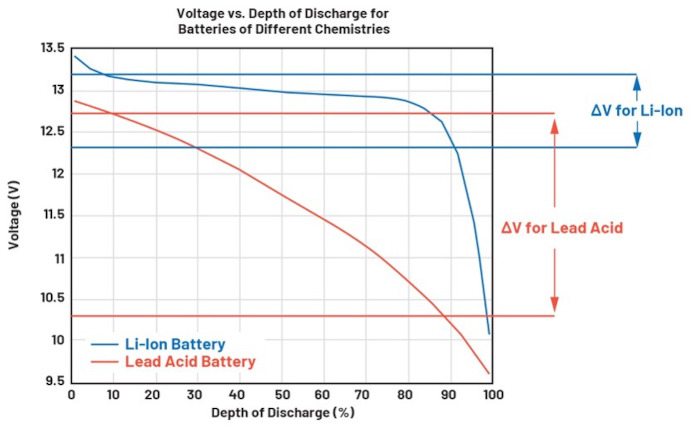
Figure 2. Battery voltage level versus DoD.

Figure 3. Generic AMR battery and BMS architecture.
To illustrate this in a real-world scenario:
Imagine the following AMR is a 24 V system and uses a 27.2 V LiFePO4 battery pack where each cell has a capacity of 3.4 V when fully charged. See Figure 3. Table
1 shows a common profile for a SoC for such a battery.
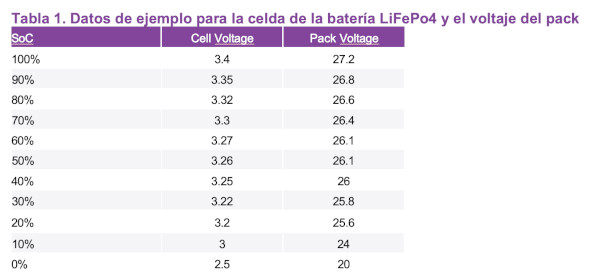
Table 1. Example data for LiFePO4 battery cell and pack voltage
For LiFePO4 batteries, the usable range can vary, but a good rule of thumb is to consider the minimum SoC to be 10% and the maximum 90%.
Any value below the minimum level can cause an internal short circuit in the battery, and charging it above 90% reduces the lifespan of these batteries.
Referring to Table 1, note that the voltage range per cell is 350 mV, and for a 27.2 V pack with 8 cells, it is 3.2 V. With this in mind, we can make the following assumptions:
If the usable cell voltage range for a LiFePO4 battery is 350 mV, then each 1 mV of cell measurement error reduces the range by 0.28%.
If the cost of a battery pack is $4,000, the cost of the error is:
$4,000 × 0.28% = $11.20/mV of error, meaning the battery packs would be underutilized for the range.
While 0.28% of the range may seem insignificant, when scaled across multiple AMR systems, this percentage could multiply by hundreds or even thousands, making it a significant factor. This factor becomes even more relevant when considering natural battery degradation.
Natural degradation also plays a significant role in battery health, as over time, a battery's maximum SoC will degrade (Figure 4). Therefore, accurate cell measurement is the best way to maintain optimal performance, even after natural degradation.

Figure 4. Maximum reduction of usable range due to natural degradation.
Monitoring all parameters and precisely controlling battery usage is the best way to extend battery life and maximize every unit of charge.
How can ADI's BMS solutions increase productivity and solve problems?
So, what technologies can ADI's BMS offer to improve and achieve high performance in mobile robotics applications?
Precise battery management significantly improves battery efficiency by accurately measuring individual cells, enabling more precise control and estimation of the state of charge across various battery chemistries. Measuring each cell individually ensures safe control of the battery's state of charge. This precise control facilitates balanced charging, preventing overcharging and over-discharging of the cells. Furthermore, synchronous current and voltage measurements increase the accuracy of the acquired data. Extremely fast overcurrent detection enables rapid fault detection and emergency shutdowns, ensuring safety and reliability.

Figure 5. Main degradation factors of lithium-ion batteries.
The ADBMS6948 provides all the key specifications required for mobile robots, but some critical specifications with BMS design considerations for a mobile robot are:
► Small total measurement error (TME) over lifetime (from -40°C to +125°C)
► Simultaneous and continuous measurement of cell voltages.
► Integrated isoSPI™ interface.
► Hot-swappable without external shielding.
► Passive cell balancing.
► Low-power cell monitoring (LPCM) for cell and temperature monitoring in the off state.
► Low power supply current in standby mode.
Reducing Waste and Helping the Environment:
According to the International Energy Agency's 2023 report on batteries, "batteries are an essential component of the clean energy transition."¹ It is crucial to recognize the importance of managing these resources properly. The materials that make up a battery are difficult to extract from the environment, which underscores the need for their optimal use. By efficiently managing charging and discharging parameters, we can extend battery life, allowing them to be used for longer periods without needing to be replaced.
The low risk factor with overcurrent protection provided by the ADI BMS function enables very safe operation and reduces the risk of damaging both the battery and the connected load.
Figure 5 shows some examples of degradation factors in lithium-ion batteries, and it is important to note that these can lead to dangerous situations such as combustion and explosion, which could quickly become catastrophic.²
All parameters that influence battery degradation can be measured, addressed, and acted upon, providing the system with the most optimal operating conditions. throughout the required lifespan. Increasing battery life is an important factor in reducing waste, as batteries can now be used for longer thanks to optimized management, effectively reducing unnecessary disposal of battery cells.
conclusion
, we can say that BMSs can not only increase overall system performance by allowing precise control of every parameter, but also reduce costs and waste. In an evolving manufacturing environment that is becoming increasingly automated and seeking additional performance gains from its mobile robots, precise asset control and management become essential.
For more information on ADI's offerings for industrial mobile robots, please see our robotic solutions page.
References
1 “Batteries and safe energy transitions.” International Energy Agency, 2023.
2 Xiaoqiang Zhang, Yue Han, and Weiping Zhang. “A review of factors affecting the lifetime of lithium-ion batteries.”
Transactions on Electrical and Electronic Materials, Vol. 22, July 2021.
About the author:
Based in Limerick, Rafael Marengo is a Systems Applications Engineer in the Connected Motion and Robotics Business Unit at Analog Devices, supporting a range of technologies including Building Management Systems (BMS), motion control, and more. He joined ADI in 2019 as a Design Evaluation Engineer for the Precision Converters Technology group. Rafael holds a degree in Control and Automation Engineering from the Federal University of Lavras in Brazil. Prior to joining ADI, he worked as an R&D Manager at a machine vision startup focused on the agricultural technology market, where he was responsible for the global commercialization of numerous products.