OLogic, an electronics consultancy based in Santa Clara, California, USA, has over 15 years of experience helping clients commercialize their robotic designs in both large and small volumes. They provide electrical, mechanical, and industrial engineering support, as well as software and firmware development. This includes specialized expertise in power electronics integration, a key design factor that determines the autonomy, functionality, and payload capacity of mobile robots. OLogic has designed dozens of robots for numerous sectors, including agriculture, smart homes, and warehouse management, to name just a few.
Unleashing Power:
Mobile robots present a unique challenge in terms of power requirements, as their needs vary considerably. The sensors, servomotors, actuators, data servers, communication systems, and other devices operating within the robot require different power levels and densities. Some consume a lot of power, while others may operate only infrequently. This necessitates the ability to supply power quickly, cleanly, and cost-effectively from a battery.
“The components we’ve been using most lately are Vicor’s ZVS step-down regulators,” Larson said. “We use them in all kinds of mobile robots. I no longer have to think, ‘Oh, I need 5 or 10 A at 12 V, so I’m going to build my own power supply.’ I don’t have to think about it anymore.”.
Saving time and money by automating building layout.
One client that works closely with OLogic to optimize its consumption is Dusty Robotics (Dusty). This Mountain View, California-based company develops robot-based tools for modern construction.
For centuries, the construction industry has used simple tools to mark out building plans on the ground: a tape measure and a chalk line. The tape measure and chalk process is slow and prone to human error, which impacts deadlines and budgets. These errors often require rework and typically account for 10% of a construction project's cost, according to Dusty.
“When plans are drawn by hand, many errors are made—far more than the construction industry realizes,” said Philipp Herget, co-founder and CTO of Dusty Robotics. “We’ve heard of cases where drafting errors have led to construction companies going bankrupt. We prevent these errors because everything is marked correctly: not by hand, but by a robot.”.
 Dusty's FieldPrinter is five times faster and error-free.
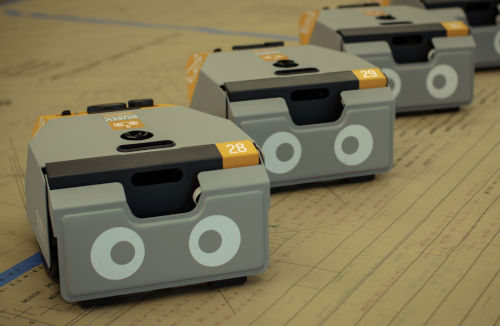
Dusty eliminates the laborious conventional process of physically transferring building plans to the ground with a robot programmed on-site to automate this task. Dusty's FieldPrinter robot loads a digital version of the plan and prints the layout onto the ground, including elements such as walls, doors, pipes, and electrical lines. It does this at speeds approximately five times faster than a person, with an accuracy of around 1.5 mm.
Thanks to its long battery life and advanced power conversion technology, Dusty's robotic innovation is helping to digitize the construction industry by creating a single source of truth on the job site, starting from the digital model.
Dusty's FieldPrinter Robot Power Supply:
Dusty's FieldPrinter is a battery-powered mobile robot that operates for extended periods under diverse weather conditions. It incorporates numerous electronic devices, including sensors, control motors and motorized components, high-performance processors, and a printer, all with varying voltage and current requirements. Therefore, Dusty collaborated with OLogic to develop the core components. After testing discrete power electronics solutions for this robot, OLogic quickly realized the time savings of switching to a modular approach for developing robot power networks. Furthermore, Vicor modules such as the ZVS step-down regulator are extremely cost-effective, delivering 200 to 300 W of power with 97% efficiency.
Thanks to its long battery life and state-of-the-art power conversion technology, Dusty's robotic innovation is helping to digitize the construction industry by creating a single source of truth on the job site. Instead of the architect, contractor, and each supplier working from their own plans, they all rely on a single design printed on the ground. The ability to provide a digital layout improves coordination between all parties, enabling better planning and execution, and faster project completion.
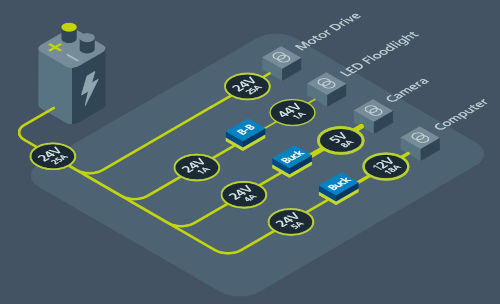
Example of a power network designed for robots: OLogic uses Vicor power modules (Buck, Buck Boosts, and PRMs) in its robots because of their power density, efficiency, and ease of use. “We use them in all kinds of mobile robots. I no longer have to think, ‘Oh, I need 5 or 10 A at 12 V, so I’m going to build my own power supply.’ I don’t have to think about it anymore,” said OLogic CEO Ted Larson.