

The selected welding atmosphere can cause or accelerate various welding defects, but it can also prevent or reduce them. Rehm Thermal Systems' Vision series convection welding systems are designed as either air or nitrogen systems.
Solder Balls/Beading:
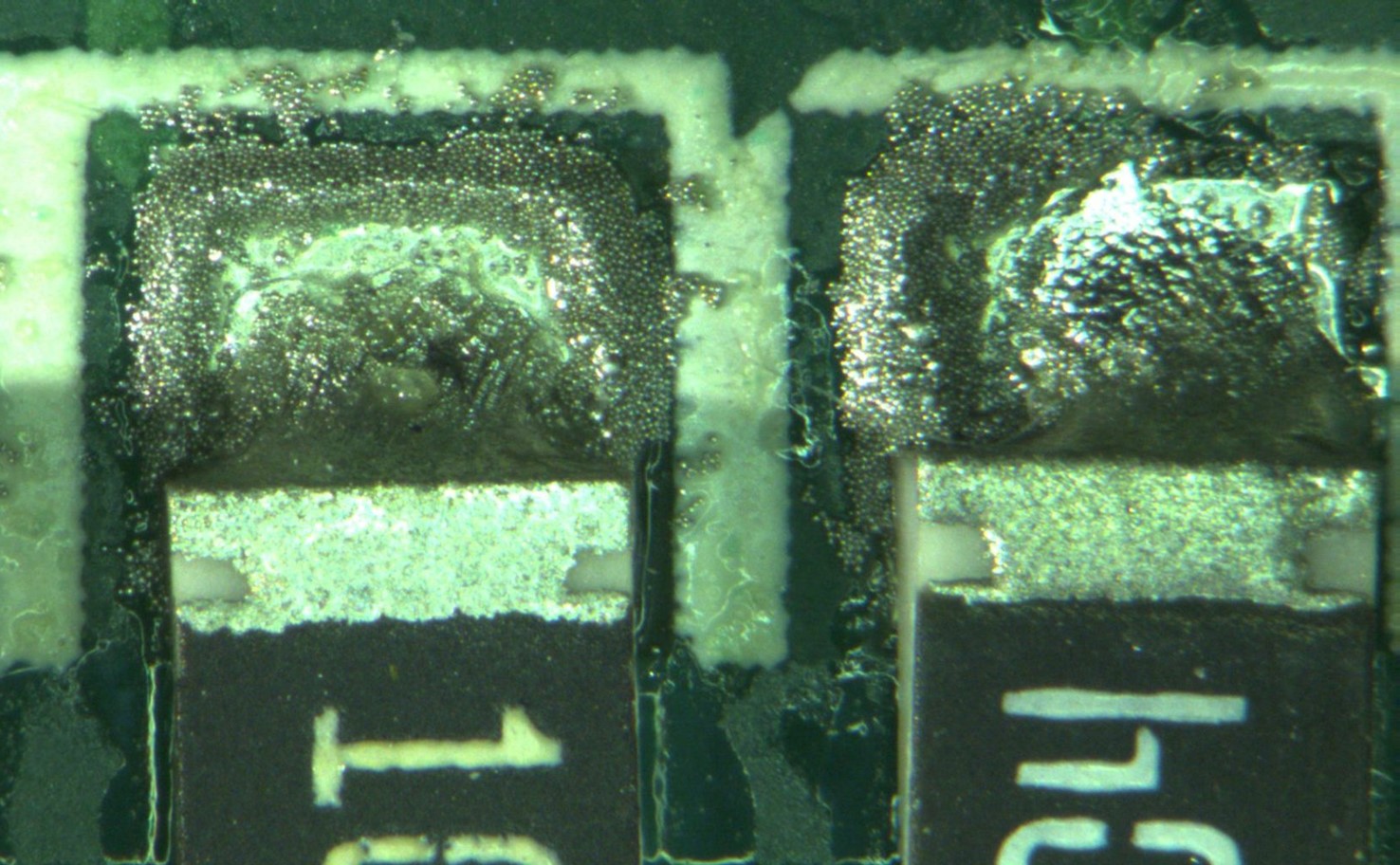
A very common defect is solder balls on bipolar components (chips), a phenomenon known as beading. Beading is caused by solder grains from the paste getting trapped under the component and being ejected laterally from the gap under the chip during reflow. All the solder pastes tested showed less beading after reflow soldering with nitrogen. This is due to the improved and faster fusion of the individual solder grains within a uniform solder volume. In the absence of oxygen, oxide films cannot form on the surface of the solder grains, which would hinder fusion. This reduces the likelihood of individual solder grains getting trapped under the chip gap.
Similarly
, the reduced voiding in surface welds or QFN welds is due to improved wetting. Fast-wetting welds can expel the gases generated during reflow welding more efficiently from their liquid state. However, these results cannot be generalized to all weld spots.
Graping:
The properties of the fluxing agent are constantly being modified and improved. However, classic properties, such as hot and cold slump, should not be neglected when developing remelting profiles. Time on liquidus and rise gradients are not the only decisive factors. Miniaturization also accompanies the granulation of the paste. The smaller the diameters, the more they need to be "protected" by the fluxing agent. If the protective fluxing agent disappears from the paste grain due to "bleeding" in the preheating zone (hot slump), it will oxidize and subsequently remelt, but will no longer fuse with other parts of the paste. The oxide layer is impenetrable and its appearance resembles a row of grapes. An inert atmosphere widens the process window, but does not completely eliminate the influence of the fluxing agent.
 Head-in-Pillow (HiP)
The Head-in-Pillow or Head-on-Pillow effect is caused by an oxide layer on the BGA bead that prevents the paste grains from fusing. Typically, twisting and deformation of the BGA and/or PCB cause the paste deposit to separate from the BGA bead. Due to the lack of flux activation, an oxide layer forms on the bead, which subsequently prevents it from fusing with the paste deposit, even if it is re-immersed in the remelted paste deposit. Since the flux is consumed at this point, the oxide layer can no longer be reduced, and no bond is formed. Therefore, the bead appears to be resting on a pillow (Head-in-Pillow; HiP) or on a cushion (Head-on-Pillow). If oxidation is prevented during separation using an inert atmosphere (N2 or vapor phase), the paste deposit and the bead can fuse. However, there must still be a small amount of residual activation from the fluxing agent. In this case as well, an inert atmosphere protects the fluxing agent, since fewer oxides need to be reduced.
Wetting Problems:
Good wetting conditions under nitrogen generally lead to better solder spread and prevent solder defects caused by insufficient wetting of the solder surfaces (IPC 610). This is well known, but the expected soldering results are not always achieved. Chip soldering is characterized, among other things, by the shape of the meniscus formed. In this context, a high amount of solder is a sign of quality. Under a nitrogen atmosphere, the detected wetting height may be less than under air. In other words, the unwetted area (the gap) increases. The reason for this is, in fact, the better spread of solder under nitrogen. Since the solder must work against gravity to wet the component lead, the surface of the printed circuit board to be wetted is favored; furthermore, the height of the sphere is lower with a greater spread. This means there is less solder available to reach the component lead.
Tombstones/Grafts:
Tombstones form due to differences in wetting times between the two sides of a bipolar component. If one weld bead melts before the other, the aggressive wetting forces and surface tension of the molten solder straighten the component. The delayed melting of the second solder bead then has no chance of wetting the second component connection. Under a nitrogen atmosphere, more tombstones are typically observed after reflow soldering. The reason is, again, better wetting, so the difference in wetting time between the two component connections is usually greater. However, even in the case of tombstones, interactions with other influencing factors are sometimes considerable.