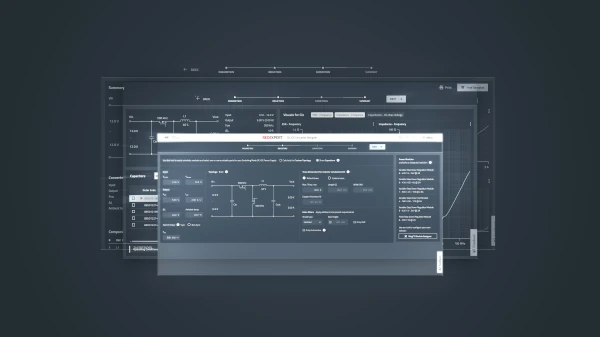
Furthermore, the effects of bias on inductance and capacitance are taken into account. New to the tool is a worst-case analysis option for losses and temperature rise, enabling the development of robust designs prepared for all real-world operating conditions.
In practice, the inductance of a core varies due to DC bias, a phenomenon that simplified datasheet specifications often systematically overlook and which can lead to incorrect component selection. The same applies to ceramic capacitors, whose capacitance decreases significantly with operating voltage. The new DC/DC converter tool accurately reflects this reality and provides loss and temperature estimates much closer to the actual circuit behavior.
Automatic Topology Selection:
The tool automatically selects the appropriate circuit topology based on the entered parameters: Buck (synchronous/asynchronous), Boost (synchronous/asynchronous), and SEPIC. For experienced users working with specialized or less common circuit topologies, the tool offers a user-defined topology mode. Additional filters allow you to select components for automotive applications, shielded inductors, and component height, simplifying component selection for specific applications. Even at this initial stage, a link to the MagI³C converter design module allows you to compare a discrete circuit with an integrated module solution.
Optimized Component Comparison:
The analysis has been significantly expanded compared to the previous tool. The system recommends the five most suitable components based on a weighted evaluation of performance and package size. It is possible to directly compare multiple components: losses as a function of output current (Iout) and switching frequency (Fsw) are displayed simultaneously for the selected components in a single graph. Furthermore, the graphical representation options have been significantly expanded: zoom, crosshair cursor, and export as an image or Excel file. Experienced users can manually load any component from the Würth Elektronik portfolio into the tool, not just relying on the list of automatic recommendations.
Capacitor Recommendation Included:
Another new feature is that the tool also recommends suitable capacitors and a microchip driver for the specified input parameters. A link to the MagI³C power module designer allows you to compare a discrete circuit with an integrated module solution.
The summary page compiles all simulation results and generates a complete bill of materials for up to six components. These components can be requested as free samples or added directly to the shopping cart.