

These include electric vehicle motors such as forklifts, electric scooters and mobility devices, as well as high-power industrial motors.
When connecting two or more MOSFETs in parallel to handle high current capacity and reduce conduction losses, it can be difficult for designers to ensure that the load current is shared equally among the individual devices during turn-on and turn-off. The MOSFETs with the lowest VGS(th) will turn on first, leading to greater thermal stress and accelerating failure. To provide a sufficient safety margin, engineers often oversize the MOSFETs used in their end applications. This costly and time-consuming approach often requires additional testing but still offers no guarantees about the behavior of the devices under higher load currents (tens of amperes). An alternative approach is to request devices from suppliers that strictly adhere to specifications, but this can further increase the cost of the final application.
The features of Nexperia's PSMN1R9-80SSJ and PSMN2R3-100SSJ ASFETs eliminate the need for designers to adopt either of these approaches, as they provide improved dynamic current sharing. These switches offer a 50% lower current difference between parallel devices (for currents up to 50 A per device) during on/off switching and also offer a VGS(th) window up to 50% lower (0.6 V min.-max.). This advantage, combined with the low RDS(on) of 1.9 mΩ or 2.3 mΩ, helps deliver high efficiency in power switching applications.
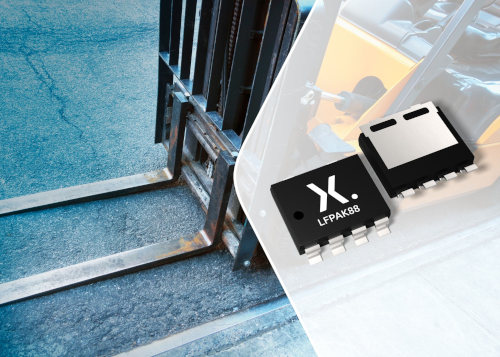
The new ASFETs are available in the rugged and compact 8 mm x 8 mm LFPAK88 package with a copper clip and offer an operating temperature range of -55 °C to +175 °C.