
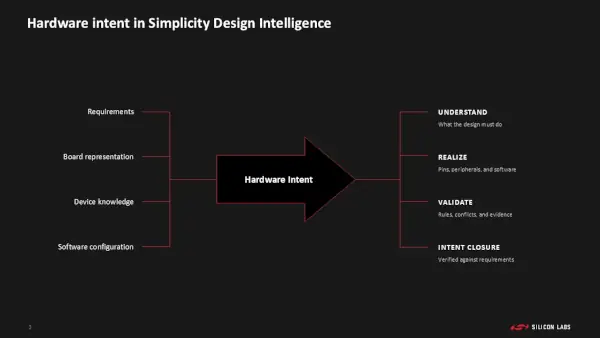
The company also announced Simplicity Design Intelligence, a suite of features for linking hardware and software requirements to project configuration. Its first feature, called Hardware Intent, is slated for an alpha release in January 2027.
The Simplicity AI SDK provides AI-powered programming assistants with structured access to Silicon Labs' SDKs, tools, documentation, and connected hardware.
The beta version supports GitHub Copilot, Cursor, and Codex, according to the company.
This approach allows general-purpose AI assistants to be used by providing them with specific context about Silicon Labs devices and tools, rather than forcing them to use a proprietary assistant.
The first officially supported experience focuses on Bluetooth Low Energy (LE).
The workflows included project creation and configuration, compilation, device programming, debugging, network and power consumption analysis, documentation queries, and hardware interaction.
Silicon Labs has also introduced Simplicity Design Intelligence, an initiative aimed at using information about a product's requirements to assist during its implementation and subsequently verify the resulting configuration.
Hardware Intent will be its first function.
The system will be able to use product requirements, board schematics, and other hardware-related documents—from datasheets to meeting notes—as input.
Based on this information, it can intervene in the configuration of pins, peripherals, and software, and then compare the result with the original requirements.
Silicon Labs indicates that this analysis can identify problems such as pin conflicts, peripheral incompatibilities, or missing constraints before a board is manufactured.
The company links this capability to a potential reduction in PCB redesigns or respins.
The alpha version of Hardware Intent is planned for January 2027, so it should be distinguished from Simplicity AI SDK, whose public beta is already available.
Open Source Community for Bluetooth LE
Another initiative is the beta launch of an open source development community, initially focused on Bluetooth LE.
Developers will have access to sample applications and Silicon Labs tools and will be able to report issues, propose fixes, and submit code via pull requests.
Accepted contributions will undergo Silicon Labs' standard engineering and testing processes before being incorporated into future versions of their SDKs.
Proposals and discussions will also remain visible before their eventual acceptance, facilitating information sharing among developers.
The Silicon Labs applications team will support issues reported through GitHub. The company plans to extend this model to other wireless technologies later, although the announcement doesn't specify dates or which ones will be added next.
integrating
its edge AI and machine learning tools with Databricks to connect embedded devices to the data processes and MLOps used by businesses.
An initial implementation of the Silicon Labs MLOps SDK allows devices to connect to Databricks and collect data from a fleet.
Once this data is integrated into Databricks, it can be used within its training flows, MLOps tools, and GPU resources.
The goal is to integrate the model training and management process for embedded devices into the same data and AI infrastructure used for other enterprise workloads.
ML Profiler for Evaluating Models on Hardware:
After training, Silicon Labs ML Profiler can provide estimates of a model's suitability for the target hardware and its memory and CPU requirements.
The press release itself characterizes this information as "directionally accurate." Therefore, it should be interpreted as guidance for development and not necessarily as an exact measurement of the model's final performance on the device.
This information can be used to modify the model before deploying it on the target hardware.
Silicon Labs' initial MLOps tools for this integration are now available at Databricks, according to the company.
Three initiatives in different stages of availability
. The announcements are at various stages of development. Simplicity AI SDK is in public beta, initially with official support for Bluetooth LE. The company cites GitHub Copilot, Cursor, and Codex among the assistants supported in the beta.
The open-source community is also launching in beta, starting with Bluetooth LE, while the first MLOps tools for connecting to Databricks are now available.
Hardware Intent, on the other hand, is not yet generally available: Silicon Labs plans to release an alpha version in January 2027.