For example, the current and voltage of the actuators must be measured. The necessary sensors are integrated directly into the power circuit of the high-voltage system, but the control electronics only operate with low-voltage technology of 5 or 3.3 V. To prevent damage to people or property, the sensor circuit must be galvanically isolated from the control circuit for safety reasons.
 There must be no electrical connection between the two circuits. The methods and test standards for galvanic isolation are well known. Depending on the solution, one of these bonding procedures is applied: capacitive, inductive, or optical.
Sigma-Delta Modulator with Galvanic Isolation:
A particularly valued method, thanks to its robustness and reliability, incorporates sigma-delta modulation with galvanic isolation, in which the signals are transmitted optically. At their output, converters of this type supply a high-frequency data stream of up to 25 MHz, as well as the clock signal.
The sigma-delta method works similarly to pulse-width modulation. If there is a zero value at the input, only zeros are transmitted. If the input value is at its maximum, the line continuously transmits a one; if the input value is 50%, a one and a zero are transmitted 50% of the time each.
The control electronics evaluate the signal provided by the sigma-delta modulator. To evaluate these signals, EBV customers often use an FPGA with an integrated sinc3 filter. In this respect, the FalconEye reference design created by EBV Elektronik has proven invaluable.
Howto Avoid Transmission Problems:
However, problems arise in some applications when transmitting a 20 MHz signal to/from the sigma-delta A/D converter because this signal does not always pass through the line or circuit board smoothly or in compliance with electromagnetic compatibility (EMC). As this problem continued to grow, EBV Elektronik began searching for a solution and found it in the use of differential data flow for this data transmission. This is precisely the function that EBV Elektronik now implements. An Avago ACPL-796J converter, already available on the market, was used as the basis for this. This product offers safe, TÜV-certified isolation between the two sides. Regarding isolation distance (creepage), transient intensity, protection circuitry, etc., the new EBVchip is in line with the proven ACPL-796J.
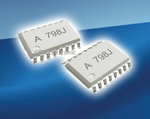
The new converter, designated ACPL-798J, provides a differential LVDS (low-voltage differential signaling) output signal. In this modified version, the signals reliably reach their destination in environments with strong electromagnetic interference (EMI).
Since the ACPL-798J generates differential output signals and electromagnetic interference affects both output lines simultaneously and with virtually the same intensity, the useful signal at the destination can be recovered by subtracting the two signals, while the interference signals caused on both lines cancel each other out during this subtraction.
While standard outputs, which use ground as a reference, operate at 5 or 3.3 V, differential signal transmission using LVDS can operate at much lower levels. In accordance with its standard, LVDS uses a 200 mV differential level, with the current sharing canceled at the end. During LVDS signal transmission, this results in significantly lower power losses compared to conventional single-ended signals. Most FPGAs can handle LVDS signals without difficulty. Therefore, virtually no modifications are required during evaluation.
Small adjustments, big advantages.
This small change results in a significant advantage. This innovative isolated LVDS delta-sigma modulator is available from EBV Elektronik as part of its EBVchip program under the name Hunter or ACPL-798J. EBV Elektronik is unaware of any other semiconductor on the global market with properties comparable to those of Hunter.
Hunter conforms to Class IIIa isolation specifications according to DIN VDE 0110 and operates with external clock signals in the 15–25 MHz range. The clock pulse signal is reliably transmitted via galvanic isolation. This allows the module to acquire data synchronously with any digital controller. The module even transmits modulator data encoded via the galvanically isolated path. The data is then recovered, decoded, and converted into a serial data stream at the other end.
With a typical signal-to-noise ratio of 78 dB and the appropriate digital filter, a differential nonlinearity of 0.9 LSB with a 16-bit lossless code resolution (12-bit ENOB) and a typical gain error of 2%, the Hunter, which has been designed for ambient temperatures of -40...+105 °C, is suitable for numerous industrial applications.
Author:
Author: Mr. Rolf Richter