

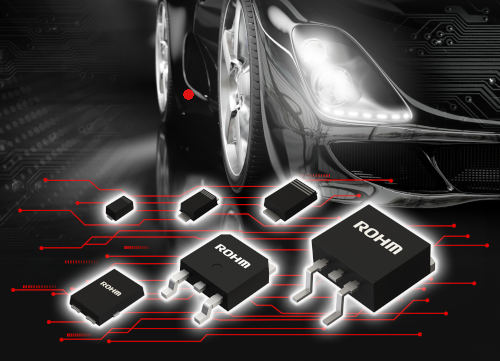
Although numerous types of diodes exist, high-efficiency SBDs are increasingly used in a wide variety of applications. Specifically, SBDs with a Trench-MOS structure, which provide a lower forward voltage (VF) than planar types, allow for greater efficiency in rectification applications. However, one of the drawbacks of Trench-MOS structures is that they typically exhibit a worse turnaround time (trr) than planar topologies, resulting in greater power loss when used for switching.
In response, ROHM has developed a new series that utilizes a patented Trench-MOS structure that simultaneously reduces both VF and IR (which are in a compensation relationship) while achieving a class-leading trr.
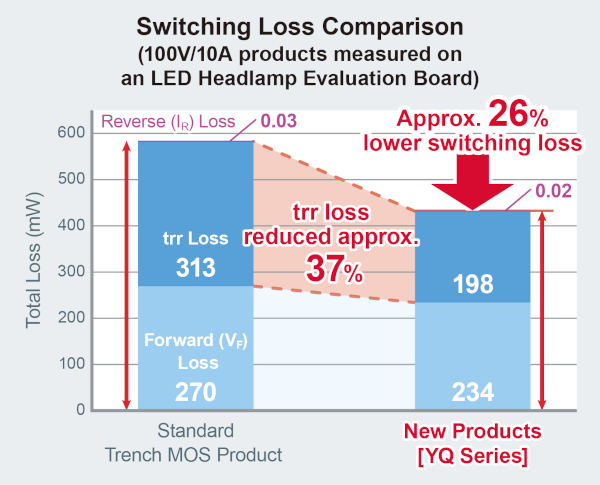
The YQ series is ROHM's first to adopt a Trench-MOS structure, expanding the four existing conventional SBD ranges optimized to meet a wide variety of requirements. The patented design achieves a class-leading trr of 15 ns, reducing trr loss by approximately 37% and overall switching loss by approximately 26% compared to general Trench-MOS products, thus contributing to lower power consumption in applications. The new structure also improves VF and IR losses compared to conventional planar SBDs. This allows for lower power loss when used in forward-biased applications, such as rectification, while also reducing the risk of thermal runaway, a major problem with SBDs. In this respect, they are ideal for assemblies requiring high-speed switching, such as drive circuits for automotive LED headlights and DC-DC converters in xEVs, which tend to generate heat.
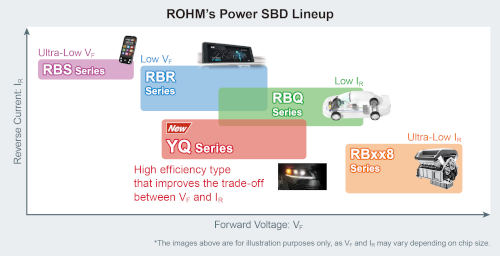
In the future, ROHM will strive to further improve the quality of its semiconductor devices, from low to high voltage, while continuing to strengthen its broad range to further reduce power consumption and achieve greater miniaturization.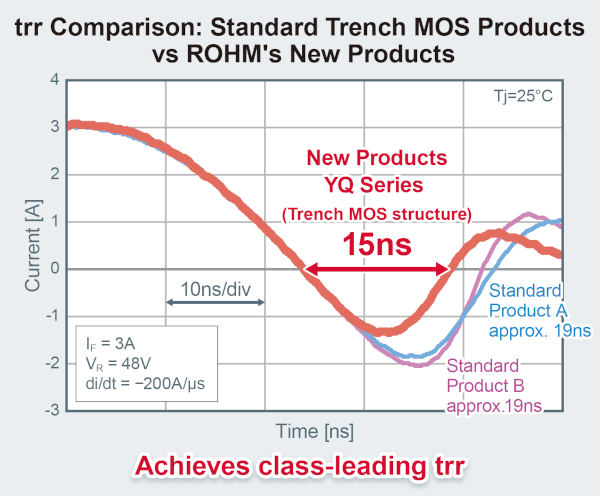
SBD Trench-MOS Structure:
The Trench-MOS structure is created by forming a trench with polysilicon in the epitaxial layer of the wafer to mitigate electric field concentration. This reduces the resistance of the wafer's epitaxial layer and results in a lower forward voltage (VF) when a forward voltage is applied. Simultaneously, during reverse bias, the electric field concentration is minimized, significantly reducing the inertial resistance (IR). As a result, the YQ series improves VF and IR by approximately 7% and 82%, respectively, compared to conventional products.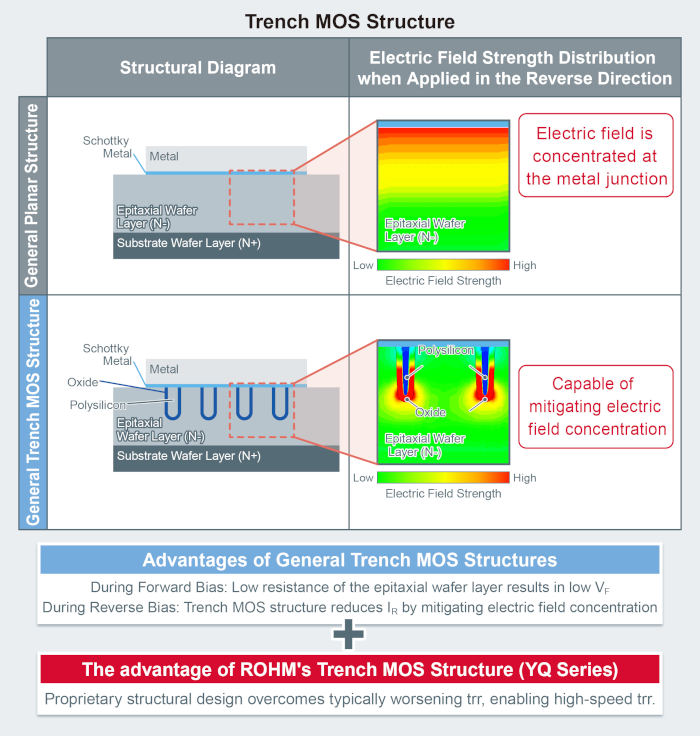
Unlike typical trench MOS structures, where the trr is worse than in planar types due to higher parasitic capacitance (resistance component in the device), the YQ series achieves an industry-leading trr of 15 ns by adopting a unique structural design. This reduces switching losses by approximately 26% and contributes to lower power consumption in applications.
Application examples
• LED headlights for automotive applications
• DC-DC converters for xEV
• Power supplies for industrial equipment
• Lighting
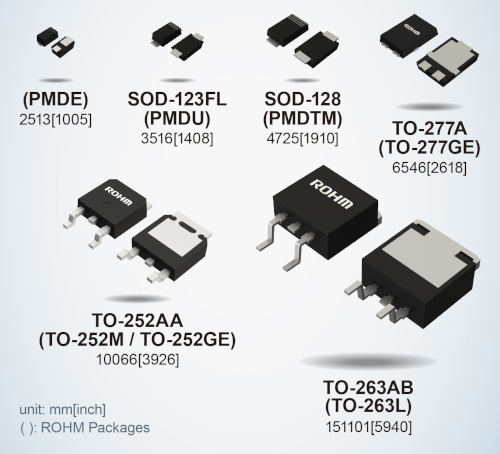
Range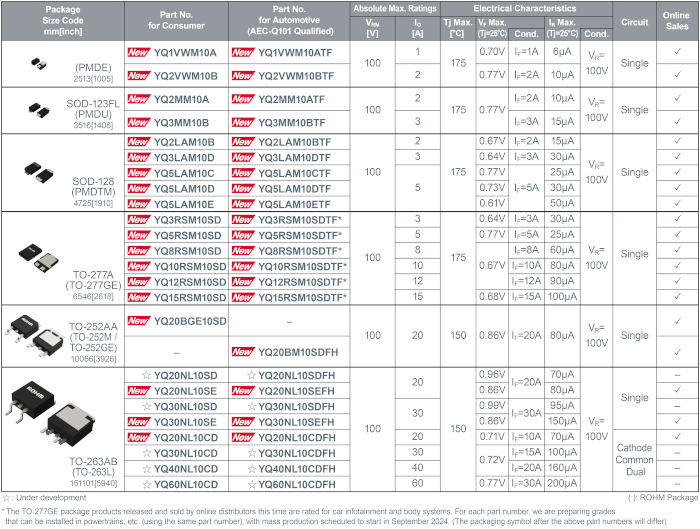
Product page and related information:
Application notes highlighting the advantages of these new products in circuits, as well as a white paper detailing the features of each SBD series, are available on the ROHM website. A dedicated SBD page is also available, allowing users to filter product options by entering voltage conditions and other parameters, simplifying the selection process during design. Click the following URLs for more information.
ROHM SBD product page
https://www.rohm.com/products/diodes/schottky-barrier-diodes
Application Notes
YQ Series Advantages: Compact, high-efficiency Schottky barrier diodes for automotive power conversion
https://fscdn.rohm.com/en/products/databook/applinote/discrete/diodes/yq_sbd_automotive_an-e.pdf
White paper:
ROHM's SBD range contributes to greater miniaturization and reduced losses in equipment for the automotive, industrial, and consumer sectors
https://fscdn.rohm.com/en/products/databook/white_paper/discrete/diodes/sbd_lineup_wp-e.pdf