Since traditional relays are unsuitable, photorelays are commonly used due to their solid-state operation and compact size. An FPGA is typically used for control, but as these increasingly operate at 1.8 V, compatibility can be an issue.
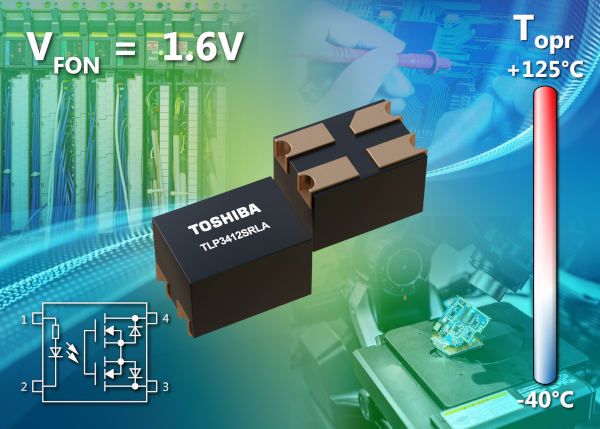
The new TLP3412SRLA offers Toshiba's lowest photoreceptor operating voltage (VFON) ever, at just 1.6 V, making it suitable for use with low-voltage 1.8 V FPGAs. It incorporates a resistor on the primary (LED) side, enabling voltage-controlled operation without the need for external resistors.
Semiconductors are often tested at elevated temperatures, and with photorelays mounted on the probe board near the DUT, they will need to operate at high ambient temperatures. The new device has a maximum operating temperature of 125 °C, ensuring a suitable temperature margin within the equipment.
Due to the need for high throughput in semiconductor testing, multiple DUTs are often tested in parallel, requiring very dense probe board designs. The TLP3412SRLA is housed in Toshiba's original small S-VSON4T package, which measures only 1.45 mm × 2.0 mm × 1.4 mm.
The new photorelay is configured for a 1-Form-A (NO) contact type and has an on-state (ION) current of 400 mA continuously, or 1200 mA pulsed (tON/tOFF). The on-state resistance is typically 1.0 Ω, and the switching times (tON/tOFF) are less than 350 μs/150 μs, respectively. The insulation voltage (BVs) is at least 500 Vrms.
In addition to being ideal for semiconductor testing, the TLP3412SRLA is also suitable for a wide variety of demanding industrial applications, including programmable logic controllers (PLCs).





- Details
- Category: Other Semiconductors
Photorelays for semiconductor testing applications
Toshiba Electronics Europe GmbH ("Toshiba") has launched a new photorelay capable of operating with a low-voltage drive. This, along with an extended operating temperature range, is ideal for demanding semiconductor testing applications. Semiconductor testers verify that the device under test (DUT) meets specifications by applying a voltage/current to the corresponding pins.




Print Magazine

Annual subscription price:
You will receive all 10 editions that are published each year.
social networks
Popular News Electronics




Spanish electronics magazine. Printed for over 25 years.
Spain - Madrid - All rights reserved © Convertronic Professional Spanish Electronics Magazine.