
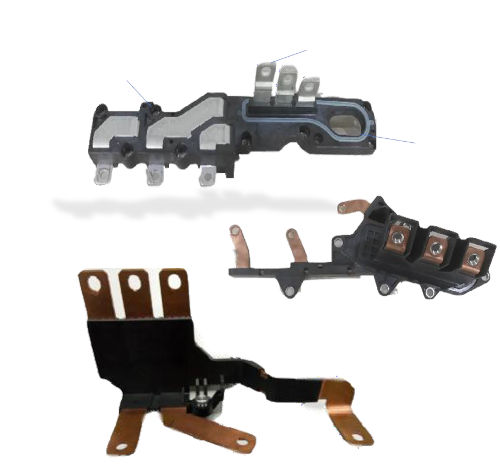
Flexible busbar.
As its classification indicates, this type of busbar allows for some movement along one or more axes, either because its construction is multi-layered or braided, or because the connection points allow for a certain tolerance for final adjustment. These busbars are typically used in equipment that must withstand vibrations and operate with high currents, in connections of low-voltage power distribution and control centers or modules, as a replacement for cables, and especially in the connection of electric vehicle batteries and photovoltaic energy storage systems.
Another key feature of busbars is their insulation; they can withstand voltages up to 3kV DC. For flexible models, the usual coverings are heat-shrink tubing or PVC sheathing, but completely exposed models are also available.
The advantages of using this type of busbar are its strong tensile strength, good seismic and vibration resistance, rapid heat dissipation, and ease of installation.

Rigid Busbars.
Rigid busbars typically have a flat design, which is advantageous for saving installation space in common applications such as: connection between the transformer and the busway, connection between the busway and the electrical cabinet, and connection between the main busbar and power distribution equipment (contactors, circuit breakers, switches, etc.).
In addition to heat-shrink tubing or PVC sheathing, rigid busbars are insulated using spray-on insulating powder, hot-pressed surface insulating tape, and injection molding.
Another advantage of rigid busbars is that their connection points are precision-punched during manufacturing, which significantly reduces burrs and increases the contact surface between the copper and the conductor, thus improving energy transfer efficiency without generating heat losses.

Laminated Busbars.
Laminated busbars are essentially compacted busbars with insulators between the copper conductors. Using an electronic analogy, they are similar to multilayer PCBs, where insulation is provided between each conductive layer. Like a PCB, laminated busbars create electrical current output points isolated from the other layers.
This type of busbar optimizes connection space while ensuring isolation and energy efficiency.
There are two basic categories of laminated busbars based on the insulation material:
- With PET insulating film: With a high density of 1.38 g/cm³ and a working temperature range of -40 to 125°C.
- With epoxy coating: Insulation thicknesses vary from 0.2 mm to 3 mm depending on the application. SRXTronic, a company specializing in busbars and mechanical parts, has its own equipment system that strictly controls the thickness and curing of the epoxy layers.
Epoxy-laminated busbars provide a smooth, glossy finish with high corrosion resistance and excellent electrical properties. Their design and properties offer unparalleled adaptability to the relatively complex requirements of high-voltage, high-current structures.

Overmolded busbars.
The overmolding process ensures the airtightness of the components. High-performance injection molds are used to manufacture these busbars, encasing multiple parts and various types of copper bars in a single molding process.
Another process applicable to this type of busbar is silver brazing between rigid and flexible copper bars.
Overmolded busbars are suitable for applications with demanding airtightness requirements. Another advantage is that both soft and hard solder can withstand maximum vibration stress.
Busbar integration.
During the manufacturing process of both rigid and flexible busbars, control or mounting components can be integrated to facilitate their use, monitoring, and/or connection within the application. The integration of sensors such as NTCs for temperature control, voltage detectors, or test sensors with their integrated wiring enables efficient preventive maintenance, ensuring equipment operation and efficient power supply.
Connectors can be integrated into the busbars to further facilitate connections.
Busbar applications are diverse: industry, telecommunications, transportation, renewable energy, and more. Within renewable energy, the main applications focus on hydroelectric and wind power generators and their associated transformers, as well as photovoltaic plants and the transmission of their energy to inverters or auto-inverters. Examples of industrial busbar applications include high-power motors, such as those found in cement plants. They are also used in the power supply systems for industrial robotic arms. In maritime transport, busbars are found in generators, motors, transformers, frequency converters, and the electrification systems of ships and vessels. The connection of battery cells in electric vehicles and their chargers is another good example of busbar applications in the transportation market.
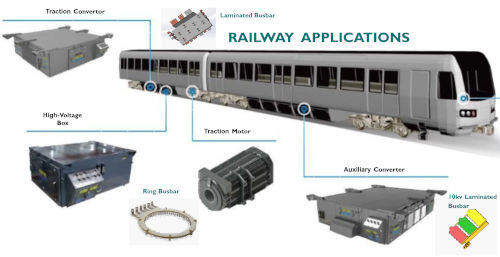
Rail transport is also a sector that uses a large number of busbars: The Traction and Power Unit (TPU), which is the train's driving unit, is responsible for providing the traction force to move the train. It contains the electric motors, power converters, and traction control systems; the communication of these power sources is carried out through highly insulated laminated busbars. The TPU is usually located in one or more specific cars of the train.
The Automatic Train Operation (ATO) is an automatic control system that allows the train to operate without a driver. It uses sensors and communication systems to determine the train's position, speed, and route. The ATO system can control speed, braking, and the opening and closing of doors.
Finally, the Automatic Tracking System (ATS) is a monitoring system that oversees the train's technical condition. The ATS collects data from various sensors on the train, such as those related to traction, braking, doors, and safety systems. The ATS can detect faults and alert maintenance personnel for repairs; this is where the integrated sensor busbars come into play.
The design, execution, and quality of busbars are fundamental to the success of applications. Steliau Technology offers the service of the company integrated into our group: SRXTronic.
SRXTronic's expertise allows us to offer our clients custom-designed busbars with the technology best suited to each application. For more information, please contact us through [contact information missing]
Article provided by Steliau Technology Iberia