


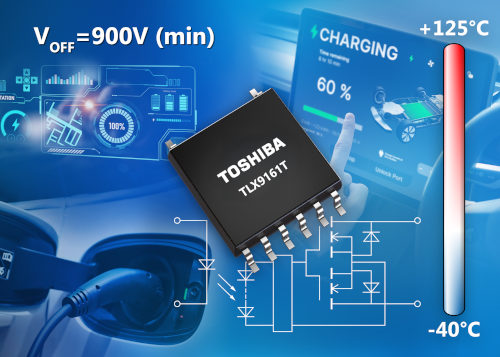
These photovoltaic relays monitor voltage and detect mechanical relay failures and ground faults. They are also ideal replacements for traditional mechanical relays.
The TLX9161T consists of an infrared (IR) light-emitting diode optically coupled to a photo-MOSFET, ensuring electrical isolation between the primary (control) and secondary (switching) sides. The high isolation voltage of 5000 Vrms allows for safe switching operation across different potentials. The trigger current (IFT) is 3 mA (max.), minimizing system power consumption. Furthermore, the off-state current (IOFF) is only 100 nA (max.) at room temperature, resulting in minimal power consumption when idle. The IR LED forward current (IF) and the detector element on-state current (ION) are rated at 30 mA in ambient conditions.
By reducing the size of the integrated MOSFET chip, Toshiba has enabled the new TLX9161T photorelay to fit into an SO12L-T package, which is approximately 25% smaller than the SO16L-T package used for its predecessor, the TLX9160T. This reduction helps minimize the overall size of the battery unit and saves costs. Despite the smaller package size, the TLX9161T maintains the same pin pitch and layout as the SO16L-T, allowing for the use of common circuit board layout designs. Typical dimensions of the SO12L-T package are 7.76 mm × 10.0 mm × 2.45 mm.
Safety and compliance are critical in automotive applications. The TLX9161T uses a resin with a Comparative Tracking Index (CTI) greater than 600, classifying it in Material Group I according to the international standard IEC 60664-1. This standard specifies the principles, requirements, and test methods for insulation coordination in systems up to 1000 VAC or 1500 VDC. The normally open (1-Form-A) device features creepage and insulation distances of 8 mm (min.), confirming effective insulation even at operating temperatures ranging from -40 to +125 °C, making it fully compliant with AEC-Q101 Grade 1.