


Current methods for monitoring transport infrastructure rely on cameras, but their performance is hampered by low light levels and adverse weather conditions. Toshiba's enhanced solid-state LiDAR unit offers a superior alternative, providing clear, long-range 3D scanning and object detection under a wide range of lighting and weather conditions. Furthermore, it is compact, measuring one-third the size of the previous prototype announced in July 2020.
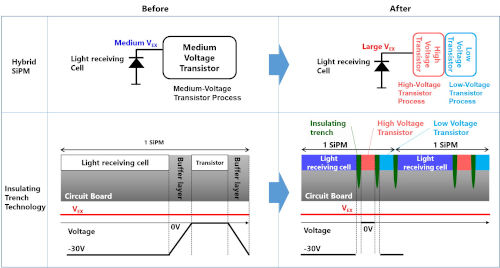 The innovations Toshiba has introduced in its silicon photomultiplier (SiPM) chips to improve image resolution are fundamental to this compact LiDAR unit. Each SiPM consists of transistor-controlled light-receiving cells. The new chips have smaller transistor modules and eliminate the layers that protect the transistors. Instead, insulators are placed between the transistors and the light-receiving cells. The potential problem of reduced light sensitivity due to the use of smaller transistors has been addressed by a supported high-voltage section to boost the input voltage to the light-receiving cell (as described in Figure 1).
These innovations have reduced the size of the SiPM by 75%, while increasing its light sensitivity by 50% compared to its predecessor from July 2020. More SiPMs can now be placed in the same package, increasing the resolution to 1200 x 80 pixels (a 4x improvement).
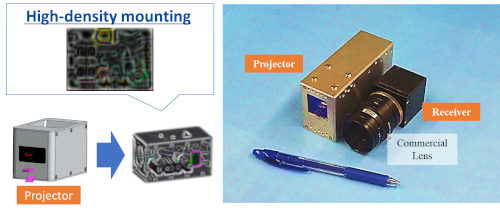 A temperature compensation mechanism automatically adjusts the voltage input applied to the light-receiving cells to mitigate the effect of external temperature changes. This means that the SiPM's performance is maintained despite ambient temperature fluctuations. Furthermore, leveraging its expertise in high-density component assembly, Toshiba has reduced the overall size of the projector and LiDAR receiver to a volume of 350 cc (as shown in Figure 2).
The LiDAR successfully circled a cardboard target placed 50 m away and accurately measured the distance. (Low frame rate (1fps). Fixed angle. Detection range: ~300m)