


Designing a Wi-Fi front-end module using a wireless SoC based on the latest Wi-Fi standards can be complex and expensive, so choosing a pre-certified module is the simplest way to get to market quickly.
When designing a printed circuit board containing a high-performance miniature wireless SoC, every detail matters, from signal integrity on the high-speed digital I/O bus that carries data to the transceiver to impedance matching between the RF output pin and the antenna. Specialized RF expertise is required to identify problems early on and avoid difficulties later. Furthermore, Wi-Fi development requires expensive test equipment. In contrast, the radio design has already been optimized in a module, which can also help eliminate potential issues from the development cycle. This results in significant cost savings.
Certification is expensive.
Products shipped with a transmitter must guarantee that they function harmoniously with other devices in a shared environment. This harmony is achieved through product certification, following rigorous radio testing in accordance with applicable local regulations. Of course, this also applies to products containing a Wi-Fi transceiver. In fact, the costs of undergoing full certification tend to be higher for Wi-Fi, given the nature of the technology. A Wi-Fi product must exhibit optimal radio performance when placed alongside other products on the same Wi-Fi networks or on different but co-located Wi-Fi networks. Furthermore, the Wi-Fi device must also ensure that it does not interfere with other ISM-band technologies such as Bluetooth, Zigbee, Thread, or other proprietary wireless protocol stacks. Additionally, a poorly designed Wi-Fi device is highly susceptible to disrupting or being disrupted by LTE mobile radios or radars operating in 5 GHz bands for use in civilian or military applications.
The situation has been further complicated by global disagreement over how to use the 6 GHz band in the context of ISM-band technologies such as Wi-Fi and Bluetooth. For example, while the United States has allowed the use of the entire 1200 MHz bandwidth for ISM applications, the European Union has only opened 480 MHz in the lower 6 GHz band. Overcoming global regulatory hurdles often ends up being the biggest hidden cost in hardware design. Working with testing labs to pass regulatory tests adds to the effort. All of this contributes to the overall development cost. Using pre-certified wireless modules eliminates much of the difficulty. System designers simply need to reuse the license issued to the module manufacturer to safely integrate the wireless functionality.
Choosing the Right Wi-Fi Module
The choice of Wi-Fi module can be guided by many different factors, including:
- Architecture
A module might have an open application processor to host the network stack as well as the embedded IoT application, all running within the context of a restricted RTOS (real-time operating system). Or the module might act as a network coprocessor (NCP) that manages Wi-Fi communication but requires a host processor for network management. The latter typically requires a full operating system (Windows or Linux). However, increasingly, device manufacturers are also able to interface the NCP with a TCP/IP stack running on top of some type of real-time operating system (e.g., FreeRTOS).
- Multiple Wireless Protocols
A project may require various connectivity options. Depending on the role to be performed, you can choose from a single-protocol module, Wi-Fi only, to a multi-protocol solution that supports mesh connectivity based on Bluetooth and 802.15.4. For a small additional cost, the multi-protocol solution offers tight integration and better coexistence management compared to a discrete multi-SoC/module solution.
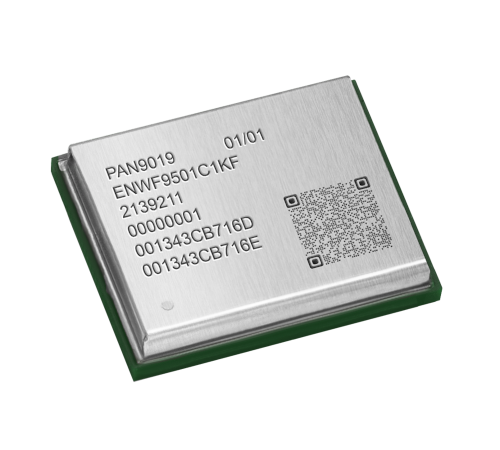
Figure 1 PAN9019: A certified radio module containing dual-band WiFi 6 and Bluetooth 5.4 subsystems.
- Communication Interfaces:
Each device and application has its own unique wireless connectivity capabilities and requirements. While one device might need to transmit multiple gigabits over a wireless link to stream 4K video, another device might only need a few kilobits to report sensor data or remotely control an actuator. The available options reflect this diversity of applications. Thus, some wireless modules support high-speed communication interfaces like SDIO and PCIe, suitable for very high-performance data transmission applications, while other solutions are optimized for power-constrained applications using interfaces such as SPI, I2C, and UART to connect sensors.
- Antenna Options:
The antenna is a crucial element in a wireless design. It acts as a transducer, converting the currents and voltages received from the transceiver into electromagnetic energy radiated by the wireless technology, and vice versa. A suboptimal antenna can render a product completely unusable. Therefore, the antenna selection is typically dictated by the final product design. While some designers prefer compact antenna designs integrated within the PCB, others use externally mounted antennas to improve coverage. It's important to remember that the antenna is an integral part of the transmitter configuration and is therefore explicitly linked to the wireless module's regulatory certification. Lesson: Pay attention to the details when choosing an antenna! Modules may come with a built-in antenna or with a certified reference design that allows users to copy the exact design and reuse the certification. The ultimate goal is always to achieve optimal radio coverage for a given design, which may require modifying the antennas and the associated certification.
What to Expect from a Wi-Fi Module Vendor
In IoT, Wi-Fi implementation is often critical. Therefore, a module vendor should offer certain core values:
- Hardware Design Support
RF designs can often deliver unpleasant surprises, just when least expected. It is at this stage that the support of engineers with valuable experience in Wi-Fi module design is crucial for achieving a rapid design cycle. A module vendor can help in various ways: reviewing the PCB design, matching the antenna input impedance, recommending module or antenna placement for better coverage, etc.
- Adding New Regulatory Domains and Antennas
As mentioned earlier, one of the main advantages of using Wi-Fi modules is the ease of obtaining regulatory certification for radio functionality. Therefore, vendors should have a comprehensive regulatory strategy to ensure design flexibility, including multiple domains to cover more markets and multiple antenna types.
In some cases, a certified antenna on the module may prove inadequate for the required radio performance, necessitating the use of a different antenna. In other cases, a product may target a new market for which the module vendor lacks approval and/or test reports. In such instances, module vendor support is required to add a new regulatory scope to the existing list of certifications or to certify an entirely new antenna type. Module vendors can provide support by conducting tests for the new regulations and issuing an authorized change notification for the original certification.
- Software Troubleshooting:
Integrating the Wi-Fi driver into an embedded platform is one of the most critical issues throughout the project's software lifecycle. Consider, for example, a Network Communication Protocol (NCP) for a Linux-based embedded device. It is standard practice for wireless semiconductor vendors to release periodic versions of drivers tested with the latest stable Linux kernel. Furthermore, wireless drivers require patches to address security vulnerabilities. Upgrading to a new version, especially for wireless devices with "outside the tree" controllers, can sometimes cause the product to exhibit unexpected behavior. This is where support from a module vendor—whether through communication about vulnerability discoveries and the availability of security patches, or through proactive troubleshooting and root cause analysis during controller integration—can greatly contribute to smooth project management. The same applies to a wireless module designed around an embedded wireless microcontroller.
- Ensure full supply chain support.
A poor supply chain assessment can ruin an exceptional PCB design. The lack of even a small, seemingly insignificant component, such as a resistor, can delay production, but an alternative must be available. However, a certified radio module is one of the most critical components, as it is intrinsically linked to the final product declarations made by the manufacturer to regulatory bodies. Consequently, redesigning the product may not be possible, which would undoubtedly be very costly. This is where the full support of a capable and committed module supplier provides tangible value. Topics may include: technology consulting to understand the best platform design; product lifecycle management; and production forecasting. Factory audits may be required to create transparency in the supply chain.
Panasonic Industry
Europe is a recognized provider of short-range wireless connectivity solutions with a portfolio that includes Wi-Fi, Bluetooth, and other networking technologies. Its wireless modules and NICs are certified for multiple regulatory domains, including the United States, Europe, Canada, Japan, and other Asia-Pacific countries. These regulatory certifications also cover a wide variety of antenna types, with certified reference antennas from multiple renowned antenna vendors. The company further enables IoT projects through an ecosystem of partners that handle antennas, embedded firmware, and proprietary wireless protocol stacks.
Panasonic Industry's wireless module portfolio covers multiple generations of Wi-Fi, from Wi-Fi 4 to Wi-Fi 6/6E solutions. Wi-Fi 7 modules are part of its future roadmap. Its modules are designed and manufactured in Europe at a wholly-owned Panasonic facility.

* Planned tbd = to be determined
Table 1: Latest Panasonic Industry Wi-Fi Modules for New Designs
For a complete guide to navigating the new era of Wi-Fi, download the whitepaper