Both models combine non-contact measurement, high resolution, and mechanical robustness that allows their use in applications subject to dust, lubricants, vibrations, or thermal fluctuations. Thanks to their IP67 protection, the sensors maintain stable operation even in harsh industrial conditions.
IKS9: Compact, Fast, and Configurable.
The IKS9 stands out for its accuracy better than 10 µm, its ability to reach travel speeds of up to 100 m/s, and its configurable resolution down to 20 nm, depending on the pole pitch used. The sensor offers Push-Pull and RS422 (Line Driver) outputs, with A/B + reference signals, facilitating its integration into industrial motion controllers.
Among its most relevant features are: incremental measurement with periodic or dedicated track reference, resolution adjustment, interpolation, counting frequency and direction, and low power consumption.
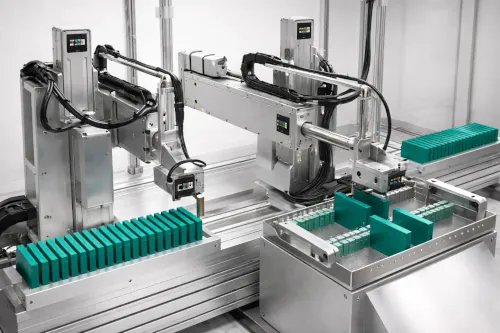
Its robust design and contamination-tolerant electronics make it an ideal solution for linear motors, Cartesian robots, and high-dynamic pick-and-place systems.
IKS15: Extreme Modularity and Sine/Cosine Output.
The IKS15 is designed for applications requiring superior signal quality and enhanced modularity. It offers a 1 Vpp analog (sine/cosine) output with reference, as well as incremental versions with resolutions down to 20 nm.
Its strengths include: signal bandwidth up to 1 MHz, extremely high travel speeds (up to 5000 m/s, depending on pole pitch), 5 V or 7–32 V power supply options, a wide range of housings, connectors, and cable lengths, and high resistance to dust, emulsions, and lubricants.
Thanks to its modularity, the IKS15 adapts to customized solutions for high-precision automation, measurement, and motion control.
Industrial applications: linear motors, pick & place, and robotics.
The IKS9 and IKS15 sensors are designed for applications where feedback accuracy and stability are essential: high-dynamic linear motors, pick & place axes, robots and handling systems, industrial automation, medical and laboratory equipment, and motion measurement and control systems.
The ability to place reference marks at any position, even multiple or coded ones, allows for great design freedom in complex machines.