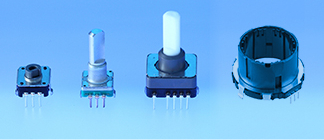
One of the most important requirements for human-machine interface (HMI) encoders in agricultural machinery is their resistance to environmental influences. Dust, dirt, and moisture are ubiquitous in these environments and can affect the operation of electronic components. Furthermore, encoder housings must be designed to withstand shocks and vibrations while ensuring a reliable seal. Another key requirement is temperature resistance. Temperatures can vary enormously depending on the application, season, and location. From periods of extreme cold in winter to hot summer days with intense sunlight, HMI components must withstand these conditions and operate reliably. For the Keiler II potato harvester, ROPA sought a rotary encoder that would function reliably under the specific conditions of agricultural machinery.
Optimized Encoders for the Keiler II:
The potato harvester underwent a fundamental technical redesign focused on hydraulics, the operator interface, and system networking to optimize efficiency and resource utilization during field operation. The updated machine now features an advanced hydraulic system with fully hydraulic drive and electronic load sensing for demand-based control. The revised telescopic axle increases steering force and turning angle. The system is complemented by LED lighting, telematics to connect the machine to the operations center, and new machine software with enhanced safety features. Design modifications such as a central hydraulic stabilizer leg and ergonomically optimized sorting stations complete the concept.
As part of the relaunch, a potentiometer previously used to control the conveyor belt speed had to be replaced with an encoder to enable machine operation from multiple control stations. An additional challenge: the main control unit is mounted directly on the machine, outside the driver's cab. As a result, the input devices are directly exposed to the elements. Therefore, in addition to dust and water resistance on the front, the rear of the front panel also had to meet the corresponding protection requirements. "We were looking for an encoder that would prove its worth in such a demanding environment and that could be expanded with a sealed connector concept," says Richard Bauer of the Development/Design department at Ropa Fahrzeug- und Maschinenbau GmbH.

The EBE ESC17 meets the high standards required of agricultural and construction machinery components.
Robust design for harsh conditions:
The ESC17 from EBE sensors + motion provided the solution. This product family is characterized by exceptional robustness and durability. Thanks to its construction with special plastics and the specifically developed retention mechanism, it withstands various extreme MIL requirements. The contactless—and therefore wear-free—sensing of rotary motion and tactile signals via a Hall sensor makes the ESC17 rotary encoder extremely reliable. With 16 retention positions, the ball-and-spring retention mechanism provides a pleasant tactile response.
Thanks to the well-calibrated and clearly perceptible latching mechanism and button, data entry errors are avoided even in demanding operating environments, such as those found on machines moving across the field. The latching mechanisms of the ESC17 family are designed for several hundred thousand rotations and button presses and can be customized to meet customer preferences for tactile feedback. ESD protection in accordance with IEC 61000-4-2 is guaranteed when the encoder is installed, and it passed the corresponding test with ease. The ESC17 is unaffected by EMC interference, as specified in DIN EN 12895, and ensures reliable operation without any negative impact.
However, initially, it was not possible to fully implement the sealing behind the front panel with the standard ESC17. Through design modifications based on existing experience in the military sector, a solution was developed that guarantees the required sealing on the back as well. Furthermore, ESC17 encoders are designed as standard with connectors or contacts for direct mounting on a printed circuit board. This design was unsuitable for use in the potato harvester's control panel, as the encoder had to be connected directly to the machine's wiring harness. Implementation was ultimately straightforward thanks to a custom adaptation with an integrated M12 connector. "These measures allowed us to develop an extremely durable yet tactile encoder that fully meets the customer's requirements," stated Andreas Hoffmann, HMI Product Manager at EBE sensors + motion.

The ESC17 is integrated directly into the main control unit of the ROPA potato harvester to control the conveyor belt speed. This presented particular challenges, especially regarding sealing.
Encoders optimized for agricultural machinery.
To continue meeting the high demands of agricultural and construction machinery, EBE has further optimized the ESC17 family in terms of installation space and functional safety. Due to increasing requirements for ergonomics, operational logic, and clarity, installation space is limited on the control panels of modern agricultural machinery. The ESC17 mini, optimized for this purpose, is designed precisely for these conditions. With dimensions of 17 × 19 mm (depth × width) and a mounting height of 11 mm below the front panel, the encoder is more compact than many comparable solutions. At the same time, it meets the robustness and service life requirements according to the company's internal HMI standards. These standards consolidate the testing requirements of the relevant MIL, DIN EN, and VDE standards. For applications with particularly high safety requirements, the ESC17 SAFETY is available. This model redundantly captures rotational and tactile signals via two independent Hall sensors. Signal processing is performed separately; in case of failure, an independent diagnostic signal is sent via a dedicated pin. This makes the model suitable for applications requiring a fail-safe input.
Customized solutions for specific needs.
Thanks to its modular design, EBE sensors + motion offers a wide range of customization options for its encoders. This provides flexibility not found in standard products, enabling solutions for highly specialized applications—such as those requiring absolute positioning—as demonstrated by ROPA. Quality and a long service life are always top priorities, ensuring that the end user benefits from the custom-developed solutions for a long time and avoiding unnecessary and costly downtime—for example, during the harvest season.