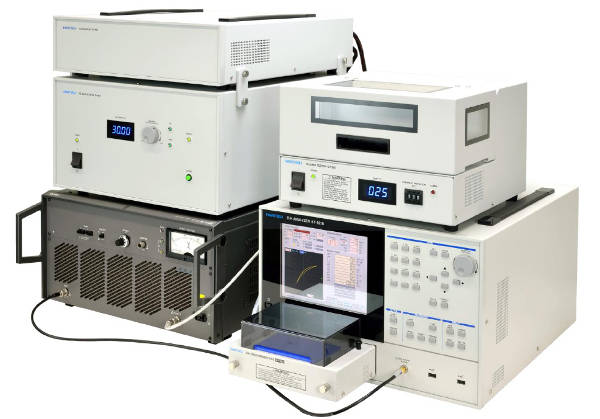
These analyzers are designed to analyze soft magnetic materials such as ferrites, magnetic alloys like permalloy, amorphous materials, silicon steel sheets, and powder cores, which can be toroidal, EE core, EI core, foil, or powder. Soft magnetic materials are typically used in inductive components and transformers; antennas for radio, television, and telecommunications technology; magnetic heads for audio equipment and amplifiers; memories for electronic data processing equipment; and radio frequency connection devices.
The SY-8218 analyzer operates with test frequencies from 10 Hz to 10 MHz, with various output power options up to ±140 V and ±5.2 A (350 W power) to suit different testing requirements. Optionally, a DC bias system of up to ±30 A can be added to simulate real-world operating conditions on power inductors. The system can be connected to a temperature chamber from -30 to +150ºC with sample holders for several specimens.
The three main functions of BH analyzers and their application purposes are:
- Measurement of losses in magnetic cores. Leakage currents in high-frequency transformers, caused by hysteresis and eddy current effects, lead to overheating and reduce transformer efficiency. Minimizing losses with new designs can reduce heating and thus decrease equipment size.
- Measurement of the BH curve. One of the most important parameters in a magnetic material is magnetic saturation, which can be obtained from the BH curve (field flux density vs. field strength). The performance of a magnetic component under saturation conditions is not as expected, and therefore the BH curve must be analyzed under different conditions, from low to high frequency, to avoid magnetic saturation in the finished product.
-Measurement of permeability. Yoke materials used in motors, actuators, and relays are made of silicon steel, soft iron, permalloy alloy, and stainless steel. However, these materials tend to exhibit different magnetic characteristics depending on their processing and heat treatment. BH analyzers allow the measurement of magnetic properties such as permeability and impedance (L, C, R) to facilitate the improvement of these materials.