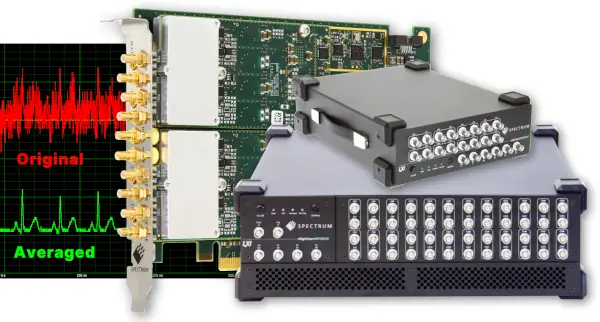
By performing processing on the integrated FPGA, digitizers can reduce the amount of data that needs to be stored or transferred for later analysis.
The new option supports signal averaging with repetition rates of up to 2 million events per second and is available for all 52 models in the 59xx series, in both PCIe and Ethernet (LXI) formats.
Signal processing directly on the FPGA:
Summation averaging allows combining multiple acquisitions of a repetitive signal to reduce the influence of uncorrelated random noise.
Spectrum Instrumentation's new feature performs this processing directly on the digitizer hardware, eliminating the need to transfer all acquisitions to a computer for processing beforehand. According to the company, the FPGA implementation allows processing waveforms of up to 64 KiSamples per acquisition, even with high repetition rates.
Oliver Rovini, Chief Technology Officer at Spectrum Instrumentation, emphasizes that the feature is geared towards applications where low-level signals may be obscured or distorted by noise. The manufacturer mentions mass spectrometry, lidar, radio astronomy, automation, radar, biomedicine, nuclear physics, communications, and sonar as potential applications.
16-bit digitizers with speeds up to 125 MS/s.
The Spectrum Instrumentation 59xx series comprises 52 models, including 24 PCIe card variants and 28 Ethernet-based instruments. These instruments offer maximum real-time sampling rates ranging from 5 to 125 MS/s, with 16-bit resolution. PCIe cards are available in configurations from 1 to 8 input channels, while standalone instruments offer from 4 to 48 channels.
Spectrum also allows PCIe cards to be connected via its proprietary Star-Hub system, enabling the configuration of fully synchronized acquisition systems with up to 128 channels. The PCIe cards support the transfer of acquired data to a computer or GPU via the bus, at speeds up to 700 MB/s. A new averaging function is included in this range as an additional signal processing option.
Signal-to-Noise Ratio Improvement Through Averaging:
Summation averaging is a time-domain processing technique that combines multiple acquisitions of the same signal. When the signal is repetitive and the noise is random and uncorrelated, averaging reduces the contribution of noise and recovers details that might be hidden in a single acquisition. According to Spectrum Instrumentation, under ideal conditions, the improvement in signal-to-noise ratio is proportional to the square root of the number of averaged measurements.
For example, averaging 64 acquisitions can provide an SNR improvement of up to 12 dB, equivalent to an approximate 2-bit increase in measurement resolution.
The company presents this feature as a way to extend the measurement capabilities of its 16-bit digitizers, especially when working with low-amplitude signals.
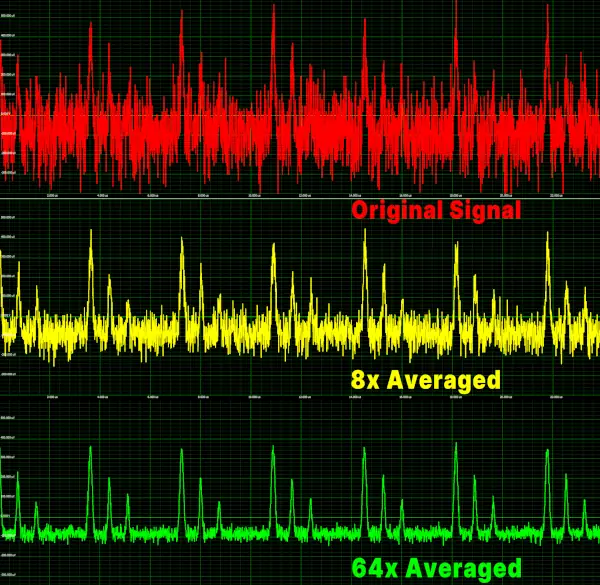
of acquiring a 300 µV signal
using the M2p.5962 digitizer. In this test, a signal of approximately 300 µV is acquired using a sampling rate of 125 MS/s. In the original acquisition, the signal is completely obscured by random noise. By averaging eight acquisitions, details that are not visible in the individual captures begin to emerge, including three pulses separated by 3.6 µs intervals. Averaging 64 acquisitions further improves the signal quality and allows the identification of a pulse of approximately 300 µV, followed by other pulses of lower amplitude. This example shows how averaging processing can facilitate the observation of low-level, repetitive signals in the presence of noise.
Available for all 52 models in the 59xx series,
the new firmware option is sold under part number M2p.xxxx-spavg. Spectrum Instrumentation confirms that it is immediately available for the new 59xx series digitizers.
It can also be installed as a field upgrade on existing units, allowing the averaging function to be added without replacing the digitizer.