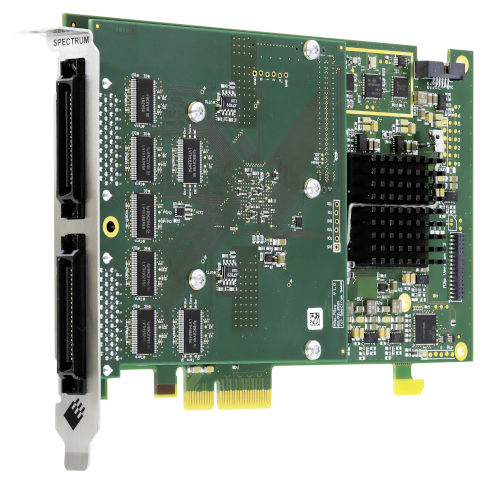
The channels are accessible via two standard Hirose FX2 connectors located on the front panel. When configured for digital acquisition, the channels support both 3.3V and 5V TTL, making them suitable for a wide range of digital signals. In generation mode, the cards typically supply 0.2V at the output for low states and 2.8V for high states at high impedance.
The cards incorporate 1 GB of memory and various acquisition and playback modes. For example, when generating frames, the cards operate in single-shot, multi-shot (burst), controlled playback, sequential, and FIFO modes. These modes allow for the generation of virtually any signal pattern. It is even possible to load new data into the onboard memory while playing back previously stored signals. Furthermore, the cards can utilize FIFO streams with a maximum transfer rate over the PCIe bus of 700 MB/s, thus enabling users to continuously generate variable digital patterns over extended periods.
Similarly, when acquiring digital signals, the cards can operate in single-shot, multi-store, controlled sampling, and FIFO modes. The combination of these different modes and the large built-in memory facilitates the capture and monitoring of long and complex digital signal patterns. To ensure precise synchronization, the cards utilize a flexible internal clock design with an integrated reference clock accuracy better than 1 ppm. If required, they can also use a direct external clock or an external clock reference.
The M2p.7515-x4 model is fully programmable and comes with drivers for Windows and Linux operating systems, as well as sample programming for C++, LabVIEW, MATLAB, Visual Basic.NET, Python, and other popular programming languages. Users have the option to create their own test programs in their preferred language, thus streamlining development and increasing efficiency. For a turnkey solution, Spectrum offers its own control software—SBench 6—which allows users to generate, acquire, visualize, process, store, and report on the signal. Data can be acquired and stored with SBench 6 and then sent back to the M2p.7515-x4 for playback. Data can also be shared with other programs or devices, such as oscilloscopes, thanks to import/export functions for transferring data in binary, ASCII, or Wave formats.
Carsten Gralla, Managing Director of Spectrum Instrumentation, explains: “The M2p.7515-x4 is our smallest digital I/O card to date. It has been designed to offer an attractive balance between price and performance, providing users with a cost-effective solution when they need to acquire, generate, and analyze high-speed digital signals. It also complements our product line for analog signal acquisition and generation and is a perfect fit for the mid-range M2p.59xx series of 5-125 MS/s, 16-bit digitizers, as well as the M2p.65xx series of 40-125 MS/s, 16-bit arbitrary waveform generators. These M2p family digitizers and arbitrary waveform generators provide up to 8 channels per card.”
For applications requiring synchronization of multiple cards, the M2p.7515-x4 also supports Spectrum's unique Star-Hub clock and trigger distribution system. This option allows up to 16 M2p family cards (digitizers, arbitrary waveform generators, and digital I/O cards) to share a common clock and trigger. For example, using Star-Hub with 16 of the new M2p.7515-x4 cards can create a single system with 512 channels of fully synchronized digital I/O.
The M2p family now consists of 24 digitizer models, 14 versions of arbitrary waveform generators, and the new digital I/O card. All 16 cards can be synchronized on a PC using the optional Star-Hub.