With their ability to simultaneously generate and acquire signals, these tools are geared towards applications involving stimulus-response or closed-loop testing. A total of 14 different hybrid NETBOX models are currently available, with 2+2, 4+4, or 8+8 paired channels and possible speeds of 40 MS/s to 1.25 GS/s.
The new models allow you to choose between two or four AWG channels combined with the same number of digitizer channels. Thanks to the use of the latest high-resolution digital-to-analog converters (DACs), the AWG channels can generate virtually any waveform. Models are available with output speeds of 625 MS/s or 1.25 GS/s and signal bandwidths up to 400 MHz (600 MHz optional). At 625 MS/s, the channels can be programmed to output signals with amplitudes up to ±3 V into a 50 ohm load or ±6 V into a high impedance (1 MOhm). Models operating at 1.25 GS/s can output signals with impressive ±2.5 V into 50 ohms and ±5 V into 1 MOhm.
For signal acquisition, users can choose between models offering 16-bit resolution and sampling rates of 180 or 250 MS/s, or 14-bit resolution and sampling rates of 400 or 500 MS/s. Each channel is programmable with six adjustable input ranges, from ±200 mV to ±10 V full scale, signal offset, and selectable input impedance of 50 ohms or 1 Mohm. Both the AWG and the digitizer feature a flexible synchronization system that allows for the selection of virtually any output setting or sampling rate, enabling users to generate or acquire signals at the required speed.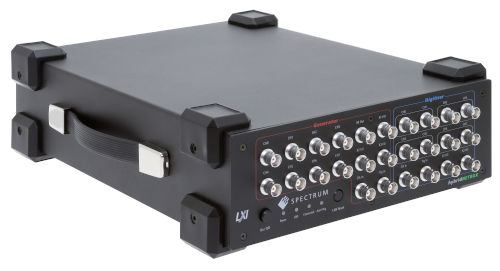
The hybridNETBOX units are geared towards automated testing applications. For example, they can reproduce and capture "echo" signals such as those found in radar, sonar, lidar, or ultrasound. The hybridNETBOX is also suitable for ATE applications where components and subassemblies need to be tested quickly and automatically. They can determine the functionality and tolerance of DUTs and UUTs (devices or units under test) by exercising them with numerous complex, easily adjustable signals. This powerful testing process can be applied to a wide range of applications, including bus testing, MIMO communications, circuit verification, robotics, automotive, and scientific experiments.
Each hybridNETBOX includes Spectrum's proprietary control software, SBench 6, for generating, acquiring, displaying, processing, storing, and reporting signals. SBench 6 allows for the creation of waveforms using standard functions and mathematical equations. Data can be acquired with the digitizing unit and then transferred to the AWG for playback. Data exchange with other programs or devices, such as oscilloscopes, is possible thanks to the built-in import/export functions for transferring data in binary, ASCII, or Wave formats. The hybridNETBOX includes drivers for Windows and Linux operating systems, as well as programming examples for C++, LabVIEW, MATLAB, Visual Basic .NET, Java, Python, and other popular languages.
To facilitate waveform generation and acquisition, the hybridNETBOX has a large amount of built-in memory (2 x 2 GSamples) and includes several operating modes. For example, it is possible to output signals using Single-Shot, Loop, FIFO Streaming, Gated Replay, and Sequence Replay modes. This flexibility allows the user to generate almost any signal, or combination of signals, and develop test routines ranging from simple to complex. Signals can also be acquired using Single-Shot, FIFO Streaming, Multiple Recording, Gated Sampling, and ABA (Sampling Rate Shift) modes.
These can be combined with a variety of flexible triggering modes (channel, external, software, window, reset, logic, or delay) to ensure that important events are never missed.
In addition to the digitizer and AWG channels, the front panel of each hybridNETBOX includes multiple digital I/O connectors. This facilitates the integration of the units into a test system. For example, synchronous marker outputs are available that can be used on the AWG channels to enable precise control of other devices or instruments. Furthermore, it is possible to synchronize the unit with other equipment by applying an external clock and triggers.