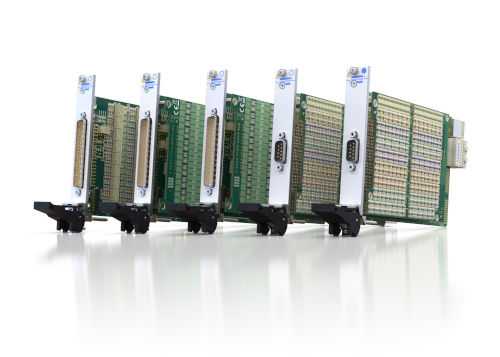
The 42-254 series is also the first medium-power module available in PXIe format.
The programmable resistors are designed to simulate resistive sensors and variable resistors in systems when testing devices such as electronic controllers. The 40/42-254 family is available in various resistance ranges and resolution capabilities (from 0.125 Ω to 8 Ω resolution and from 1 Ω to 395 kΩ range) to meet the needs of most functional test systems. For broader test coverage, each channel can simulate short-circuit or open-circuit conditions that might be encountered in a system due to faulty wiring or sensors.
Software control is simplified by using resistance value calls. The module calculates the resistance value closest to the requested value and adjusts accordingly. The user can then query the module to determine the actual adjustment used. To ensure long-term accuracy, a set of calibration cables can be connected to the module instead of the UUT (unit under test), allowing simple calibration with a DMM (digital multimeter) to check the resistance channels.
These resistor modules are available in 28 standard models to suit the most common configurations:
- Narrow resistance range, available in 1- or 2-channel variants.
- Medium resistance range, available in 1-channel variants.
- Wide resistance range, available in 1-channel variants.
Depending on the variant, each module consists of a base board and a sub-board, or just a base board. These are equipped with resistor strings that are switched by bipolar electromechanical relays. User connection is made via a 9-pin D-type male connector on the front panel. For applications requiring higher density with lower power, users should consider the high-density precision resistor modules (model 40/42-297A).
“As part of Pickering’s ongoing investment in simulation, these PXI/PXIe programmable resistor modules are ideal for automotive, aerospace, and medical hardware-in-the-loop (HIL) applications, as well as for functional testing and verification of low- to medium-power products such as power supplies, chargers, batteries, solar panels, and DC-DC converters,” says Paul Bovingdon, Product Manager for Simulation at Pickering. “The modules’ built-in fault insertion functionality is ideal for validating against potential failure conditions.” Complementing Pickering’s broader range of PXI sensor, battery, and load simulators, the modules can also be used in functional test systems to emulate actuators, coils, lamps, or auxiliary power supplies. These programmable modules offer a more flexible alternative to the hardwired, fixed-function load resistors typically found on test benches or custom load boards, providing similar functionality to the PXI modular platform, but allowing the simulation of multiple devices simply by dynamically changing the resistance amount via software.
All standard products manufactured by Pickering Interfaces include a three-year warranty and guaranteed long-term product support.