
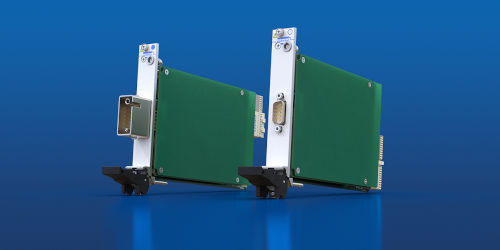
The new module, part of Pickering's expanding range of programmable resistor modules, is available in 70 standard configurations, including four single-channel configurations offering a wide variety of resistance ranges and resolution capabilities. It plays a critical role in simulating real-world resistive loads and fault conditions for high-voltage devices under test (DUTs) in the automotive, aerospace, and energy sectors.
The 40/42-230 high-voltage programmable resistor module plays a key role in simulating real-world resistive loads and fault conditions for high-voltage DUTs, such as electric vehicle (EV) power inverters, battery management systems (BMS), and certain aerospace components. Engineers can use these modules for critical tasks, such as voltage insulation verification testing, which ensures the safe operation of high-voltage systems and compliance with safety standards like ISO 6469 and IEC 60664.
The module allows engineers to emulate resistance sensor values, such as those from thermistors and RTDs, in high-voltage environments, enabling safe testing without the need for the actual sensor hardware. For broader testing coverage, when used in hardware-in-the-loop (HIL) simulation testing of electronic control units (ECUs), each channel of the 40/42-230 can be configured for short-circuit and open-circuit conditions to verify the controller's response to a faulty sensor or connection.
“Building on Pickering’s ongoing investment in sensor and battery simulation, this new range is one of the few PXI or PXIe modules that can handle voltages up to 1.2 kV, making it suitable for high-voltage environments such as electric vehicles, aerospace, or power electronics test benches,” said Stephen Jenkins, Product Manager for Simulation at Pickering. “With the proliferation of high-voltage systems, engineers face significant challenges in ensuring that high-voltage subsystems can operate safely alongside low-voltage electronics. This module is an invaluable tool in meeting these demands.”
With up to four channels available in a single slot, the module offers multi-channel flexibility and a wide resistance range, from 1 Ω to 76.8 MΩ, in a compact, single-slot PXI or PXIe form factor, as well as resistance resolution down to 0.125 Ω. The module’s hardware lockout and simulation features ensure safety and facilitate diagnostics. Key applications range from high-voltage test environments, including automotive, EV, and aerospace systems, to applications requiring rapid resistance reconfiguration, or test systems with limited PXI slots (requiring multi-channel modules), as well as HIL simulation platforms needing fault insertion.
The 40/42-230 is available in 70 standard configurations, including four single-channel configurations to suit the most common setups:
Narrow resistance range version, available in 2- or 4-channel variants;
Medium resistance range version, available in 1- or 2-channel variants;
Wide resistance range version, available in 1-channel variants.
Software control is simplified by using resistance value calls. The module calculates the resistance setting closest to the requested value and sets that value. The user can then query the module to find the actual setting used. To help ensure long-term accuracy, an optional set of cables can be connected to the module instead of the DUT, allowing for easy calibration using a DMM (digital multimeter) to verify the resistance channels.
The 40/42-230 high-voltage modules are equipped with a hardware interlock, providing greater safety than typical software protection. When activated, the interlock returns all relays to their default de-powered state (assuming the switches are functioning correctly) and provides an error notification through the software interface. The interlock function can be daisy-chained between additional hardware-interlock-enabled modules, allowing a single signal to disable multiple boards.
Drivers are supplied for Windows and, unlike many competitors, for Linux and real-time operating systems. All standard products manufactured by Pickering Interfaces include a three-year warranty and guaranteed long-term technical support.
Emerson brings AI and resource planning to NI SystemLink
Emerson has announced an update to its NI SystemLink software, which incorporates new resource planning and scheduling features, as well as the integration of NI Nigel AI for engineering test data analysis.
The new features are designed to centralize data...