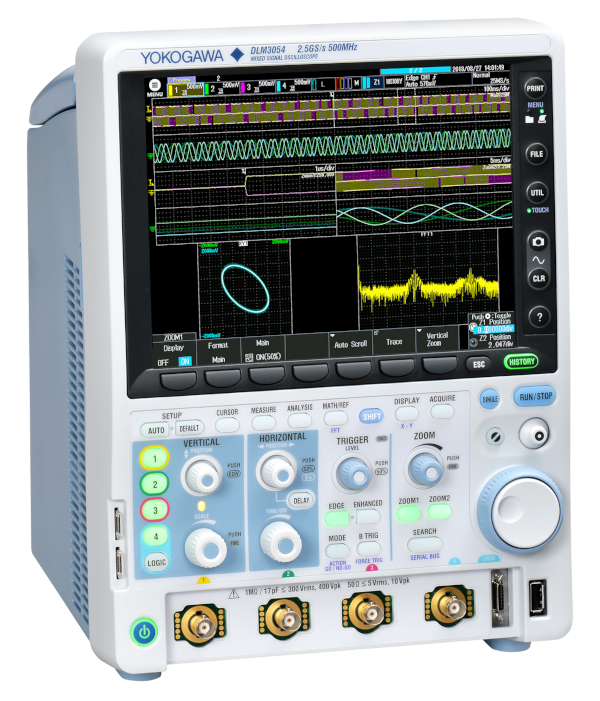
With a bandwidth of up to 500 MHz and a sampling rate of 2.5 GS/s, the instrument is capable of accurately analyzing waveforms at the fastest switching frequencies in inverters, for example. This sampling rate, combined with an acquisition memory capacity of 250 million points and an increased voltage range, results in lower residual noise and greater sensitivity. The DLM3000 also incorporates a variety of real-time low-pass filters to ensure the fidelity of the measured signals.
In the DLM3000 series' multi-channel mixed-signal capability, four channels of analog input signals are converted to 8-bit logic, so the instrument functions as a 3-channel analog oscilloscope combined with an 8-bit logic analyzer. As a result, up to 11 input signals can be observed simultaneously.
This means that the instrument can be used not only for observing data and control signals or as a trigger source, but also for analyzing logic inputs from I2C, SPI, or other serial buses, eliminating the limitations imposed by the four channels of a standard oscilloscope in applications where the operation of multi-channel digital control circuits needs to be examined.
The instrument's memory capacity of up to 500 Megapoints allows it to maintain its high sampling rate during extended measurements. A search and zoom function enables the user to select and display two waveforms with different time-axis scales simultaneously, search for captured waveforms in deep memory, and display waveforms that meet a wide range of search criteria within the zoom area.
The history function stores up to 100,000 previously captured waveforms in the acquisition memory and subsequently displays only one or all of them on the screen. The user can then perform measurements with the cursor, mathematical calculations, and other operations on the waveforms in the history, allowing for the analysis of randomly occurring signals.
The DLM3000 series comes with a variety of easy-to-configure triggers that combine analog and logic inputs, such as edge, enhanced, and B triggers.
A real-time filter is also included for optimal noise reduction, supporting a wide cutoff frequency range from 8 kHz to 200 MHz. The DLM3000 series features two types of filters: an analog filter processed in the input circuit and a digital filter based on mathematical functions. These filters are effective at rejecting unwanted signals, allowing observation of only the desired bandwidths.
A range of features that aid operational efficiency include:
• Displaying peak-to-peak or pulse width trends per cycle
• Automatic measurement of voltage and time differences
• Frequency spectrum analysis
• Instant signal capture with a hotkey
• Display of saved waveforms in thumbnail format
• “Go/No Go” function
• Function verification with online graphical assistance.
Serial bus analysis options (F01 to F05) are available for embedded systems and vehicle bus signals, along with decoding visualization. Logic inputs can also be used for specific UART, I2C, SPI, and SENT buses. Complex trigger and decoding settings, bit rate, and threshold levels are automatically detected by the device, simplifying measurements. Simultaneous analysis of four different buses is possible, and waveforms and results from buses at different speeds are displayed in the device's zoom window.
The 4-channel model offers power supply analysis capabilities to measure switching losses, Joule integral (I²t), SOA (Safe Operating Area), power supply current harmonic analysis based on EN61000-3-2, and other power measurement parameters such as active power and power factor. Using its memory capacity, voltage and current waveforms over multiple cycles are computed to calculate switching losses. The values can then be processed and statistically analyzed.
The DLM3000 is equipped with Gigabit Ethernet and USB 3.0 as standard communication interfaces for fast and easy PC connectivity.
The DLM3000 features an 8.4-inch capacitive touchscreen and its compact, portable form factor is approximately two-thirds the size of an A4 sheet of paper (with a depth of approximately 200 mm) to save space on a desktop or test bench.