The DL950 is used in a wide range of applications, including testing electric vehicles and SiC/GaN inverters. Energy sector applications include capturing data on renewable energy systems, while industrial equipment manufacturers will find the DL950 an invaluable tool for testing high-efficiency motors, robots, and sensors.
Offering a unique combination of high-speed sampling, the signal fidelity of an oscilloscope, and the long-term data recording capabilities of a recorder, the DL950 measures signals at high bit resolution while ensuring data integrity in even the harshest environments. Building on the capabilities of its predecessor, the DL850E, the new ScopeCorder DL950 can handle large amounts of data at a faster sampling rate and with longer recording times. With up to 8 Gpoints of acquisition memory and a sampling rate of 200 MS/s - 14 bits, it doubles the sampling rate with greater detail compared to the DL850E's 100 MS/s - 12 bits. The DL950 can execute up to 32 isolated analog channels of 10 MS/s - 16 bits or up to 128 digital channels.
This provides a complete solution for developers in the high-precision electrical power and mechatronics markets and contributes to further technological advancement and development.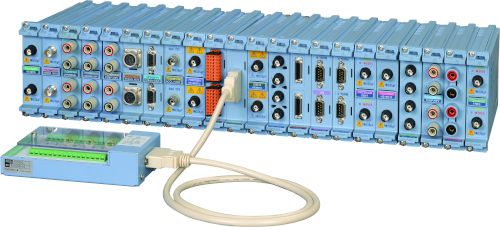
The ScopeCorder DL950 gives developers a high degree of insight into the behavior of these systems by capturing and analyzing a wide variety of electrical signals, mechanical performance parameters via sensors, and decoded signals from the vehicle's serial bus.
The dual capture function offers both the recording capabilities of a data acquisition system and the sampling rate and triggers of an oscilloscope. This allows developers to analyze the smallest details of a waveform while observing multichannel measurements over longer periods.
The DL950 offers five data acquisition options, allowing users to choose the best method for their application. They can opt for fast acquisition to the internal acquisition memory, recording to flash memory (coming soon), recording to the internal hard drive (SSD), or directly to a PC via standard Ethernet or 10 Gigabit Ethernet.
Data can be captured on a PC by transmitting at up to 160 MB/s, with data volumes limited only by the PC's storage capacity. With 10 Gigabit Ethernet, data can be transferred from the DL950 to a PC at 50 times the speed of its predecessor. A fiber optic cable and Yokogawa's IS8000 PC software are used for transmission.
The DL950 will also feature Flash Acquisition (coming soon), which is used to store data when a PC cannot be used, such as when capturing data from inside a vehicle, power plant, or other similar applications. In these applications, the unit would typically need to be powered off before being moved to an office to save the data to a PC. With Flash Acquisition, data can be captured over extended periods at high-speed sampling rates of 20 MS/s (8CH) and 10 MS/s (16CH).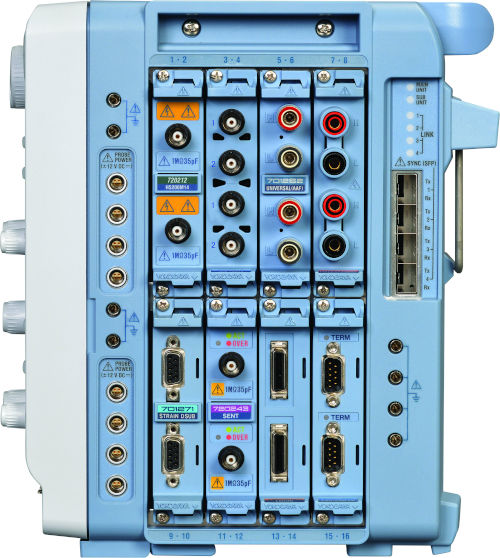 The internal 512 GB SSD can record for up to 50 days. Depending on the sampling rate, it can record one channel for five hours at 2 MS/s, or record up to 16 channels at 200 kS/s for 20 hours. Dual capture waveforms can also be recorded, which is useful for vehicle stress testing and capturing rare spontaneous events.
The DL950 offers maximum versatility, as it can connect up to 21 different types of input modules. These include 12-, 14-, and 16-bit isolation modules, universal voltage/temperature modules, acceleration/voltage modules, strain modules, and frequency modules.
Up to five DL950 units can be synchronized to provide up to 160 voltage channels. Alternatively, up to 640 temperature channels can be used, employing 16 channels with eight inputs for each of the five DL950 units. The subunits can be synchronized to start and stop their measurements using signals from the main unit.
Its large 12.1-inch touchscreen allows for easy operation of the DL950 and provides convenient access to a wide range of functions. Yokogawa power analyzers and a selection of other equipment can be synchronized in real time via the device's integrated IEEE 1588 PTP master function and the IS8000 software platform. The units can also be remotely controlled, allowing workers to continue testing while working outside the test lab.
Application menus simplify setup. Tapping an application icon displays its graphical configuration screen. Users can also save frequently used applications as favorites.