
The rise of networks and platform connectivity is generating entirely new control architectures. In short, the world surrounding machine tools is transforming at breakneck speed. This topic will be a major focus of discussion among exhibitors and visitors at AMB, the International Exhibition for Machining of Metals, taking place from September 13 to 17 in Stuttgart. Professor Dr.-Ing. Thomas Bauernhansl, Director of the Institute for Industrial Manufacturing and Factory Operation (IFF, Institut für Industrielle Fertigung und Fabrikbetrieb) at the University of Stuttgart and the Fraunhofer Institute for Production Technology and Automation (IPA), urges that this evolution be taken seriously and discussed from the perspective of the opportunities it presents.
Professor Bauernhansl, robots are taking over production plants. Will they become competition for machine tools?
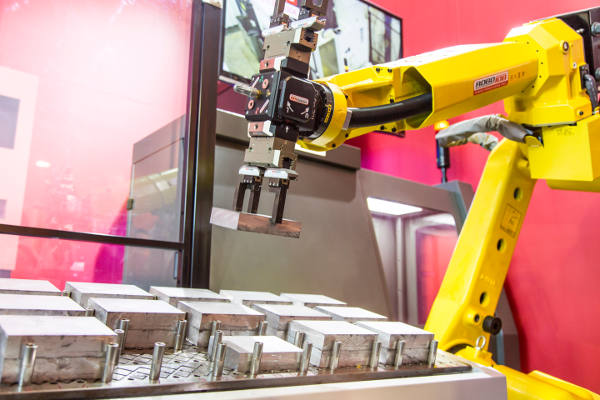
There is still no robot that can completely replace a machine tool. It is only capable of performing non-essential machine processes. For example, handling tasks or tasks that assist and support the operator. Some typical tasks include deburring, positioning, or replacing parts. But a robot will not perform chip removal, as it lacks the precision and agility required for that. However, in the future, the boundary between machine tools and gantry robots could become increasingly blurred. The advantages of robots are their flexibility and advanced programming capabilities. Undoubtedly, machine tools will move further and further towards a fusion with robots: they will cease to be independent components.
How is automation technology evolving in general with regard to machine tools?
We can see that competition in machine tools is increasing among automation system manufacturers. They are optimizing system design and configuration. Flexibility plays a key role, specifically the ability to switch from manual to semi-automatic to fully automatic, and vice versa. This partially limits the integrated approach. Machine tool components must be quickly replaceable. This allows for the rapid integration and removal of robots or palletizing systems. It's not just about transformation capacity, but also about cost-effectiveness—that is, enabling the machine operator to simply plug in and produce.
The control technique must also be adapted to this situation. What modifications can we expect in this area?
Traditional machine tool control techniques are evolving towards a plug-and-produce approach. Wired, hardware-based NC systems are destined to disappear. Plug-and-produce requires greater intelligence in the relevant component—the robotic arm, gripper, spindle, conveyor belt, and so on. These autonomous systems have their own microcontroller and communicate with a platform via an interface. They report on the services they offer, allowing the operator to configure an intelligent workflow. With increasing bandwidth and latency, it's possible to isolate machine tool services and, for example, offer them on cloud-hosted platforms. After all, only a few tasks, such as safety, require a local implementation. Functionality as a service is a growing trend.
How does automation technology manage the different demands posed by, on the one hand, large-scale manufacturing and, on the other hand, the increasing individualization of products?
Large-scale manufacturing will always exist, but there is a growing demand for customized products tailored to specific customer needs. Automation in large-scale manufacturing is already quite advanced. The only remaining challenge is to further strengthen processes through the skillful use of data and maximize efficiency. Customization, on the other hand, demands maximum flexibility—the ability to produce just one part, to be retooled in seconds, or even during the manufacturing process itself. These demands require a different kind of automation technology with sufficient transformation capabilities, perhaps even with the ability in the future to autonomously optimize communication with the component.
A question that will generate controversy in the debate at the WBA: what position does Germany occupy on these issues in the international comparison?
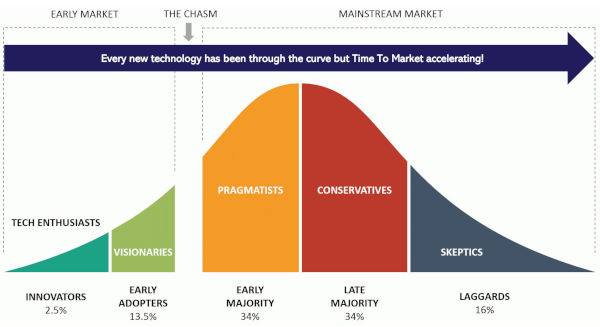
This topic is gaining significant momentum in the US, Japan, Korea, and more recently, China. In Germany, we must take this development seriously and address the issue in depth. Surveys are alarming: on the one hand, between 80 and 90 percent of companies report being affected by the new situation, but only between 10 and 20 percent are seriously addressing it. It is essential that this movement spreads and that more and more companies join this new trend. We must focus our discussions primarily on the opportunities that arise, not just the risks involved.
Andreas Richter will replace Eugen Elmiger as CEO of the maxon Group in March 2027
The maxon Group will make a change in its executive leadership in March 2027. Eugen Elmiger will step down as CEO after 15 years at the helm of the company and will be replaced by Andreas Richter, currently Chief Operating Officer (COO) and Deputy CEO.