
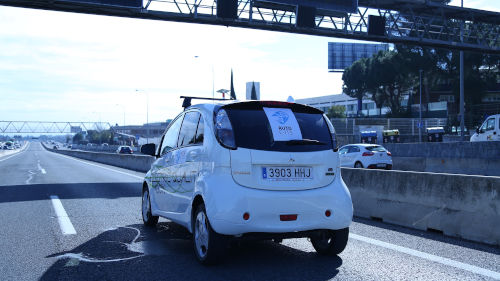
This will contribute to the sustainable mobility goals set for 2030 at both the national and international levels, such as those outlined in the UN Sustainable Development Goals. In fact, among the quantitative indicators that will measure the project's success are specific targets such as reducing travel times by 15% and improving vehicle efficiency and the performance of six other mobility-related parameters by 8%, thanks to the cutting-edge technology developed in each of the six planned validation and evaluation scenarios.
Furthermore, thanks to the use of advanced digital technologies such as IoT, cooperative transport systems (C-ITS), Artificial Intelligence, deep learning, and big data, innovative solutions can be developed that allow for the detection of anomalous behavior in an autonomous vehicle, facilitate its autonomous parking, predict traffic conditions, enable new payment methods at toll booths with smart technology, and improve the management of range, inductive/wireless charging, and intelligent fleet and route planning of the electric vehicle, among others.
A strategic project aligned with the UN Sustainable Development Goals (SDGs).
With a budget of €9 million and a duration of three years, the project is funded by the CDTI's (Center for Industrial Technological Development) Science and Innovation Missions program. This program supports strategic sectoral initiatives for business innovation that are R&D-intensive and highly relevant to Spain's future challenges, in line with the UN Sustainable Development Goals, such as sustainable and smart mobility. Mobility 2030 achieved the highest score among mobility projects and the third highest overall among the more than 100 proposals submitted.
Indra will coordinate the work of the seven companies that make up the project consortium, which, in addition to Indra itself, are Sacyr, Iberdrola, Ficosa, Wall Box Chargers and Disid Corporation, as well as the ten research centers and universities throughout Spain that participate.
a leading smart mobility platform,
will also deploy its In-Mova Space platform for the integration and use of all transport data generated by the project. In-Mova Space promotes more sustainable and collaborative mobility and facilitates the development of new business models in the field of smart mobility.
Among the research areas in which Indra will participate are Intelligent Transportation Systems (ITS), which will enable the safe coexistence of connected and non-connected vehicles, and Cooperative Transportation Systems (C-ITS), which facilitate communication with connected and autonomous vehicles. C-ITS systems will facilitate infrastructure management and the deployment of vehicles with an advanced level of automation (Level 4). Indra will also develop new traffic prediction systems based on deep learning techniques, which will also incorporate the connected car itself as an additional source of information.
The company will also use Artificial Intelligence and advanced LIDAR systems for vehicle characterization in access control systems, in order to develop solutions that allow monitoring of connected and autonomous vehicles to detect and warn the vehicle network and the control center of unusual or unforeseen behavior resulting from hacking or malfunctions. This will enhance the autonomous driving capabilities of the entire network and allow the control center to prevent situations that pose a risk to road safety.
Mobility as a Service and smart tolls to reduce CO2 emissions.
The technologies developed in Mobility 2030 will allow the development of advanced traffic characterization and toll systems for connected and conventional vehicles, which consider different characteristics of mobility and make possible a pricing model that favors the use of less polluting vehicles.
By using advanced technologies such as 3D cameras for precise vehicle geometry detection, and vehicle connectivity with infrastructure to obtain data on occupants, emissions, travel distance, etc., the project will help advance the implementation of a pricing model focused not only on the vehicle but also on the passenger. The goal is to integrate this cost into passenger mobility within the city, so that connected and autonomous vehicles are considered a further element of the emerging Mobility as a Service (MaaS) paradigm.