COM-HPC is an open Computer-On-Module (COM) form factor standard for high-performance computing (HPC) that combines high-end I/O bandwidth with edge computing performance levels. Standard COM-HPC modules connect to an application-specific carrier board (also known as a motherboard) and provide OEMs with an application-ready computing core that accelerates design cycles, reduces NRE costs, and increases return on investment, as well as sustainability by extending longevity options beyond a specific processor family or module vendor.
"The dedicated modular system management interface, which enables remote management access to embedded systems—even out-of-band—is another industry first introduced by COM-HPC," explains Christian Eder of congatec, chair of the COM-HPC committee. "Thanks to this feature, OEMs and users can ensure the highest levels of reliability, availability, maintainability, and security (RAMS) for their global deployments of distributed network infrastructure equipment and edge/fog computing servers, as well as IIoT gateways and clients. For individual needs, these COM functions can be extended via an optional board management controller on the carrier board. This provides OEMs with a modular framework of uniform remote management functions that can be flexibly scaled to specific requirements."
The COM-HPC PMI specification is a complement to the open COM-HPC standard and serves as a guide for achieving interoperability between COM-HPC modules from different vendors and motherboard combinations. It adapts the Intelligent Platform Management Interface (IPMI) specifications to COM-HPC designs and also addresses the implementation of Redfish features.
IPMI is a collection of sideband/extraband management commands used for system interaction. IPMI firmware typically runs on a board management controller, a discrete integrated circuit accessed via a network connection and/or serial interface, and/or LPC/eSPI. Redfish, a standard managed by the DMTF, provides a Representational State Transfer (RESTful) interface for system management. Redfish is still under active development and continues to evolve as new use cases are discovered.
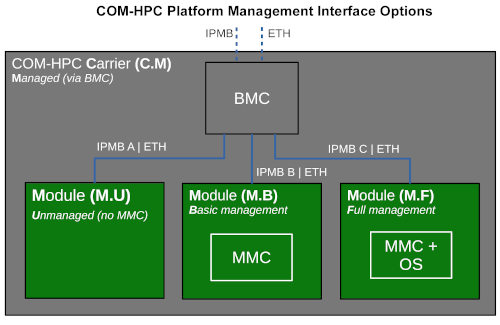
The COM-HPC PMI document describes three different PMI maturity levels for modules and two for carrier boards. Module PMI maturity levels range from Unmanaged Modules (MU) and Basic Managed Modules (MB) to Fully Managed Modules (MF); and carrier board levels range from Unmanaged (CU) to Managed (CM). The purpose of specifying these different levels is to enable interoperability between multiple module and motherboard designs. The different module management capabilities are broken down by their adherence to a set of IPMI commands, which are listed below.
Download the modular COM-HPC platform management interface specification
element14 launches a smart design competition to boost recycling and sustainability
element14, an Avnet community, presents a new smart and sustainable design competition, inviting engineers, makers, and technology enthusiasts to design and build innovative projects focused on recycling, waste reduction, and environmental sustainability.