


Falk Senger, CEO of Messe München, expressed his satisfaction with the record-breaking results after the four days: "Electronics is the most important meeting place for the electronics industry, and this year it saw an eight percent increase in exhibitors, a ten percent increase in visitor numbers, and an increase of more than 20 percent in exhibition space. In terms of the number of exhibitors, the leading countries were Germany, followed by China, Taiwan, the United States, and Great Britain (in that order).".
80,000 trade visitors from over 80 countries came to Munich. Visitor satisfaction reached a new all-time high, as the survey shows: 99 percent of visitors rated the event as good to excellent. In terms of visitor numbers, the leading countries were Germany, followed by Italy, Austria, Great Britain and Northern Ireland, France, Switzerland, the United States, the Russian Federation, China, and Poland, in that order.
CEO Roundtable Dominated by Artificial Intelligence.
On the first day of the trade fair, leading industry representatives discussed the importance of artificial intelligence for electronics. Participants  included Jean-Marc Chery (STMicroelectronics), Dean Ding (Alibaba), Alexander Kocher (Elektrobit), Reinhard Ploss (Infineon), Walden Rhines (Mentor Graphics), and Kurt Sievers (NXP). During the CEO Roundtable, Reinhard Ploss emphasized the need for a sustainable approach to artificial intelligence: “We have a number of strong industries in Germany. Artificial intelligence will permeate them and complement or even replace existing devices. Therefore, it is important to develop an AI strategy to establish a digital industry in Germany and Europe.”
In Hall C6, the new "Electronics Experience" format focused on networking among exhibitors, school students, and trade visitors. Over the four days of the fair, applications, live demonstrations, and a job fair provided insights into the world of electronics and its related professions. A highlight was the opening address by American economist Jeremy Rifkin on the first day. In his speech, he expressed clear concerns regarding the use of artificial intelligence: “We need to understand what we can and cannot use artificial intelligence for. Big data plays a significant role in communications, energy, and transportation. AI makes sense in these sectors to increase efficiency and reduce costs.”.
Physicians and electronics engineers discussed the future of medicine for the first time at the Electronic Medical Conference (eMEC), which focused on medical electronics and networking among electronics engineers and physicians. The discussion theme was "The Connected Human: Healthier Thanks to Electronics and Data?"
 As for the most noteworthy new features of the fair, we will list some of them.
Bosch introduced the first smart position-tracking sensor, the BHI160BP, for wearable devices, which uses integrated inertial sensors to enhance GPS location tracking. When used with a GPS or GNSS module, the BHI160BP allows users to maximize pedestrian position tracking with up to 80% savings in system power consumption compared to a typical GNSS-only solution, without compromising accuracy. This new approach to position tracking is poised to enable a new class of compact devices with even smaller batteries.
The BHI160BP tracks a person's position by intelligently applying an algorithm based on an inertial sensor for pedestrian direct calculation (PDR). To maintain accuracy, it calculates the user's relative location based on data collected from the inertial sensors and then recalibrates every few minutes to obtain the absolute position provided by the GNSS/GPS module. This means that the GNSS/GPS module can remain in sleep mode most of the time, reducing a device's power consumption and extending its operating time.
Bosch also presented the SMI230 six-axis industrial sensor for navigation systems. With this integrated sensor, navigation systems will not deviate from their destination, even when the GPS signal is interrupted. The Bosch SMI230 provides the navigation system with motion data, allowing it to determine the current position of the traveling vehicle, even when the GPS signal is weak or nonexistent.
The SMI230 MEMS sensor accurately measures the vehicle's yaw rate and acceleration. In this way, the onboard navigation system continuously calculates the direction and position of the journey while the car is moving. Navigation is not interrupted, for example, when the vehicle is inside a tunnel. The sensor's capabilities not only enhance navigation but also find applications in fleet management, toll collection systems, and car alarm systems. 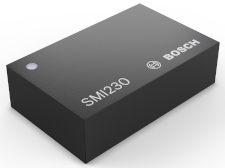
The SMI230 combines a three-axis MEMS accelerometer with a three-axis MEMS gyroscope in a single component. Both sensors operate digitally in 16-bit mode. In addition to this combination, the gyroscope and accelerometer can operate independently or be interconnected for data synchronization.
The SMI230 offers high accuracy, with noise levels of only 0.02°/s/√Hz (rms) for the gyroscope and 0.12 mg/√Hz (rms) for the accelerometer. Furthermore, the accelerometer has a low-temperature compensation coefficient (TCO) typically less than 0.2 mg/K and a temperature coefficient sensitivity (TCS) of only 0.002%/K. The typical gyroscope bias instability is well below 2°/h.
 Delta, a provider of energy and thermal management solutions, presented several innovations at Electronica 2018. Among the most notable were:
Delta programmable power supplies, with up to 9000W of power generation, are applicable in testing for verification or mass production applications, including general commercial products, power electronics, industrial, aviation, military electronics, and regulation testing.
Also available is the DME-D751ABS A DC power supply, a high-performance switching power supply that can operate on a wide range of electrical networks worldwide. It eliminates the need for an input voltage selection switch. The front panel LED continuously displays the output voltage and its current and operating status. Users can configure the output voltage and current level, protection activation level (OVP, UVP, OCP), and preview these settings from the front panel. The rear panel includes the necessary connectors for voltage and current output control and monitoring via an analog signal or RS232/GPIB.
The Delta DME-ACS1152B AC power supply is a high-performance AC power supply. It implements advanced digital signal processing techniques to provide precise power parameter measurements, such as Vrms, Irms, Ip+, Ip-, frequency, peak factor, power factor, starting current, VA, and VAR, among others. It can synthesize 30 different waveforms and delivers a maximum power output of up to 1.5 kW. Its frequency range is programmable from 30 Hz to 1 kHz. It can be remotely controlled via GPIB or RS232.
- CellD Systems. CellD units can be installed alongside other equipment in an existing rack. They operate seamlessly with optimal efficiency of up to 98% using Delta's EnergE rectifiers and advanced controllers. This configuration ensures reliable system operation and generates OPEX and CO2 savings, which in turn maximizes battery lifespan.
- Lithium-ion battery energy storage systems that stabilize grid voltage and can be installed in parallel for modular expansion. Each energy storage cabinet can be configured as 43.5 kWh or 49.7 kWh with a long lifecycle of over 4,000 charge cycles. Customers can select different energy storage modules—high-voltage module (DBSHV60S series) and 48V module (DBS48V60P parallel)—in cabinets according to their application requirements.
Keysight , for its part , presented several solutions, among which we find:
The X8712A software solution for battery optimization in IoT devices offers IoT device manufacturers the ability to:
• Detect design weaknesses with a wide dynamic range current measurement and a fast 20 μs sampling rate to capture the dynamic current consumption of an IoT device for a specific radio frequency or DC event. It then automatically correlates that event with the device's current consumption to easily identify subsystems or events that require optimization.
• Optimize battery life by calculating the percentage of charge and current consumption of the RF or DC event. By specifying the battery capacity and area of interest, the software calculates battery life based on the device's charge consumption.
Keysight Technologies, Inc. also introduced the Keysight DAQ970A data logger. The Data Acquisition (DAQ) system accelerates test development times with fast measurement and scan speeds, expanded measurement types and ranges, and easy test sequence automation.
The Keysight DAQ970A leverages BenchVue DAQ application software to facilitate rapid creation of automated tests, instrument control for setting parameters and status alerts, and simple analysis of measurement results. Integrated test flow capabilities automate DAQ setup and measurements in test sequences, while a new, intuitive graphical front panel display offers self-guided menus that allow test engineers to quickly perform all tasks directly from the instrument.
Keysight's data acquisition system improves design validation and accelerates test development times with:
• Up to 5,000 readings per second and scan speeds of up to 450 channels per second
• An advanced internal 6.5-digit digital multimeter and automatic calibration that compensates for internal drift caused by temperature and time changes
• Comprehensive testing of a wider range of designs with expanded measurement capabilities and ranges for voltage (300 V), current (1 μA DC, 100 μA AC), resistance (1000 MΩ), diode, and capacitance (1 nF - 100 μF)
• Multiple display formats (number, bar, meter, trend graph, and histogram) for easy monitoring of measurement results
• A new solid-state switching multiplexer module with faster scan speeds and a longer lifespan than multiplexers with mechanical relays
 Regarding Littlefuse, the company presented the AEC-Q101 rated TVS diode at electronica 2018 as a single-component protection solution for higher voltage transients.
The expansion of the TPSMB series of automotive transient voltage suppressor (TVS) diodes protects sensitive automotive circuits from higher levels of voltage transients induced by lightning and other transient voltage events.
The latest additions extend the series' breakdown voltage range from 7.5V to 550V for unidirectional devices and from 10V to 650V for bidirectional devices. These AEC-Q101 rated TVS diodes provide 600W peak pulse power dissipation in a standard SMB DO-214AA package, one of the most popular form factors for automotive applications. By eliminating the need for multiple TVS diodes in series to provide adequate protection, the TPSMB series simplifies printed circuit board design and improves reliability.
Typical applications for the expanded TPSMB series of TVS diodes include:
• Active clamping IGBTs in HVAC systems.
• Converter/inverter systems for electric vehicles.
• Battery protection series in automotive battery management systems (BMS).
• Xenon headlight igniters (for bidirectional parts).
• Electronic Control Units (ECUs)
. • Automotive sensors.
• BCMs/LIN Bus/CAN Bus.
• On-board entertainment systems.
On the other hand, the IXYS Integrated Circuits division, now part of Littelfuse, Inc., introduced the CPC1984Y, a  600V normally open SIP power relay rated for a continuous load current of up to 1A DC/1 Arms. This device utilizes optically coupled MOSFET technology to provide 4000 Vrms of input-to-output isolation. In fact, the CPC1984Y SIP relay offers the best combination of load voltage and load current available with a 4000 Vrms isolation voltage. The optically coupled outputs, which employ IXYS ICD's proprietary OptoMOS architecture, are controlled by a highly efficient infrared LED.
The CPC1984Y, with a typical resistance rating of only 0.51 ohms and a maximum rating of only 0.66 ohms, has a blocking voltage rating of 600 V, providing ample design headroom for 110 Vrms/220 Vrms power line applications in universal power supplies.
 The American company Maxim introduced a series of high-performance analog integrated circuits for building automation, automotive, and backup power systems. Maxim Integrated Products, Inc. launched three new analog integrated circuits: the MAX41464 sub-1GHz wireless transmitter, the MAX38888 backup power regulator, and the MAX16141 36-volt FET ORET controller for building automation, industrial, automotive, and wearable applications.
The MAX41464 is a sub-1 GHz frequency-hopping (FSK) transmitter with an industry-leading +16 dBm output power for long-range wireless sensors used in a variety of applications, including security systems and building automation. The transmitter is powered by a single cell-type battery and extends battery life by consuming only 12 mA of operating current. It is fully programmable via an I2C interface. A preset frequency mode using a single 16 MHz crystal eliminates programming and allows for a single-wire interface to an external microcontroller. In preset mode, the transmitter also features automatic shutdown at less than 20 nA of turn-off current, as well as a data activity detector for automatic power-up. Its frequency hopping range of 300 MHz to 960 MHz supports worldwide use, and the IC can operate in ambient temperatures ranging from -40°C to 105°C.
Maxim's Continua™ family of backup power regulators is setting the standard for power backup in mission-critical applications. These high-performance regulators charge a backup power source, such as a supercapacitor or capacitor bank, in seconds to provide continuous power to critical system components when the primary power supply fails. The first member of the Continua family, the MAX38888 reversible buck/boost regulator, offers a maximum efficiency of 95 percent. Operating via a 2.5 to 5V input in buck mode, the MAX38888 charges an energy storage device at a peak inductor current of up to 500 mA. In the event of a power failure, the MAX38888 operates in boost mode, providing a 2.5 to 5V output at a peak inductor current of up to 2.5A from an energy storage device, discharging down to 0.8V. In portable electronic devices where the primary power source is a battery, the MAX38888 doubles battery life by reducing quiescent current by up to 15 times during idle mode. The MAX38888 is available in a solution size of only 38 mm².
The MAX16141 is a 36V FET ORing controller with voltage and current circuit breaker for monitoring overvoltage, undervoltage, overcurrent, reverse current, and overtemperature conditions in automotive power applications, including infotainment and advanced driver assistance systems (ADAS). By providing a comprehensive set of system protection features, the controller generates a fast 0.3µs response time to reverse current events, increasing system hold time and functionality during automotive transient conditions. By enabling a true shutdown mode to prevent current leakage and minimizing current draw to idle circuits, the controller reduces overall system power and prioritizes engine starting power over all other electrical systems.
Microchip , the semiconductor company , announced a family of highly integrated LoRa® System-in-Packages (SiPs) featuring a low-power 32-bit microcontroller, a sub-1 GHz LoRa RF transceiver, and a software stack. The combination of long-range wireless connectivity and low power consumption aims to accelerate the development of LoRa-based connected solutions.
The SAM R34/35 SiPs are supported by certified reference designs and have proven compatibility with leading LoRaWAN™ gateway and network vendors, significantly simplifying the entire hardware, software, and support development process. The devices also offer the lowest standby power consumption on the market, extending battery life in remote IoT nodes.
LoRa terminal devices typically remain in standby mode for extended periods and are only activated sporadically to transmit small data packets. SAM R34 devices, incorporating the ultra-low-power SAM L21 microcontroller based on the Arm® Cortex®-M0+, consume as little as 790 nA in standby mode, significantly reducing power consumption and extending battery life in end-user applications. The SAM R34/35 family is characterized by its high level of integration within a compact 6 x 6 mm package, making it ideal for a wide range of long-range, low-power IoT applications that demand a small form factor and long battery life.
Along with its very low power consumption, the simplified development process allows developers to accelerate their designs by combining their application code and Microchip's LoRaWAN stack, as well as rapidly prototype using the ATSAMR34-XPRO development board (DM320111), which is supported by the Atmel Studio 7 software development kit. The development board is
certified by the Federal Communications Commission (FCC), Industry Canada (IC), and the Radio Equipment Directive (RED), so developers can be confident that their designs will meet regulatory requirements in different countries.
LoRa technology has been designed to enable low-power applications to communicate over longer distances than Zigbee®, Wi-Fi®, and Bluetooth® using the open LoRaWAN protocol. It is ideal for various applications such as smart cities, agricultural monitoring, and supply chain tracking, as it allows for the creation of flexible IoT networks that can operate in both urban and rural environments. According to the LoRa Alliance™, the number of LoRaWAN operators has doubled from 40 to 80 in the last 12 months, and LoRaWAN networks are being actively deployed in more than 100 countries.
The SAM R34/35 family features Microchip's LoRaWAN stack support and a certified, tested chip package, enabling customers to accelerate RF application design with reduced risk. With worldwide LoRaWAN compatibility between 862 and 1020 MHz, developers can use a single version in multiple countries, simplifying the design process and reducing inventory. The SAM R34/35 family supports both Class A and Class C devices, as well as proprietary point-to-point connections.
Microchip also took the opportunity to introduce the smallest MEMS clock generator on the market: the DSC613, capable of replacing up to three crystals and oscillators on a single board, thus reducing the space occupied by timing components by up to 80%. This device eliminates the need for an external crystal by integrating a low-power, high-stability MEMS (Micro-Electro-Mechanical Systems) resonator.
System designers need to place multiple crystals/oscillators near the controllers to achieve the frequency range required by today's smart devices, or use a clock generator with an external crystal for the reference input. The DSC613 family is a true single-chip solution that integrates a MEMS resonator and two low-power PLLs (Phase-Locked Loops) into a 6-pin DFN package starting at 1.6 mm x 1.2 mm. The small package size and high frequency flexibility make the DSC613 family suitable for compact, low-power devices such as digital cameras, smart speakers, VR headsets, streaming devices, and set-top boxes.
The DSC613 family offers up to three clock outputs between 2 kHz and 100 MHz, making it ideal for microcontroller-based embedded systems. For example, in an IoT application, the clock generator can be used to supply a main reference clock and a 32.768 kHz real-time clock (RTC) for the microcontroller, as well as another clock for functions such as connectivity and sensors. The DSC613 family includes two low-power fractional PLLs with AnyRate® clock synthesizers, allowing the device to generate any frequency between 2 kHz and 100 MHz. With an approximate current of 5 mA when all three outputs are operating, the family saves up to 45% of the power compared to a solution consisting of three low-power quartz oscillators. To further reduce power consumption, the clock output can be disabled via the output enable pin.
MEMS products are manufactured using standard semiconductor processes, providing the same reliability and stability as integrated circuits. Their operating temperature range is -40 to +125°C with a stability of ±20 ppm. All products are supported by Microchip's obsolescence policy, which is determined by its customers and ensures device availability whenever customers need them.
The DSC613 family is also supported by Microchip's ClockWorks® online configuration tool. Customers can enter a clock configuration and receive a custom part number and data sheet, as well as free samples, at clockworks.microchip.com/timing.
The clock configuration includes output frequency, control pin function, package size, PPM accuracy, and temperature range. Up to three levels of control are available depending on the board's load status. Spread spectrum clocks are also available to reduce EMI, and application support is provided, including board layout guidelines and schematic review.
 Molex introduced the Coeur CST High-Current Interconnect System with a new float design that accommodates pin-to-socket misalignment, facilitating PCB-to-PCB, PCB-to-bus, or bus-to-busbar mating without the risk of overload damage to the socket contact system. This unique float design provides 1.00 mm of axial float. The Coeur CST High-Current Interconnect System also features a compact footprint, allowing for mated board-to-board profiles as low as 5.00 mm.
The flexible and scalable Coeur CST High-Current Interconnect System delivers currents from 30.0 to 200.0 A and offers a wide range of configurations to suit PCB, busbar, and cable solutions.
Mouser Electronics Inc.announced the start of another major expansion of its global headquarters and distribution center. Construction will begin soon on a new 11,845-square-meter expansion of the distribution center, following a previous major expansion that included more warehouse space and the addition of a fitness center and employee medical clinic, all completed in the last two years. Mouser also plans to add a new building on its 31-hectare campus to house its customer service teams. The distributor has approximately 1,800 employees at its corporate headquarters and more than 2,300 employees worldwide.
Mouser will ship approximately 8 billion units in 2018 and plans to end the year with projected revenues of approximately $1.85 billion. The company continues its upward sales trajectory and has posted record double-digit growth in all regions: Asia is up 47 percent; EMEA, 46 percent; and the Americas, 35 percent.
The company will add four new branches—in Vietnam, the Philippines, Poland, and Brazil—to its existing 23 locations. Its website is available in 17 different languages (with Polish, Vietnamese, and Filipino to be added in early 2019), live chat is available in eight languages, and 27 currencies are accepted.
 Japanese company Murata has announced the availability of a new narrowband cellular modem module for the Internet of Things (NB-IoT). Measuring just 12.6 mm x 10.6 mm x 1.8 mm, it is the world's smallest. Its small size and low power consumption (~3 µA in power-saving mode) make the 1SS module ideal for miniaturized battery-powered IoT devices, such as wearables or tracking devices, where it can achieve a battery life of up to ten years.
Based on the Mediatek MT2625 chipset and housed in a shielded package, the module includes an ARM® Cortex®-M4 microcontroller (MCU) running at 156 MHz. The module can execute AT commands thanks to its integrated SRAM and 4 MB of Flash memory. It features multiple GPIO lines, a UICC interface for SIM cards, and SPI and UART interfaces, providing designers with greater flexibility. An open MCU option offers even more flexibility, allowing designers to run their own applications.
Ensuring the greatest possible compatibility with diverse use cases, the 1SS modem module supports a wide range of protocols including TCP/IP, DTLS, Ping, LwM2M, CoAP, HTTP/HTTPS for the web, MQTT for IoT, iperf, SNTP and SIM toolbox. The 1SS module complies with GSMA GCF/PTCRB certifications.
It also introduced a high-precision, 3-axis inclinometer with digital output of the true tilt angle. The high-  performance SCL3300 series of devices will be used in a variety of demanding applications, including leveling, tilt detection, machine control, and structural condition monitoring.
The SCL3300-D01 is a 3-axis (XYZ) inclinometer with four user-selectable measurement modes that can be used to optimize sensor performance for different applications and requirements. The integrated device includes a mixed-signal ASIC for signal processing along with a flexible digital interface that eliminates the need for an external ADC, reducing size, power consumption, and design complexity. The SCL3300-D01 features sophisticated tilt angle conversion within the sensor, enabling simple and robust application software. The SCL3300-D01 inclinometer provides a tilt angle output of ±90°, simplifying the use of both the software and the measuring device. The device operates from -40°C to +125°C with a typical temperature offset deviation of less than ±10 mg across the entire operating temperature range. Ultra-low noise density is as low as 0.001°/√Hz for high measurement resolution.
The SCL3300-D01 operates on a single 3.3V power supply and is ideal for battery operation in remote locations, including IoT-based applications, due to a typical sleep mode current consumption of only 3 μA.
The French group Nicomatic & Eca presented an electrical fault location solution to accelerate maintenance and repair. The TC50-eTool Electrical Ground Support Equipment (E-GSE), developed in collaboration with the ECA Group, allows for: voltage/current/resistance measurement; phase order control; diode testing; insulation testing; and thermography. Furthermore, the tool utilizes Nicomatic's SmartCo solution, based on reflectometry technology, to provide precise cable fault location, enabling rapid diagnostics. Measurement parameters include:
Voltage: 0 to 260VAC/400VDC, 50Hz to 3kHz - 5% accuracy
; Current: 0 to 30A (AC/DC) - 5% accuracy; Resistance - Low current: 10Ω to 200kΩ - 1% accuracy. 200kΩ to 2MΩ - 5%
accuracy
or Resistance: 1A high current load, 20mΩ to 10Ω - 1% accuracy
or Phase order: 115VAC/230VAC, 50Hz to
3kHz Insulation test, 0.5MΩ to 200MΩ,
or Diode test
or Thermal imaging: -20 to 120°C, FLIRTM
Technology with MSX function (real and thermal image overlay)
The TC50-eTool comes in an IP65 waterproof case that measures 305 mm x 270 mm x 194 mm and weighs 5 kg.
ON Semiconductor introduced its new integrated power modules, along with the latest smart power modules, MOSFETs, IGBTs, and integrated motor controllers for power conversion and motor control
The new NXH160T120L2Q1SG and NXH160T120L2Q2F2SG (PIM) integrated power modules simplify the designer's challenge by offering compact, integrated solutions in easy-to-assemble packages. Available in Q1 and Q2 packages for 30kW and 50kW inverters, the devices incorporate field-stop trench IGBTs and fast recovery diodes, resulting in lower conduction and switching losses. This allows designers to choose between low VCE (SAT) and low EON/EOFF losses to optimize circuit performance. The direct copper bond (DBC) substrate enables high-current operation with minimal parasitic inductance effects, allowing designers to achieve high switching speeds and providing 3000 Vrms of isolation with a creepage distance of 12.7 mm.
In addition, the company has announced the new FDMF3170, a fully optimized and ultra-compact Smart Power Stage (SPS) multi-chip module for DC-DC buck converter applications in servers, data centers, AI accelerators, and telecom equipment.
Panasonic Industry showcased its IoT connectivity and power solutions, passive components, and sensors at Electronics 2018, addressing the critical design challenges of miniaturization, high efficiency, and energy savings. The wireless connectivity solutions on display offer the largest link budget and lowest power consumption on the market and are available in compatible BLE mesh and wire mesh versions. With its Amorton solar cells, Panasonic Industry presented its unique integrated amorphous silicon solar cells, delivering the desired voltage for a variety of equipment operations. However, there is no IoT without sensors: the company's booth also featured a wide range of passive infrared (PaPIR) motion sensors.
Panasonic Industry Europe is also expanding its portfolio of conductive polymer hybrid capacitors for the second time this year with the addition of a sixth series. The new ZS series not only extends the capacitance range and doubles the ripple current capability, but also boasts a 4,000-hour lifespan at 125°C. The ZS series introduces new case sizes while maintaining the same footprint (ø10mm), with the initial launch featuring 16mm long hybrid capacitors.
Developed with the automotive sector in mind, the ZS series covers the 25V to 63V range, with a capacitance range up to 560uF, an ESR as low as 11mΩ, and a 4-arm ripple current. In addition to saving space, the lower ESR and reduced ripple improve filters and DC link circuits in automotive control and powertrain applications. The new series further enhances the potential of hybrid conductive polymer capacitors as effective replacements for the larger, hard-to-find, and soon-to-be-discontinued MLCCs, offering a reliable and proven alternative to lithium capacitors in tighter spaces or tantalum capacitors in higher-frequency circuits. All ZS series products are fully RoHS and REACH compliant, as well as AECQ-200 compliant.
Pickering Electronics has introduced the industry's smallest reed relay. The 124 Series is part of a new line of ultra-high-density 4mm² reed relays, occupying a minimal board area of just 4mm x 4mm, enabling the highest  possible density. The 124 Series relays have a profile of only 9.5mm in height. The devices are currently available in Form A with 3- or 5-volt coil options.
The 124 series reed relays feature a powder-coated ruthenium switch rated at 5 watts, 0.5 amps. These are the same reed switches used in Pickering's long-established 111, 111P, and 117 series, but they are oriented vertically within the package, facilitating the high density.
Relays have very fast operating times, typically 80 µs, making them ideal for high-speed test systems, and due to their small size, they are also suitable for very high-density applications such as ATE and semiconductor switching arrays or multiplexers.
Rigol Technologies , a company specializing in test and measurement instrumentation , which was celebrating its 25th anniversary, showcased its high-performance oscilloscopes, among other instrumentation products.
The newly launched, full-featured MSO/DS7000 series of mixed-signal digital oscilloscopes is based on Rigol's advanced on-chip ASIC technology. With bandwidths from 100 MHz to 500 MHz and sampling rates up to 10 GS/s, this series is ideal for demanding applications in research, development, and production. The instruments feature a 10.1" color touchscreen for clear signal presentation and optimal display of additional information. A memory depth of up to 500 million points is available for recording and processing large measurement datasets, and with a signal acquisition rate of up to 600,000 wfms/s, users can acquire, display, and evaluate fast signal sequences. Fast analysis and display capabilities are achieved through the ultra-fast chipset of the latest UltraVision II architecture.
Another new addition is the MSO5000 high-performance oscilloscope with a 9" color touchscreen, which offers less functionality than the MSO7000 series. With bandwidths ranging from 70 MHz to 350 MHz and sampling rates up to 8 GS/s, these oscilloscopes are aimed at less demanding applications requiring memory depths of up to 200 million points and signal acquisition speeds of up to 500,000 wfms/s.
Rigol also unveiled a high-end oscilloscope with bandwidths ranging from 600 MHz to 2 GHz and a multitude of highly efficient features. This device is designed for high-speed signal analysis across all high-tech industries and will be available in 2019.
In addition, Rigol announced its Vector Signal Analysis (VSA) software for the RSA5000 series, which will also be available starting in Q1 2019. This measurement application is integrated into the signal analyzers and will also be available as an upgrade for existing RSA5000 instruments. With the VSA application, users have a comprehensive tool for demodulating and analyzing vector signals to identify problems in the time, frequency, and modulation domains.
As an extension of its arbitrary function generators, it also introduced the new, low-cost DG800 and DG900 series. These combine the application fields of function generator, arbitrary signal generator, pulse generator, harmonic generator, analog/digital modulation, and counter function in a single device. In addition to the previously used direct digital synthesizer technology, which provides highly stable, accurate, and minimally distorted signals, the innovative new "SiFi II" signal fidelity technology reduces signal jitter to 200 ps.
 Renesas Electronics Corporation has introduced an innovative embedded energy harvesting controller that can eliminate the need for batteries in IoT devices. Developed using Renesas' SOTB™ (silicon-on-thin-buried-oxide) process technology, the new embedded controller achieves an extreme reduction in active and standby current consumption—a combination previously unattainable in conventional microcontrollers. These extremely low current levels in the SOTB-based embedded controller allow system manufacturers to take the next step and eliminate the need for batteries in some of their products by harvesting ambient power sources such as light, vibration, and flow. This could lead to a new market for maintenance-free, connected IoT sensing devices with endpoint intelligence for applications in industrial, commercial, residential, agricultural, healthcare, and public infrastructure, as well as health and fitness, clothing, shoes, wearables, smartwatches, and drones.
Renesas' first commercial product to utilize SOTB technology, the R7F0E embedded controller, is a 32-bit Arm® Cortex®-based embedded controller capable of operating at up to 64 MHz for fast local processing of sensor data and execution of complex control functions. With an active current consumption of only 20 μA/MHz and a standby current of only 150 nA, the R7F0E eliminates many challenges faced by system designers seeking to build cost-effective products with efficient energy harvesting capabilities. A unique, configurable Energy Harvest Controller (EHC) function enhances robustness and minimizes expensive external components. The EHC allows direct connection to many different types of ambient power sources, such as solar, vibration, or piezoelectric, while protecting against damaging inrush current at startup. The EHC also manages the charging of external energy storage devices, such as supercapacitors or optional rechargeable batteries. The R7F0E addresses many other system considerations for extremely low power consumption. Three of these examples include the ability to: (1) detect and capture external analog signals at all times because the 14-bit analog-to-digital converter (ADC) draws only 3 µA of current, (2) retain up to 256 KB of SRAM data content while drawing only 1 nA per KB of SRAM, and (3) provide graphics data conversion, including rotation, scrolling, and colorization, by incorporating sophisticated low-power hardware techniques to control an external display using the Memory-In-Pixel LCD screen.
ROHM , for its part, announced the development of a 1700V/250A SiC-based power module optimized for outdoor power generation systems, such as solar power inverters and high-power industrial supply converters.
ROHM has achieved high reliability in 1700V devices while maintaining the low-loss performance of its popular 1200V products, resulting in the first successful commercialization of SiC-based 1700V power modules. The BSM250D17P2E004 utilizes novel construction methods and cladding materials to prevent dielectric breakdown and suppress leakage current rise. As a result, it achieves high reliability, preventing dielectric breakdown even after 1000 hours of high-temperature, high-humidity polarization testing (HV-H3TRB). This ensures a blocking voltage up to 1700V, even in harsh temperature and humidity environments.
By incorporating ROHM's well-known SiC-based MOSFETs and Schottky barrier diodes into the same module and optimizing the internal structure, the conduction resistance is reduced by 10% compared to other SiC products in its class. This translates into greater energy savings in any application.
In the future, we will continue to expand our range to ensure trouble-free use by customers and will work to increase demand by offering evaluation boards that allow for easy testing and verification of our SiC modules.
In addition to the presentation of this and other new products, ROHM had the presence at its stand of former Formula 1 driver Felipe Massa, who will be an official driver for the Formula-e Venturi team, sponsored by ROHM, in the next season (fifth since its inception) of the championship.