
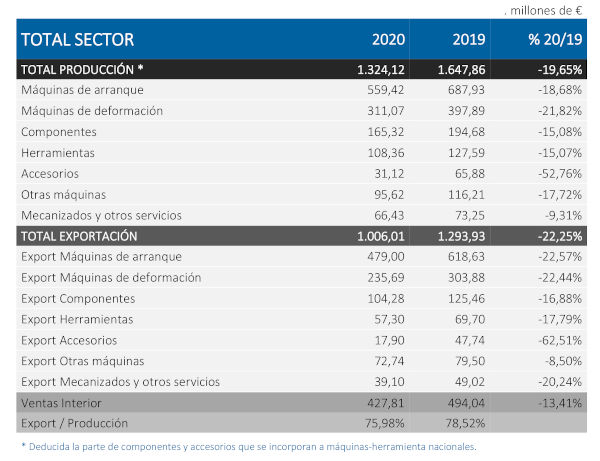
The decline is most pronounced in the metal forming subsector, which, at €311.07 million, fell by 21.82%, while metal cutting machinery, at €559.42 million, dropped by 18.68%. All other subsectors also declined compared to 2019: components and tools, -15%; other machinery, down 17.72%; accessories, -52.76%; and machining and other services, -9.31%.
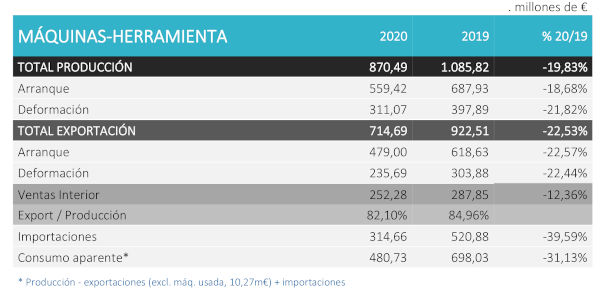
Exports, hampered by mobility and transport difficulties, fell by 22.25%, reaching €1,006.01 million compared to €1,293.93 million in 2019, and represent almost 76% of production. In this case, the declines in machining and forming are similar, with -22.57% in the former and -22.44% in the latter. Sales by domestic manufacturers in the internal market fell by 13.41% in 2020. Meanwhile, apparent consumption (production + imports - exports) of machine tools in Spain fell by 31.13%.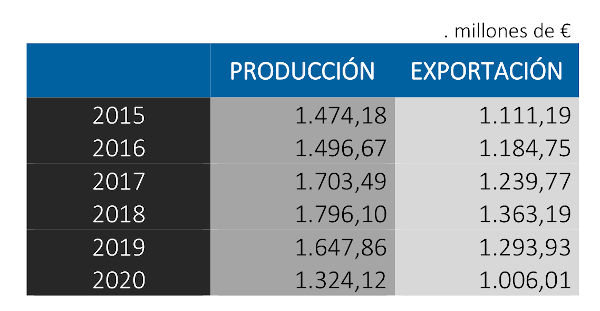
In 2020, the main destinations for our exports were Germany, which received 11.8%, followed by the United States (10.3%), France (9.1%), Italy (7.3%), and China (7.3%). Rounding out the top ten are Mexico, Portugal, India, the United Kingdom, and Russia.
New orders this year show a different trend, with a strong surge from China, which has become our leading market, ahead of Germany and the United States. They are followed by Turkey, France, Italy, India, Russia, and Canada. The rapid recovery of Chinese industrial activity (whose GDP only declined in the first quarter of 2020) has enabled it to undertake significant investments throughout the past year.
 Despite the impact of the pandemic, Spain has maintained its position as the world's tenth largest producer and exporter, preserving its market share. The five leading producing countries have maintained their positions in the ranking: China, Germany, Japan, the USA, and Italy; the latter two swapping places compared to 2019. The declines in production in these five countries are also significant, especially in the case of Germany (-30.9%) and Japan (-29.3%). Italy shows a similar drop to Spain's (-23%), slightly less in the USA (-9.4%), and very slight in China (-1.3%). Global consumption fell by 20.1% in 2020; a considerably smaller decline than the contraction experienced in 2009. The forecast for 2021, however, points to 15% growth, which in 2022 would reach an increase of 7.5%, although the speed of recovery will vary considerably among the three main consumption regions: Asia, Europe, and the Americas.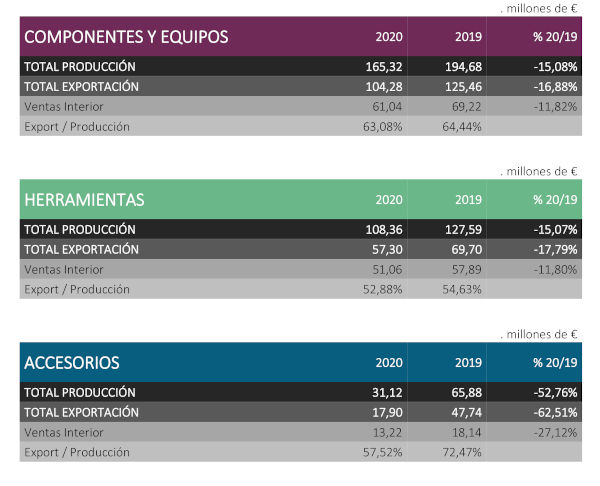
Orders registered in 2020 decreased by 23.5% compared to those received in 2019. As for the subsectors, deformation was the worst affected, with a decrease of 34.7%, and the start-up sector, although somewhat better, saw a reduction in orders received by 17.65%. It should be noted that orders began to recover strongly from October 2020 onwards, and this positive momentum has continued throughout the first four months of the year, yielding similar order intake figures to those of 2019. It remains to be seen how long this trend will last, which can be partly attributed to a rebound effect following the global slowdown experienced by the industry in the first half of 2020. Italy has announced a 48.6% increase in order intake for the first quarter of 2021, and Germany is confident that the pace of orders from China (which grew by 17% in the last four months of 2020) will provide a strong boost in the coming months.
Strong demand growth in the Chinese market and the expectations generated by Joe Biden's US economic stimulus plan point to a robust global economic recovery. This recovery should be accompanied by greater dynamism in Europe, driven by the acceleration of vaccination processes and the availability of recovery funds. Thus, if the second quarter continues the strong growth seen in the last six months, revenue growth expectations for 2021 would be around 12-15%, approaching the levels reached in 2019. 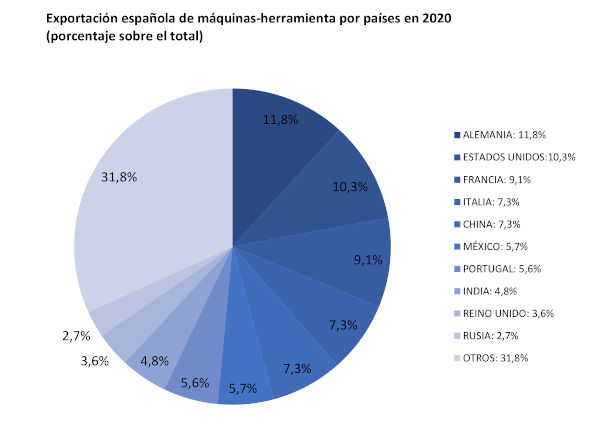 Regarding user sectors, while the automotive sector recovered activity levels after the forced shutdown at the start of the pandemic, the transition to electric and hybrid powertrains, on the one hand, and the changes related to the mobility model, on the other, make it difficult to predict vehicle demand, which is slowing new investments. The aeronautical sector, for its part, is feeling the impact of the decline in mobility, and, except in the defense sector, the outlook is not good for the next two to three years. The rail sector, on the other hand, is currently thriving, while the energy sector, with its mixed results, continues to make slow but steady progress towards renewable energy sources.