

The DRAM and NAND flash markets continue to closely follow the original IC industry cycle model, in which market cycles are primarily driven by fluctuations in capital expenditure and capacity. Including IC Insights’ 2019 forecast, it appears that little has changed regarding the extremely volatile nature of DRAM market cycles (Figure 1).
At $99.4 billion, the DRAM market was by far the largest single product category in the semiconductor industry in 2018, surpassing NAND flash ($59.4 billion), the second-largest market, by $40 billion. Since 2013, the memory market has been a tailwind (i.e., a positive influence) on the overall annual growth of the integrated circuit market and only once a headwind (i.e., a negative influence) (Figure 2).
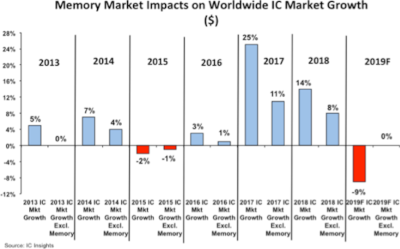 A 64% increase in the memory market segment in 2017 helped boost the overall IC market growth rate by a whopping 14 percentage points. Despite a slowdown in the fourth quarter, the memory market grew strongly by 26% in 2018, contributing a significant six percentage point to the overall global IC market growth for the year.
By 2019, the memory market is projected to be a significant obstacle to the global growth of the integrated circuit market. The total memory market is forecast to decline by 24% this year (a decrease of $38.6 billion). This substantial decline in the memory market is expected to reduce overall integrated circuit market growth by 9%. Factoring in memory, the overall growth rate of the IC market is projected to remain flat (0%) this year.