
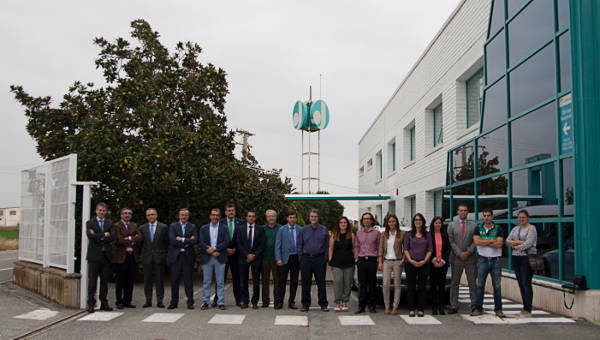
During the event, which took place at Jofemar's industrial facilities in Peralta, the partners presented the developments and progress made during the first months of execution of this project, which so far have focused on the study of the state of the art and research and on the detailed specification of the wide spectrum of technologies that the project covers.
Within the framework of the project, Jofemar Energy has already successfully completed the definition of the specifications of the flow battery to be hybridized with the charging points and those of the electrodes for Zn-Br flow batteries that will be incorporated, as well as the adaptation of the battery to the specifications required in the consortium and its effective integration into the charging point.
For its part, Ayesa (project leader) has been working with satisfactory results on the identification and evaluation of data sources, as well as on the design of a new architecture for Big Data environments. Fagor Electrónica has made considerable progress in the study of new power systems for microvehicles, in Smart Communications, and in innovative electric vehicle charging systems. Exide has obtained good results following its research on the use of carbon nanofibers in lead-acid battery electrodes, and the Antolín Group has made excellent progress in the development of new materials for various mechanical (microvehicle bodies) and electrical (electrodes and heating materials) applications. Sofitec, during this period, has advanced its research on new body topologies with novel formulations, using graphene materials. Francisco Albero Sau has
formulated new ceramic electrodes for use in Zn-Br flow batteries and has also characterized new materials for the manufacture of heating materials. Finally, Noxium has made significant progress in the study of sensors applicable to Smart Cities, as well as in defining the acquisition and control infrastructure.
Furthermore, attendees discussed the benefits of the technologies used to influence the use of personal and individual transportation in connection with city infrastructure. The project aims to "contribute to greener mobility in the city of the future, thanks to the technologies and new materials researched and developed," emphasizes Maura Colera, Technology Director of Jofemar Energy.
To conclude, the working group visited the company's pilot plant where pre-series flow batteries are being developed and manufactured and made a forecast for the coming months. Participants agreed that the project is progressing satisfactorily and that the work is on schedule.
The companies that make up the consortium are: AYESA, GRUPO ANTOLIN INGENIERÍA, FAGOR ELECTRÓNICA, EXIDE TECHNOLOGIES, JOFEMAR, FAE, SOFITEC, and NOXIUM. The consortium is further strengthened through collaborations with public universities and technology centers throughout Spain (UPM, USAL, UAM, US, CSICINCAR, CSICCINN GRADIENT, GAIKER, ITCL, and MATERFAD).