
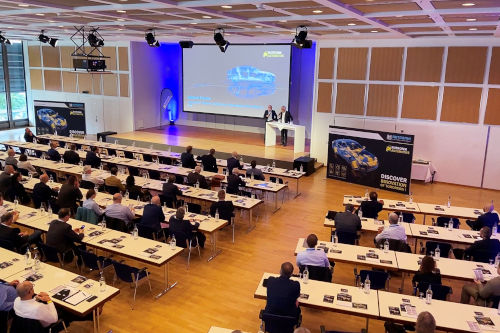
Rutronik's Automotive business division, founded in 2014, specializes exclusively in the procurement and development structures of its clients in the automotive sector. Especially during times of supply and distribution bottlenecks, the focus is on achieving the highest possible reliability in planning. Rutronik is not only a key partner as a reliable distributor, but also acts as an accelerator and pioneer of the latest technologies. As an innovative partner, Rutronik accelerates its clients' pre-development phases, thereby bringing future-proof products to market faster.
“Our congress provides an important forum for discussion not only for us as distributors and system solution providers. It brings together speakers and representatives from universities, manufacturers, and customers,” says Markus Krieg, Chief Marketing Officer (CMO) of Rutronik. “The congress discussions on alternative propulsion systems, sensor technologies, and the increasing connectivity and digitalization are linked to major trends in the automotive sector, such as e-mobility, autonomous driving, and urban mobility in various application scenarios, including passenger and delivery transport,” Krieg continues.
At the Rutronik Automotive Congress, three fundamental aspects of next-generation mobility were discussed:
New technologies related to lighting and visibility: What will change in the lighting sector?
Future lighting and visibility solutions require a complex interaction of many electronic components. This will make it possible to achieve high light output and thus benefit from very powerful and flexible illumination in road traffic. However, it is essential to ensure that, for example, oncoming vehicles are not dazzled. Essentially, this involves partial control of light output to achieve maximum safety for both near and far vision.
Propulsion systems of the future: What type of engine will prevail?
New propulsion solutions are urgently needed, especially for delivery traffic in urban areas. Against the backdrop of legal constraints (driving in city centers), the replacement of fossil fuel-based engines is already on the horizon. Currently, the debate centers primarily on fuel cells and purely electric propulsion systems. The economic and sustainability aspects of both propulsion solutions are being weighed.
Safety through driver assistance systems and intelligent on-board networks: How can driving become ever safer?
High-voltage vehicle networks are becoming increasingly powerful, and driver assistance systems are making them more complex. This entails risks that must be considered during vehicle development. To ensure that on-board networks can be quickly disconnected from the battery in the event of an accident or malfunction, new solutions are needed as an alternative to mechanical disconnectors. The goal is to preserve battery life and ensure occupant safety. Experts at Rutronik have developed an electronic disconnector based on semiconductor technologies connected to the high-voltage on-board network.