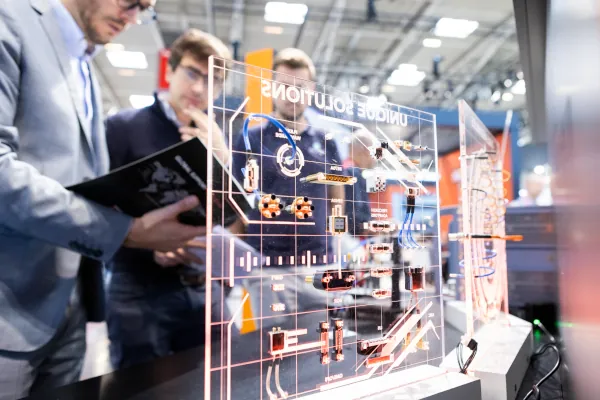
Only modern semiconductors and sensors, scalable embedded systems, and efficient connectivity make AI solutions possible in industry, mobility, energy, and medicine. At the same time, as AI adoption grows, so do the demands for computing power, energy efficiency, and cyber resilience. The electronics industry will showcase the technologies driving this development at the electronics trade fair in Munich, from November 10 to 13.
The electronics sector provides the technological foundation for the All Electric Society and enables smart applications in energy supply, mobility, industrial automation, and buildings. “Artificial intelligence places entirely new demands on electronic systems. What’s needed are powerful, energy-efficient, and secure solutions where hardware, software, and connectivity work seamlessly together,” says Caroline Pannier, director of the electronica trade fair. “It is precisely these developments that are the focus of electronica.”
AI as an accelerator and stress test for the economy and infrastructure
To remain innovative and competitive, companies today must integrate AI into their products, services, and processes. According to theGerman Economic Institute, 66.3% of large companies already use AI, while approximately half of medium-sized companies do as well. Small businesses have the most ground to make up: only 35.6% use AI in their operations.
At the same time, AI is opening up entirely new possibilities: machines and vehicles are becoming increasingly intelligent, power grids more efficient, medical diagnoses more accurate, and devices more autonomous. However, as the use of AI grows, so do energy needs and cybersecurity requirements.
Energy efficiency and cyber resilience as key criteria.
Due to the increased use of AI, modern electronic systems must provide high computing power, use energy moderately, and operate reliably under adverse thermal conditions. At the same time, the attack surface for cyber risks increases as systems exchanging large amounts of data become increasingly interconnected and software updates are released regularly.
As a result, energy efficiency and cyber resilience are moving from being individual and isolated requirements to becoming fundamental system criteria. Moreover, the EU Cyber Resilience Act (CRA) is increasing the pressure on companies to take action. Therefore, approaches such as "security by design" must be incorporated as early as the architecture phase and integrated into hardware, software, interfaces, updates, and operating concepts.
Hardware, software, and the application layer are converging.
The development of modern electronics is increasingly shifting from optimizing individual components to complete, integrated systems. What matters now is not just the performance of an individual processor, sensor, or module, but rather the interaction between hardware and software, the operating system, connectivity, security, and the application layer. Customers expect products that can be quickly integrated, easily scaled, and upgraded throughout their entire lifecycle. This places greater demands on system design, software quality, and lifecycle management. At the same time, it opens up opportunities for the electronics industry to access new markets and position itself competitively for the future.
Electronics as a platform for AI, cyber resilience, and energy efficiency
As the world's leading trade fair for the electronics sector, electronica brings together key players across the entire industry spectrum. Around 3,500 exhibitors from some 60 countries will showcase how individual components are transformed into complete, integrated, intelligent, and secure systems. The focus will be on the key themes of artificial intelligence, energy efficiency , and cyber resilience. A comprehensive program of side events will foster discussion and knowledge sharing. SEMICON Europe, running concurrently across two and a half halls, will offer an overview of the entire semiconductor industry value chain.