3D LiDAR can provide accurate images and maps for many applications; it's the "eyes" of autonomous cars and is used in facial recognition software and by autonomous robots and drones. Accurate imaging is essential for machines to map and interact with the physical world, but the size and cost of the technology currently required have limited LiDAR's use in commercial applications.
Now, a team of researchers from Pointcloud Inc. in San Francisco and the Optoelectronics Research Centre (ORC) at the University of Southampton has developed a new integrated system that uses silicon photonic components and CMOS electronic circuits on the same microchip. The prototype they have developed would be a low-cost solution and could pave the way for the mass production of low-cost, compact, high-performance 3D imaging cameras for use in robotics, autonomous navigation systems, construction site mapping for enhanced safety, and healthcare.
Graham Reed, Professor of Silicon Photonics at ORC, stated: “Lidar has promised a lot, but it hasn’t always lived up to its potential in recent years because, although experts have acknowledged that integrated versions can lower costs, the necessary performance hasn’t been achieved. Until now.
The silicon photonic system we have developed provides significantly greater distance accuracy compared to other chip-based Lidar systems to date, and to most mechanical versions, demonstrating that the long-awaited integrated system for Lidar is viable.”
Remus Nicolaescu, CEO of Pointcloud Inc., added: “The combination of high performance and low manufacturing cost will accelerate existing applications in autonomous and augmented reality, as well as open up new directions, such as industrial and consumer digital twin applications requiring high depth accuracy, or preventative healthcare through remote monitoring of behavior and vital signs requiring high speed accuracy.”
"The collaboration with the world-class team at ORC has been fundamental and has greatly accelerated the development of the technology."
The latest tests of the prototype, published in the journal Nature, show that it has an accuracy of 3.1 millimeters at a distance of 75 meters.
Among the problems that previous integrated systems have faced is the difficulty in providing a dense array of pixels that can be easily addressed; this has limited them to fewer than 20 pixels, whereas this new system is the first large-scale 2D coherent detector array consisting of 512 pixels. The research teams are now working to expand the pixel arrays and beam steering technology so that the system is even better suited to real-world applications and further improves its performance.
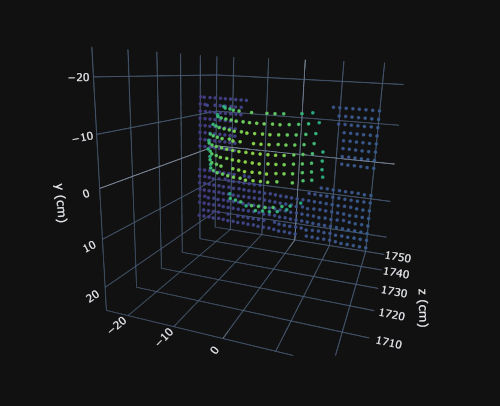
Pointcloud Inc. Basketball 17m
CREDIT: Pointcloud Inc. Basketball and screen at 17m - image taken with a 32x16 pixel sensor (2mmx2.5mm sensor size)
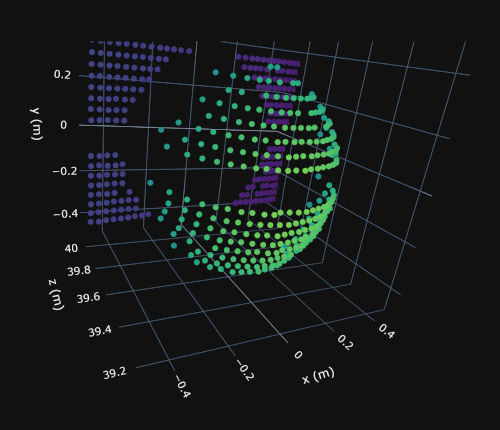
Pointcloud Inc 40m Exercise Ball
Exercise ball and display at 40m - image taken with a 32x16 pixel sensor (sensor size 2mmx2.5mm)