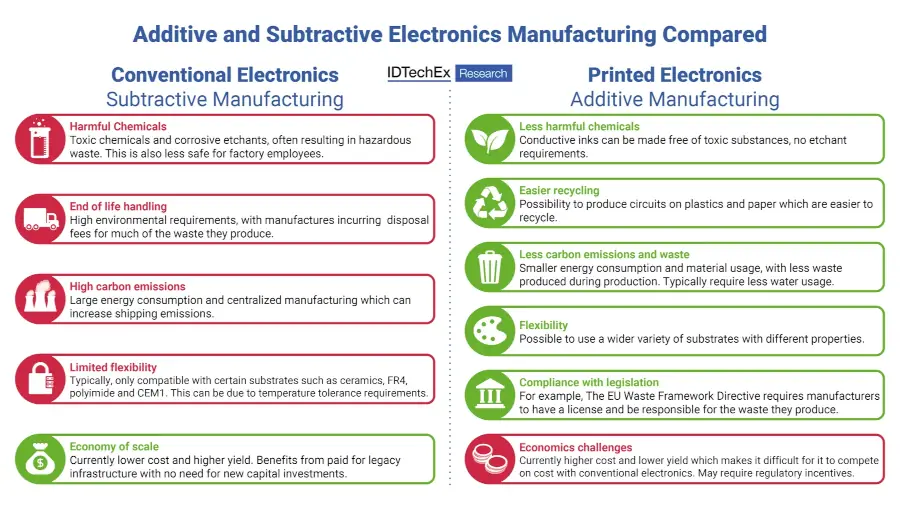
These figures highlight the potential of technologies such as printed electronics to improve the sustainability of the industry, although their large-scale adoption still faces significant technical and economic challenges. The analysis is part of the report Sustainable Electronics and Semiconductor Manufacturing 2027-2037: Markets, Technologies, Forecasts, which examines opportunities to reduce the environmental impact of electronics and semiconductor manufacturing.
Additive vs. subtractive manufacturing of electronic circuits
Conventional printed circuit board (PCB) manufacturing primarily uses subtractive processes, in which material is removed to obtain the necessary conductive patterns. During metallization, for example, copper-coated laminates are used, and chemicals are applied to remove the areas that are not part of the circuit. This procedure requires materials such as photoresistors and etching agents, as well as significant quantities of water for rinsing. Among the products used are ferric chloride solutions, cupric chloride solutions, and ammonia compounds. Consequently, chemical waste is generated that must be properly treated.
Additive manufacturing, on the other hand, allows conductive materials to be deposited only in the areas where they are needed. This approach can reduce raw material waste and simplify certain stages of the production process.
Reduction of emissions, water consumption and energy costs
One of the main arguments in favor of additive manufacturing is its ability to use materials more efficiently. According to IDTechEx, available estimates suggest that certain additive processes can achieve emission reductions of around 80% and water savings of up to 95% compared to conventional metallization techniques. These figures depend on the specific process used and should not be interpreted as results automatically applicable to any manufacturing line.
The adoption of additive technologies also offers the possibility of redesigning production processes. For example, some applications could replace higher-cost substrates, such as polyimide, with more economical alternatives, such as PET. Furthermore, certain additive processes allow for operation at lower temperatures, which can reduce both energy consumption and operating costs. These advantages are particularly relevant in a sector whose demand for energy, materials, and water continues to grow.
Profitability remains the main obstacle
Despite its environmental benefits, additive manufacturing still faces challenges competing with established industrial processes. IDTechEx notes a growing interest among European and American companies in adopting more sustainable production methods. However, this interest doesn't always translate into purchasing decisions when new technologies fail to achieve costs comparable to those of conventional processes. Implementing an additive manufacturing line can require significant investments in equipment and infrastructure. Furthermore, current subtractive processes benefit from decades of optimization and economies of scale that are difficult to match. Therefore, reducing environmental impact must be accompanied by improvements in productivity, manufacturing efficiency, and economic competitiveness.
Production yield should be close to 96%
Another significant challenge is the percentage of correctly manufactured products. According to interviews conducted by IDTechEx, some printed electronics processes still have lower yields than conventional technologies. The consultancy cites the case of a printed electronics company whose current yield is around 75%. To achieve comparable economic competitiveness, this company believes it needs to approach 96%, a figure typical of established subtractive manufacturing processes. This difference represents a significant obstacle in markets where manufacturing costs are critical. Added to this is the difficulty of producing complex multilayer devices using certain additive technologies. These limitations mean that additive manufacturing is, for now, more suitable for specific applications than for widespread replacement of conventional consumer electronics production.
RFID, flexible electronics and sensors: the first opportunities
IDTechEx identifies several applications where additive manufacturing could find commercial opportunities in the short term. These include RFID labels for smart packaging, where relatively simple circuit printing processes can be advantageous. Wearable devices and electronic textiles, which require integrating components onto flexible materials, are also highlighted. Another area of application is disposable sensors and medical patches, where low material consumption and reduced weight can offer advantages. Additive manufacturing is also interesting for rapid prototyping and small production runs, as it can reduce the need for tooling and facilitate design modifications. However, IDTechEx believes that competing with conventional manufacturing of high-volume, multilayer electronic devices will remain challenging in the short and medium term.
Subtractive manufacturing can also improve its sustainability
The report emphasizes that additive manufacturing is not the only alternative for reducing the environmental impact of the electronics industry. Conventional processes can also be improved through chemical recovery and regeneration technologies. Regenerating etching agents, for example, allows for reduced substance consumption and waste generation. IDTechEx also mentions developments such as those by DP Patterning, which is working on subtractive metallization processes without etching agents for flexible printed circuit boards. These solutions demonstrate that the shift towards more sustainable electronics manufacturing can combine different technologies, rather than relying exclusively on additive processes.
The growth of electronic waste increases the pressure on the industry
The sustainability of electronics manufacturing is gaining increasing importance due to the growing demand for devices and components. IDTechEx indicates that the global volume of electronic waste could exceed 96 million tons by 2037. The consultancy also highlights the high resource consumption associated with semiconductor manufacturing. According to data collected in its report, this activity currently uses approximately 200 billion kWh of energy and one trillion liters of water annually. In this context, more efficient manufacturing technologies can contribute to reducing resource consumption and improving the resilience of supply chains.
Source: IDTechEx press release, Can Additive Manufacturing Deliver for Electronics?, published on October 27, 2026