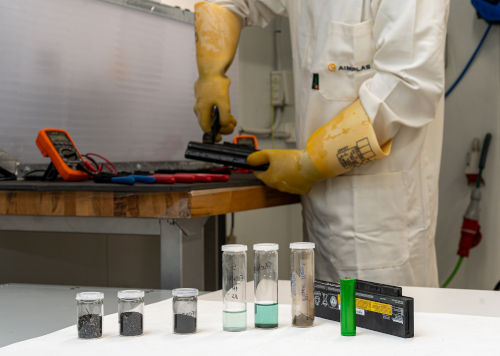
Regarding their environmental impact, batteries contain chemical components that can be released into the environment as they degrade.
On the other hand, lithium is one of the raw materials considered critical by the European Union due to its strategic and economic importance and the risk of high demand, as it is considered essential for electric mobility and the transition to a low-carbon economy.
The Technological Institute of Plastics (AIMPLAS) is addressing these two challenges with the METALLON project, a collaboration between the Environmental Engineering Research Group (GI2AM) at the University of Valencia, GDV Mobility (an electric vehicle mobility company), and Recuintec, a company specializing in the management of computer and technological waste. The project aims to improve the reuse and recycling of complex waste materials such as lithium-ion batteries (LIBs) in order to, firstly, recondition them and give them a second life, and secondly, if they must be disposed of, optimize recycling and recovery processes to extract and recover the lithium and other high-value metals and minerals they contain. This project is funded by the Valencian Institute of Competitiveness and Innovation (IVACE+i) with support from the European Regional Development Fund (ERDF).
As explained by Santiago Llopis, a researcher in chemical recycling at AIMPLAS, “current lithium-ion battery recycling processes, such as pyrometallurgy and hydrometallurgy, have certain limitations. These include the inability to recover lithium using standard pyrometallurgical methods, the high energy cost, the intensive use of inorganic acids, and the generation of highly polluting waste (gases and water). In the METALLON project, we are investigating techniques for recovering the metals present in lithium-ion batteries (LIBs) that do not have a negative environmental impact. We will replace inorganic acids with less harmful agents, such as green solvents, and study biohydrometallurgical processes as an innovative, cleaner, and more economical alternative that requires minimal energy consumption and uses biological reagents.”
The research also includes pre-recycling strategies to try to reduce the generation of this waste in the first place. Thus, methods will be established to identify the health status of LIBs at the end of their life cycle, and procedures will be implemented to determine their potential refurbishment and reuse in various sectors such as mobility and the electrical and electronics sector.
The METALLON project is funded by the Valencian Institute of Competitiveness and Innovation (IVACE+i), through the 2023 Strategic Cooperation Projects call of the Valencian Innovation Agency, supported by European Regional Development Funds (ERDF).