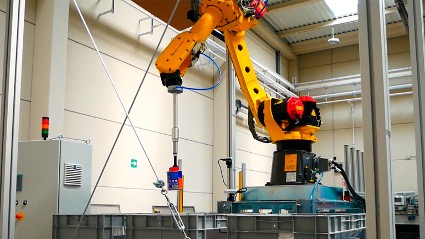
However, this is not the case when handling parts with high variability or in less structured environments (unbounded and with variations). In these types of applications, commercial bin picking solutions are not applicable since configuring each of the thousands of SKUs that need to be managed is not feasible.
In this context, the technology center Tekniker, a member of the Basque Research and Technology Alliance, has developed new machine vision algorithms within the framework of the European project PICK-PLACE. These algorithms allow industrial robotics applications to identify gripping points for unknown objects placed inside boxes.
“The system we have developed, based on Deep Learning techniques, allows us to directly predict gripping points for objects without considering their identification, offering a flexible solution capable of handling a wide variety of objects,” explains Ander Ansuategi, a researcher at Tekniker.
Tekniker also coordinated the technical aspects of the project and worked on a monitoring system for the shared workspace between the technicians and the robots.
“The aim is to advance robotic strategies linked to artificial vision, flexible manipulation and gripping, and the precision and reliability of operations that allow us to solve the challenges associated with handling complex products with short production cycles in the logistics sector,” adds the Tekniker researcher.
Software Integration
: To verify the effectiveness of the machine vision system designed by Tekniker, two pilot projects were carried out as part of the initiative.
First, the developed software was integrated into an automated order picking and return system at ULMA Handling Systems, the project coordinator. Second, the system was also tested in the order picking of spare parts for the dealer network of TOFAS, a FIAT Group automotive manufacturer.
The project's outcome involves the transfer of advanced Artificial Intelligence technologies to industry through the creation of automation and robotics solutions for applications such as single-unit order creation and machine feeding, among others. Tekniker researchers are now working on integrating the software into the bin picking solution developed by Tekniker.
Completed in 2021, the PICK-PLACE initiative (Flexible, safe and dependable robotic part handling in industrial environments) is a project funded by the European Union's Horizon 2020 program that focuses on developing technologies for handling and gripping complex products.
Along with Tekniker, the initiative involved partners such as ULMA Handling Systems, CNR-STIIMA, Fraunhofer IFF, Mondragon Assembly, and the Turkish automotive manufacturer TOFAS.
This Project has received funding from the European Union's Horizon 2020 research and Innovation Program under grant agreement No. 780488.