




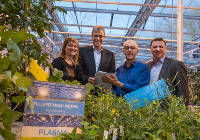
 Ampleon has initiated a research project in collaboration with HAS University of Applied Sciences in Den Bosch, the Netherlands, on the use of full-spectrum lighting for horticultural applications. The project will also validate and summarize existing research and investigations.
Lighting plays an increasingly important role in horticulture, both for urban agriculture and for cultivation without daylight, and increasingly in greenhouses. Until now, the focus has been primarily on achieving higher yields through the use of light. However, aside from the focus on crop yield, no detailed research has yet been initiated on the effects of the light spectrum on crop growth, quality, flavor, and seed production. This research project will study the growth of a variety of plants under four different light sources and record six plant growth attributes. This will include how the plant forms and how it grows, for example, whether it becomes more compact. Plant quality will be analyzed, including sugar content, acidity, firmness, and lifespan. Research on plant roots will also be conducted, based on the premise that a better root system leads to improved crop growth. For many crops, flowers and fruits are key aspects to achieving not only a better harvest, but also a more controllable yield; therefore, monitoring this as part of the cultivation process will also be carried out.
Today, several different lighting technologies are used for horticultural applications, such as high-pressure sodium (HPS) and LEDs. However, light plasma (LP) lamps, powered by an RF power source, provide a full spectrum of light and are believed to offer greater value to growers.
Ampleon is sponsoring a 20-week research program that began in late 2015, based at the university's newly opened greenhouses and research centers. The research will focus on different aspects of crop growth under full-spectrum LEP lighting, comparing it to the use of LEDs, SON-T high-pressure sodium, and ceramic metal halide (CDM) discharge lighting.













