




The Directorate General of Traffic (DGT), the Polytechnic University of Madrid (UPM), the National Road Safety Authority (ANSR), the University of Coimbra (UC), the Pedro Nunes Institute (IPN) and Inventeurs du Monde Numérique (INRIA) complete the consortium of the R&D&I project AUTOCITS, which has a budget of 2.6 million euros and funding from the European program CEF (Connecting Europe Facility).
Indra's headquarters will host the consortium's first meeting on November 23, where the project will be officially launched, along with a presentation to various stakeholders. Additionally, a presentation will be given at the event "Technologies for Safe, Accessible, and Sustainable Mobility," organized by INSIA (Automotive Research Institute) of the UPM (Technical University of Madrid) on November 17 and 18.
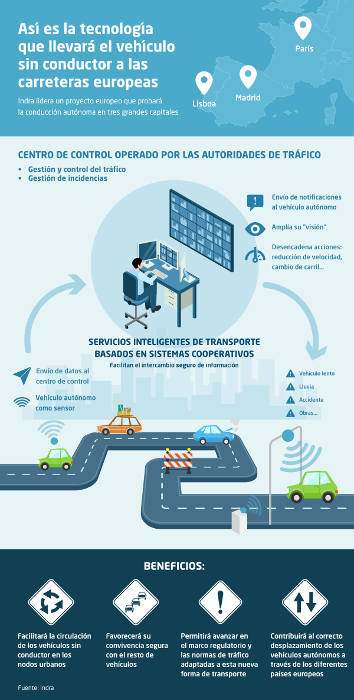
AUTOCITS aims to facilitate the movement of autonomous vehicles in urban nodes by developing intelligent transport services based on cooperative systems (C-ITS), which enable communication and secure data exchange between vehicles, users and infrastructure, using the European communications standard ITS-G5.
The project addresses the links between connectivity and automation, focusing particularly on road safety and the necessary changes to infrastructure and traffic control centers, both physically and digitally. It aims to reconcile the traffic management function performed by these centers with the presence of driverless vehicles, while also recognizing that the information provided by traffic authorities through C-ITS intelligent services is increasingly important at higher levels of automation for triggering actions in both conventional and automated vehicles.
The three pilot projects, to be designed, developed, and deployed in Lisbon, Madrid, and Paris throughout 2017 and 2018, will allow for testing the relationship between autonomous and conventional cars and control centers, as well as the development of recommendations based on the analysis of results. The objective is to advance the regulatory framework and traffic regulations to improve the interoperability of autonomous vehicles, ensure their proper operation on all types of roads in different European countries, and guarantee their safe coexistence with other vehicles. Currently, there is no European standard, and the regulations in each country vary in their level of development, with Spain and France in an advanced position.
In addition to involving traffic authorities, operators and universities, AUTOCITS plans to collaborate with other existing R&D initiatives at European level in this field, for example, the C-Roads project and the EU EIP Platform.
Driver-operated and driverless vehicles on European roads
The pilot projects in Lisbon, Madrid, and Paris are pioneers in the Atlantic Corridor and among the first in Europe to include autonomous vehicle testing, from various suppliers, both on closed and open roads with conventional traffic, on urban and suburban roads and highway interchanges. Specifically, the tests will take place on the Bus-HOV lane connecting to the M-30 ring road in Madrid; on the A-4 motorway outside Paris; and on Avenida Marginal and Avenida Brasilia, two important thoroughfares connecting Lisbon to the A-36 motorway and other transport infrastructure, such as shipping and rail.
In each of these pilot projects, cooperative services that are technologically possible today (called "Day 1" services) will be deployed, thanks to other previous R&D projects in which different members of the consortium have participated.
For example, in Madrid, the plan is to test the direct transmission of information from the control center to vehicles (I2V) to notify drivers of potentially hazardous locations, such as roadworks, the presence of an emergency vehicle, a slow-moving or parked vehicle, and weather alerts. In Lisbon, similar information will be communicated, including warnings and hazardous locations, but using V2X communication between the vehicle and any connected object or device—in this case, a second, instrumented vehicle.
In Paris, in addition to these types of warnings about dangerous situations, traffic jams will be reported and help will be given to manage them, offering information on recommended speeds or lanes, alternatives, etc., using I2V communication from the control center to autonomous vehicles.
The three pilot projects will also design and test different services that leverage the information provided by the connected vehicles themselves to the control centers. Furthermore, the services and systems tested in one city will be shared with those of the other two to verify their interoperability and proper functioning.













