Emerging Battery Technologies Will Accelerate the Electrification of Construction Machinery.
Off-highway machinery in the construction, agriculture, and mining sectors is undergoing electrification, driven by the financial, operational, and environmental benefits it can bring. However, different machines vary greatly in size, range, duty cycle requirements, and other aspects, necessitating diverse battery options to meet the needs of each machine.
What battery technologies are currently being used in these machines?
In the early days of electrifying construction machinery, particularly in construction, lead-acid batteries were used in smaller, compact machines. However, with the maturation of the global electric vehicle market and battery technologies, machines now widely use lithium-ion battery packs. Specifically, they follow the lead of the automotive market by using both NMC and LFP packs.
These technologies offer a good balance of energy density, lifespan, charging speed, and cost, enabling broad application across many types of machines. It is crucial to highlight that, due to their use in the automotive market, they have an existing supply chain infrastructure that can be leveraged to facilitate original equipment manufacturers' (OEMs) access to battery packs for machine development and manufacturing.
NMC and LFP technologies have performed well in the off-highway machinery market and will continue to advance, especially as their development continues and prices continue to fall. However, certain machines will demand more from their batteries than conventional lithium-ion designs can offer, such as longer lifespan, higher energy density, or faster charging capabilities.
In these cases, OEMs may need to turn to emerging battery technologies to bridge the performance gap. Specifically, the new IDTechEx report, "Batteries for Construction, Agriculture, and Mining Machinery 2026-2036: Technologies, Players, and Forecasts," highlights LTO anodes, silicon anodes, solid-state batteries, and sodium-ion batteries as key technology options for the machines of the future.
What can emerging battery technologies offer?
LTO Anodes
LTO anodes utilize an active material of lithium titanate oxide that can be used in place of a typical graphite anode, often combined with an NMC cathode. The resulting cell has an energy density three to five times lower than that of a cell with a graphite anode, but, more importantly, the anode undergoes very small volume changes during cycling, resulting in an excellent lifespan of 20,000 to 60,000 cycles. Furthermore, it allows for very fast charging at rates of 6–10C.
This unique combination of performance parameters makes LTO anodes well-suited for use in mining machinery. These machines often need to operate 24/7 for many years at a time, requiring both a long lifespan and fast charging to minimize downtime. Furthermore, larger machines, such as those used in mining, are more tolerant of lower energy densities and can accommodate the shortcomings of LTO anodes.
LTO technology is increasingly being commercialized in the mining sector. Although the high lithium content of the anode entails significantly higher costs, sometimes reaching US$1,000 per kWh, this can still be more economical than having to replace NMC or LFP packs multiple times over the life of a machine.
Silicon Anodes and Solid-State Batteries:
Both silicon anodes and solid-state batteries are technologies that have been the subject of extensive development and research for future use in the automotive market.
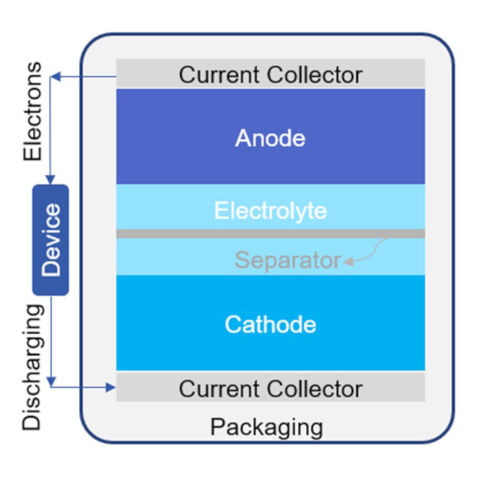
Silicon anodes use a higher percentage of silicon (10% or more) in graphite anodes, while solid-state batteries involve replacing the liquid electrolyte of a typical lithium-ion cell with a solid electrolyte.
Both technologies can provide higher energy densities than typical cells, but they also face considerable lifespan limitations that restrict their use to only about 1,000 cycles. As a result, off-road applications will primarily focus on smaller machines (where density is paramount) with lower utilization. This fits well with the operational profile of electric tractors in agriculture, which may operate for fewer than 1,000 hours over their lifetime but benefit from high-density batteries to transport plows and implements across large areas.
Sodium-ion
batteries are emerging as a potentially more economical alternative to lithium-ion batteries, as they use more abundant and lower-cost materials, such as sodium and aluminum, instead of lithium and copper, respectively. Sodium-ion batteries also offer similar densities to LFPs, with the potential to improve power and lifespan, although these can vary widely depending on the cell design. The result is a battery cell that can be widely applied in construction, agriculture, and mining machinery, and its adoption is expected to be significant in the next decade.
IDTechEx Market Outlook:
The IDTechEx report, “Batteries for Construction, Agriculture, and Mining Machinery 2026–2036: Technologies, Players, and Forecasts,” delves into all the technologies mentioned above and more, highlighting how the global off-highway machinery battery market will grow to 45 GWh by 2036. The development of battery technologies that meet the performance needs of machines will be critical to achieving this projected growth in the global market.
The IDTechEx report breaks down the state of electrification in the construction, agriculture, and mining sectors, providing analysis of the technical, economic, and performance requirements of machines, a benchmarking of turnkey battery products currently on the market, and an in-depth overview of key battery technologies and their relevance to off-highway applications.
Detailed 10-year forecasts are provided on global demand for off-highway batteries (in GWh) and battery revenues (in billions of US dollars), segmented by sector (construction, agriculture and mining), machine type, region (USA, China, Europe and the rest of the world) and battery technology (NMC, LFP, LTO, silicon anode, solid state and sodium ion).