




As Moore's Law slows, the semiconductor industry is seeking innovative solutions to boost performance and functionality beyond simply increasing transistor density, as detailed in IDTechEx's report, "Chiplet Technology 2025-2035: Technology, Opportunities, and Applications." Chiplets offer a promising path forward, providing flexibility, modularity, customization, efficiency, and cost-effectiveness in chip design and manufacturing. Companies like AMD and Intel have been at the forefront of this technology, with products such as AMD's EPYC processors and Intel's Ponte Vecchio GPU for data centers demonstrating the potential of chiplets to increase core counts and integrate diverse functionalities.
Chiplets are discrete, modular semiconductor components that are co-designed and manufactured separately before being integrated into a larger system. This approach is similar to a system-on-a-module (SoC), where each chiplet is designed to work in conjunction with others, necessitating co-optimization in the design.
In the future, augmented reality (AR) could be combined with the head-up display (HUD) to show text and graphics at different focal distances. It could be compatible with advanced driver assistance systems (ADAS) to improve vehicle safety and autonomy, although these developments are expected to be expensive and are not yet mature.
The IDTechEx report outlines the readiness levels of the various technologies used in heads-up displays, as well as the advantages and barriers hindering their adoption. Increased screen size and improved resolution are among the aspects on which future development will focus, along with high luminance and minimal limitations on the virtual image distance, allowing for alignment with the real world. Chiplet modularity aligns with key semiconductor trends such as IP chipletization, heterogeneous integration, and incremental I/O. Chiplets are also associated with heterogeneous integration and advanced packaging.
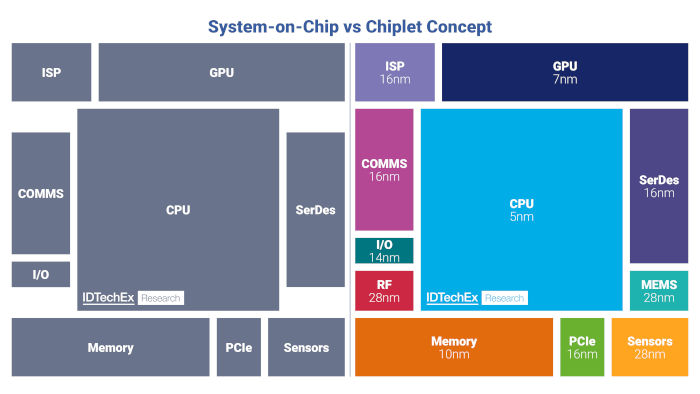
SoC versus the chiplet concept. Source: IDTechEx
Why are chiplets gaining ground?
The slowing of Moore's Law has made it increasingly difficult to add more transistors within a limited area. Instead, interest has shifted toward improving function density, an area in which chiplet design excels. Meanwhile, development efforts have increasingly focused on system-level integration, rather than solely on wafer fabrication.
The adoption of chiplet technology is driven by its ability to overcome several critical limitations inherent in traditional monolithic chip designs. One advantage is its ability to overcome constraints such as lattice size and memory wall size, which traditionally hinder the performance and scalability of semiconductor devices. By modularizing chip functions into discrete chiplets, manufacturers can more effectively optimize the use of semiconductor materials and processing nodes. Furthermore, chiplets can better utilize wafer corner space and have a lower chip defect rate, as this space is often underutilized in conventional chip designs, particularly in larger SoCs that demand an ever-increasing number of functions. Discrete components can be individually tested and validated before integration. As a result, manufacturing throughput increases, enabling higher production quality and reduced per-unit costs. Additionally, chiplets facilitate a more flexible design process, allowing for the integration of diverse functionalities tailored to specific applications without requiring entirely new chip designs. This flexibility reduces development time and costs and allows for rapid adaptation to evolving technological demands.
The nature of chiplets allows manufacturers to source different parts from multiple suppliers across various regions. This diversification reduces reliance on a single supplier or geographic area, thereby improving supply chain resilience. In a context of geopolitical tensions and trade restrictions, chiplet technology provides a strategic advantage by mitigating the risks associated with supply disruptions. By adopting chiplet designs, companies can circumvent these limitations more effectively, ensuring a consistent supply of critical components without relying heavily on regions subject to political instability or trade sanctions.
Taken together, these factors make chiplet technology an attractive option for manufacturers looking to improve performance while maintaining economic efficiency.
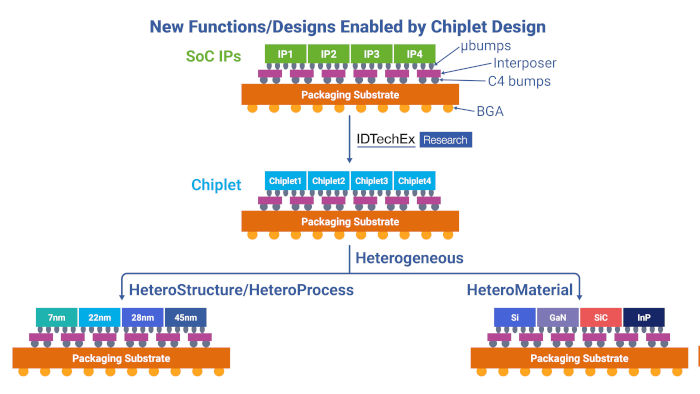
New features and designs thanks to the chiplet. Source: IDTechEx
Current Market Overview:
The global chiplet market is experiencing remarkable growth and is projected to reach $411 billion by 2035, driven by the demand for high-performance computing in sectors such as data centers and AI. The modular nature of chiplets enables rapid innovation and customization, addressing specific market needs while simultaneously reducing development time and costs.
While chiplets offer numerous advantages, they also present new challenges. Integrating multiple chiplets requires advanced interconnect technologies and standards to ensure seamless communication between components. Thermal management is another critical aspect, as the increased function density can lead to overheating if not properly managed. These challenges create opportunities for various players in the supply chain. For example, different packaging areas in chiplet design require different types of filler materials to meet specific needs, such as protecting the chips themselves by providing mechanical support and thermal stability, and safeguarding the delicate wires and solder balls that connect the chiplets, preventing issues like delamination or separation. This creates a demand for innovative materials that improve reliability and performance.
Report Coverage:
The IDTechEx report, "Chiplet Technology 2025-2035: Technology, Opportunities, and Applications," provides a comprehensive analysis of the chiplet technology landscape. It begins with an executive summary that offers an overview of the report's findings and perspectives, laying the groundwork for a detailed introduction to the fundamentals of chiplet technology. The report explores the drivers and advantages that make chiplet design attractive, while also identifying the challenges and obstacles to its adoption and deployment. It provides insights into the technology and manufacturing processes, including design methodologies and packaging techniques. The discussion extends to chip-to-chip communication, focusing on the interconnects and standards required for seamless integration. Thermal management strategies are outlined to address heat management in densely packaged systems. Finally, the report examines various application areas, presenting use cases across different industries and demonstrating the versatility and impact of chiplet technology. A 10-year market forecast, segmented by application, is provided, examining growth trends and future projections. It also delves into the supply chain, highlighting key players and their role in advancing chiplet technology.
Author: Dr. Xiaoxi He, Research Director at IDTechEx













