However, modifications to battery pack design can also significantly improve vehicle range by increasing energy density at the pack level. Cell-to-pack technology is one such example, and it has been developed by several major players, including BYD, Tesla, and CATL. Cell-to-pack trends are analyzed in detail in IDTechEx’s new market report, “Materials for Electric Vehicle Battery Cells and Packs 2026–2036: Technologies, Markets, Forecasts.”.
Cell-module-package, cell-to-package, and cell-to-chassis
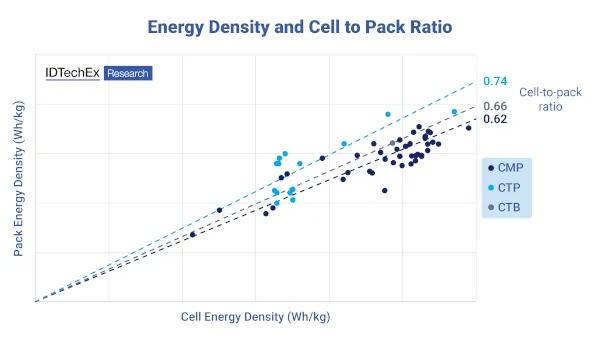
The standard battery pack structure used by automotive original equipment manufacturers (OEMs) in the 2010s and early 2020s was "cell-module-pack" (CMP), which describes a system in which multiple cells are grouped into a module, and multiple modules form a pack. The advantage of this design is that the packs are highly modular, allowing for easy scaling to larger vehicles, as well as easy repair and replacement. It is also a simple design in terms of thermal management and battery management system integration. However, having an additional layer in the pack hierarchy requires additional non-active components, particularly the module housing and internal wiring. This reduces packing efficiency and, therefore, energy density at both the pack and vehicle levels.
The cell-to-pack (CTP) system describes a system in which the cells are integrated directly into the package, without being stored in individual modules. This reduces non-active material components and increases the cell-to-pack ratio (i.e., the ratio between the volume/mass of the cells and the volume/mass of the package), which in turn allows for increased vehicle range.
The cell-to-body (CTB) system takes this concept a step further, describing a system in which the cells are integrated directly into the battery pack, and the pack itself acts as a structural component of the vehicle body. This requires additional materials to mechanically reinforce the pack, which reduces the energy density at the pack level, but it still allows for greater vehicle range compared to the cell-to-pack system, as it increases the energy density at the vehicle level (due to the reduced material requirement throughout the body).
Companies that use CTP and CTB technology: CATL, BYD, LG ES, Tesla
CTP and CTB technologies have only recently begun to be implemented. There are several reasons for this: firstly, the technology requires alternative thermal management systems, which needed development, and secondly, the technology requires adapted cell designs. Specifically, CTP and CTB technologies can only be reasonably implemented using large-format cells, primarily large prismatic cells and large cylindrical cells (46x).
These types of cells have only begun to be deployed in the last five years, with BYD's Blade Gen 1 being one of the first large-format prismatic cells compatible with CTP designs, while BYD and Tesla were the first developers of CTB packs. Other major players in this sector include both cell developers and automotive original equipment manufacturers (OEMs), such as CATL, LG ES, Volkswagen, Stellantis, and SVOLT. For a more detailed analysis of CTP and CTB players, see the recent IDTechEx report, "Electric Vehicle Battery Cell and Pack Materials 2026-2036: Technologies, Markets, Forecasts.".
BYD Blade Gen 2: allows for a higher cell-to-package ratio
BYD recently announced the first implementation of its second-generation Blade cell in the DENZA Z9GT, which reportedly boasts an impressive range of 1,036 km. BYD's first-generation Blade cells dominated the market and significantly contributed to the dominance of lithium iron phosphate (LFP) batteries in China.
Both the first and second generations use a prismatic battery design, though the Blade 2.0 is said to use an LMFP cathode instead of an LFP cathode, as well as a silicon-carbon composite anode instead of pure graphite. Both chemical changes allow for significantly higher energy density and improved fast charging. The Blade 2.0 also uses a new electrolyte formulation, called "Flash-Flow," which aims to improve lithium-ion mobility and increase charging speeds.
Blade 2.0 also appears to allow for a higher cell-to-pack ratio, thanks to CTB technology. While specific cell-to-pack ratios will depend on the vehicle model and battery pack design, the technology is claimed to offer a cell-to-pack volume utilization of 76%, which is significantly higher than the average for CTB designs. It is also superior to that of the first-generation Blade packs, which initially offered a cell-to-pack volume utilization of 62%.
Part of this is due to improvements in the Blade 2.0 battery pack's thermal management system design, which utilizes coolant cooling on two planes: the top and bottom of the pack. This also increases the cell-to-package gravimetric ratio, thanks to a significant reduction in the thermal management system's weight. This technology is expected to enable a significant improvement in the range and charging capabilities of next-generation Chinese electric vehicles.
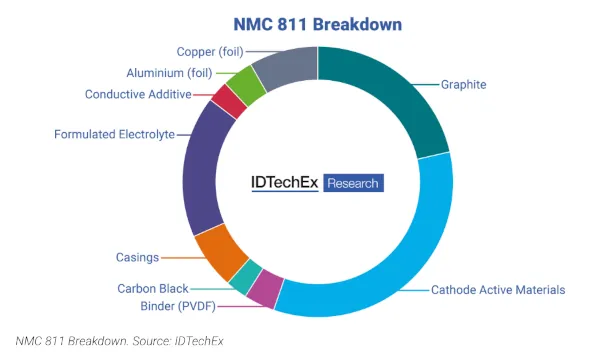
Perspectives on materials for cell-to-pack design
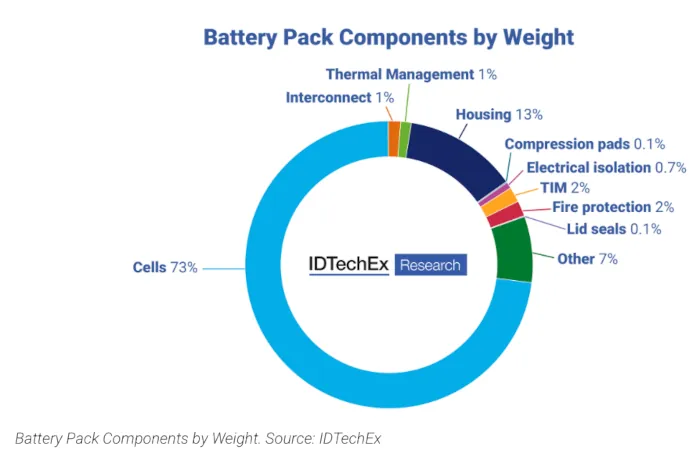
Cell-to-pack technologies modify the proportions of battery pack materials in several ways. First, because large cells are required, the proportions of non-active materials at the cell level are reduced. Second, by eliminating module casings, the requirements for non-active materials at the pack level can also be reduced. Third, cell-to-pack and cell-to-body designs may require adjustments to other materials at the pack level; for example, more powerful thermal management systems (since passive cooling is reduced due to increased packing efficiency) and more mechanically stable casings for cell-to-body (CTB) packs. Cell-to-pack (CTP) and cell-to-body technologies have gained significant market share in China and are gaining popularity in North America and Europe. IDTechEx predicts that CTP will become the dominant pack design choice for passenger cars over the next decade, as it allows for increased vehicle range without altering battery pack space requirements.
Furthermore, the report highlights that the shift towards CTP and CTB architectures not only addresses the need to improve energy density but also to optimize system-level costs. By reducing the number of structural components and simplifying assembly, manufacturers can lower both material and production costs. This is a key factor in a context where the competitiveness of electric vehicles increasingly depends on reducing the total cost per kWh.
Another relevant aspect is the impact of these architectures on battery safety. Although the elimination of modules introduces new challenges, especially regarding thermal propagation between cells, advances in thermal interface materials, flame barriers, and active cooling systems are mitigating these risks. In fact, the latest designs integrate advanced insulation and heat dissipation solutions that can match or even exceed the safety levels of traditional CMP systems.
In terms of materials, the shift towards CTP and CTB is driving increased demand for multifunctional solutions. For example, structural materials must combine mechanical strength with suitable thermal properties, while adhesives and sealants must offer both structural bonding and thermal conductivity or fire resistance. This is fostering innovation in advanced polymers, composites, and hybrid materials.
The report also emphasizes that the adoption of these technologies will not be uniform globally. China is clearly leading the implementation of CTP and CTB thanks to the strong vertical integration of its battery and automotive industries, while Europe and North America are progressing at a more gradual pace, constrained by the adaptation of their supply chains and safety regulations.
Looking ahead, IDTechEx anticipates that the convergence of new battery chemistries (such as LMFP or silicon-rich anodes) and advanced architectures like CTP and CTB will be crucial for achieving ranges exceeding 800–1000 km in mass-produced vehicles. Simultaneously, these innovations are expected to significantly improve charging times and battery lifespan.
Taken together, the transition to cell-to-pack and cell-to-body designs represents a structural shift in electric vehicle battery engineering, with profound implications for materials, manufacturing, costs, and performance. These technologies not only redefine battery pack architecture but will also play a key role in the next generation of electric mobility.