




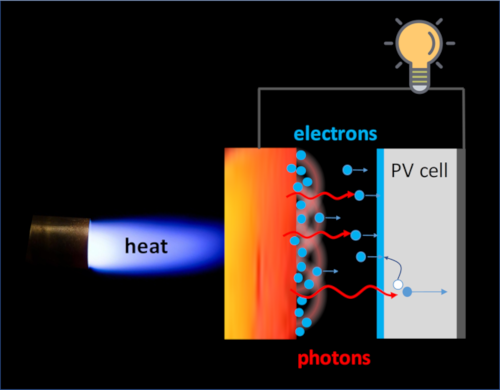
With the aim of reversing this situation and achieving greater efficiencies, researchers from the Solar Energy Institute of the Polytechnic University of Madrid (UPM) and the Center for Energy and Thermal Sciences in Lyon have proposed a new device in which the electron flow is replaced by the emission of photons and electrons through a nanometric empty space. This interrupts the propagation of a type of particle called "phonons," which are the main cause of thermal losses in current thermoelectric devices. This new conversion mechanism has been named "thermionic-enhanced near-field thermophotovoltaics" and, theoretically, allows for a considerable increase in both electrical power density and conversion efficiency.
“To convert heat into electricity, current devices use the flow of electrons through a solid. These electrons move driven by a thermal gradient and eventually create a voltage that can be harnessed to produce electricity. This is called the thermoelectric effect and is the basis of many generators used today to produce electricity from waste heat or in space missions,” explains Alejandro Datas, a researcher at the UPM Solar Energy Institute and author of the study recently published in the journal Nano Energy. “Currently, the biggest limitation of thermoelectricity is that the flow of electrons competes with the flow of phonons, which are vibrating quasiparticles transmitted through the material's crystal lattice. Phonons carry much of the heat and account for most of the device's thermal losses. These losses explain why thermoelectric conversion efficiency rarely exceeds 10%,” he adds.
Transferring Heat at the Nanoscale.
But these losses can be eliminated if we look for other mechanisms to transfer and convert heat into electricity. A hot material contains atoms in constant vibration. Besides phonons, these vibrations also produce electromagnetic waves. Some of these waves escape from the material and we perceive them as light, or electromagnetic radiation. But other waves cannot escape and remain confined in the vicinity of its surface. The laws of electromagnetism state that the intensity of electromagnetic energy skyrockets when we position ourselves just a few hundred nanometers away (one-thousandth the thickness of a human hair) from the surface of a hot material. This effect is called the "tunneling effect" and allows us to transfer a great deal of electromagnetic energy without the need for physical contact with the material. The key is that this minimal distance is sufficient to interrupt the flow of phonons and thus eliminate the heat losses associated with them. Therefore, the fundamental challenge lies in how to efficiently convert that large amount of surface electromagnetic energy into electricity.
The proposed device offers a solution that combines thermionic and photovoltaic effects. “It involves placing a solar cell extremely close to the surface of the hot material, just a few hundred nanometers away. Just as a solar cell produces electricity from sunlight, this cell will generate electricity from the electromagnetic radiation present on the material's surface. However, since it's very difficult to run a wire to extract the electricity at such a close proximity, we replace the wires with the thermionic emission of electrons from the surface itself,” explains Alejandro Datas. In this way, the device allows the conversion into electricity not only of electromagnetic waves (or photons) but also of the electrons emitted by the surface. The simultaneous use of photons and electrons represents a new technological paradigm in the field of direct heat-to-electricity conversion. “The simultaneous use of photons and electrons as heat carriers in thermoelectric conversion processes presents new scientific and technological challenges that will need to be studied further in future research,” explains Alejandro Datas.
This new device is the result of a collaboration between two European projects: the EU-funded AMADEUS project, coordinated by the UPM's Solar Energy Institute and focused on the experimental implementation of these hybrid devices at macroscopic distances, and the French DEMO NFR TPV project, which aims to develop a device for near-field thermophotovoltaic conversion.
"The next challenge would be to coordinate the achievements of these two projects to develop a hybrid near-field converter," the researchers explain.













