




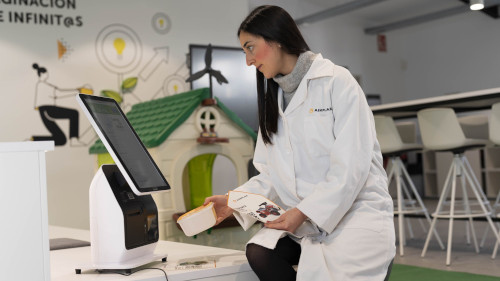
This tool provides consumers with essential information about the traceability, materials, recycling, and carbon footprint of the products they purchase. Furthermore, this solution, developed by AIMPLAS, officially demonstrates that plastic products comply with all European regulations.
As an example of what this digital passport will entail, the totem includes examples of a supermarket ice cream tub and a toy house, which, in addition to being made with at least 90% recycled plastic, seeks to educate about sustainable habits and respect for nature.
Both products (packaging and toy) are framed within the priorities defined by the European Commission's Joint Research Centre for the Sustainable Product Ecodesign Regulation.
The totem, designed as an interactive screen with barcode and label readers, allows for a visual and intuitive exploration of the information that these two products could include in their future digital passport. It integrates detailed data on the product's life cycle, from its origin and manufacturing process to its material components and end-of-life recycling options, as well as its carbon footprint. With this demonstrator, AIMPLAS aims to raise awareness among industry and consumers about the importance of having verified and accessible information that promotes more responsible and circular consumption.
Digital passport: transparency, security and sustainability
The digital product passport will offer consumers easier, more transparent, and more secure access to key information about the products they buy. This will improve the shopping experience, promote sustainability, and strengthen consumer confidence in product authenticity and quality.
The digital passport will give consumers access to a product's complete history, from manufacturing to distribution and consumption. Through the digital passport, consumers will be able to access detailed information about product characteristics (materials, manufacturing date, etc.), instructions for use, warranties, and recycling recommendations. This will allow them to make more informed and confident purchasing decisions. Furthermore, digital passports will facilitate tracking a product's environmental impact throughout its lifecycle, which can include its carbon footprint, resource use, and recycling practices. This will help consumers choose more sustainable products and allow companies to demonstrate their commitment to the environment.
The products that the European Commission has identified as key to be included in the Sustainable Products Ecodesign Regulation (which encompasses the digital passport) are eleven final products (textiles and footwear, furniture, tires, mattresses, detergents, paints and varnishes, lubricants, cosmetics, toys, fishing gear, absorbent hygiene products), and seven intermediate products (iron and steel, basic chemicals, non-ferrous metal products other than aluminum, aluminum, plastics and polymers, pulp and paper, and glass). In addition, three horizontal requirements will be taken into account (durability, recyclability, and recycled content).
The development of this demonstrator of the future digital passport has been made possible thanks to funding from the Valencian Institute of Competitiveness and Innovation (IVACE+i) with resources from the Valencian Regional Government for independent R&D activities by technology centers. It falls within the framework of the Circular Economy Initiative promoted by AIMPLAS and represents a step towards transparency and sustainability in the plastics industry.
The companies ITC Packaging and Famosa collaborated on this development by providing relevant information from the technical specifications of the ice cream container and the toy. Both companies are working with AIMPLAS on the OASIS project, which is currently under evaluation for funding by IVACE+i within the program of grants aimed at technology centers in the Valencian Community for non-economic R&D projects carried out in collaboration with companies for the 2024 fiscal year, funded by the European Regional Development Fund (ERDF) of the European Union within the framework of the 2021-2027 Operational Program.













