In nanoscience, compared to rigid molecules, controlling the movement of soft molecules is difficult due to their flexibility. In particular, only a portion of soft molecules are suitable for absorbing the tunneling current energy needed to induce movement, rather than undergoing conformational changes.
A collaboration led by Waka Nakanishi and Katsuhiko Ariga at WPI-MANA and We-hyo Soe and Christian Joachim at GNS and WPI-MANA Satellite, CEMES-CNRS in Toulouse designed, synthesized, and characterized a conformationally flexible molecule consisting of two binaftilin paddles mounted on a simple phenyl chassis. The vibrational modes of the side paddles can be exploited to induce the molecule's movement on an Au(111) surface using inelastic STM tunneling effects. The molecule has two different non-planar configurations in solution, which it retains when adsorbed onto the surface. However, on the metal surface, it is possible to change molecules, one by one, into a planar configuration using a specific STM mechanical manipulation protocol. The planar configuration is the most interesting for this work, since only planar molecules can be moved in a controllable way on the surface by local STM excitations. Once they assume this configuration, the molecules are reasonably stable on the surface.
The molecules in the planar configuration were characterized to determine the spots where electrons should be injected to make them move on the surface without mechanically pushing them. In fact, depending on the location where the tunneling current enters the molecule, it can assume a non-planar configuration (different from the original one) instead of moving. If the current is applied at the right location, the molecule can be moved in a controlled manner. The experimental characterization of the molecules was complemented by molecular dynamics simulations and density functional theory calculations, which helped to determine the energy of the molecules. In April 2017, a "nanorace" took place, in which several molecular machines synthesized by groups around the world competed to cover a set distance on a gold surface in the shortest possible time, propelled by STM tips. The molecule presented in this paper is one of the vehicles that participated in the race.
Reference:
Soe, W.-H., Shirai, Y., Durand, C., Yonamine, Y., Minami, K., Bouju, X., Kolmer, M., Ariga, K., Joachim, C., and Nakanishi, W. Conformation Manipulation and Motion of a Double Paddle Molecule on an Au(111) Surface. ACS Nano 11, 10357-10365 (2017).





- Details
- Category: Technology
Driving soft molecular vehicles on a metallic surface
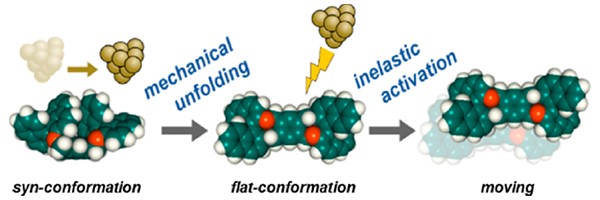 The soft molecules deposited on metallic surfaces were guided using a scanning tunneling microscope (STM) without pulling or pushing them mechanically, but by inducing inelastic excitations with the tunneling current.






Print Magazine

Annual subscription price:
You will receive all 10 editions that are published each year.
social networks
Popular News Electronics



Spanish electronics magazine. Printed for over 25 years.
Spain - Madrid - All rights reserved © Convertronic Professional Spanish Electronics Magazine.