




Flexible Hybrid Electronics: Strategies for Enabling Cheaper Substrates.
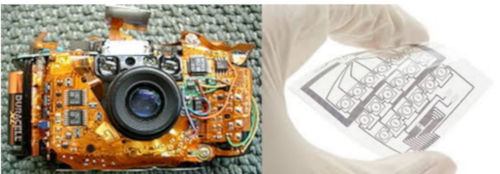
Imagine a flexible front-end circuit board (FPCB) and you will almost inevitably picture a sheet of orange/brown plastic, probably with some copper etchings and perhaps a few components soldered onto it. This plastic is PI (polyimide/Kapton), and its ubiquity is primarily due to its temperature resistance and overall durability. In fact, it is so durable and temperature-insensitive that PI is commonly used in laboratory ovens, cryostats, and (when laminated with aluminum) wrapped around satellites.
Disadvantages of Polyimide:
These capabilities make it seem like the ideal material for flexible electronic applications, but there are some drawbacks. First, it costs around 100 times the price of PET (polyethylene terephthalate), a common clear plastic used in beverage bottles. This doesn't matter if the plastic film is going to a laboratory or around a satellite, but as a circuit substrate for disposable smart packaging or other low-cost applications, it's a significant disadvantage.
Secondly, and at the risk of stating the obvious, it is orange. This prevents its use in optical applications, such as LED-coated sheets. Thirdly, the trade-off for its durability is that it doesn't stretch, making it difficult to use in wearable skin patches or electronic textiles.
All of this means that switching to cheaper but thermally more brittle transparent substrates, such as PET, PEN (polyethylene naphtholate), and stretch TPU (thermoplastic polyurethane), is a major trend in the flexible electronics industry. However, it requires a significant technological shift in how electronic components are attached to the substrate. This attachment of conventional components to flexible substrates with printed (rather than etched) interconnects is called flexible hybrid electronics (FHE).
The new IDTechEx report, "Flexible Hybrid Electronics 2020-2030: Applications, Challenges, Innovations and Forecasts," analyzes the technologies and innovations needed to enable electronics manufacturing on low-cost substrates. It is based on extensive primary research, including interviews and visits to companies worldwide, and is referenced throughout this article.
Flexible hybrid electronics need low-cost substrates.
Flexible hybrid electronics (FHE) promises to combine the functionality of conventional rigid electronics with the flexibility of printed electronics. The diagram shows a prototype FHE circuit, in which an integrated circuit is combined with many other elements, including (for example) printed sensors, an antenna, a thin-film battery, and even thin-film PV. Not all components need to be included, or even printed, for a circuit to qualify as FHE, but it must include at least the printed and placed functionality.
With a conventional rigid PCB, or indeed an FPCB, component joining is achieved through soldering, a crucial technology that is largely taken for granted. Soldering has multiple benefits: surface tension helps position components in the correct alignment, reducing the requirements for precise placement; errors can be rectified by hand; and, most importantly, it provides excellent electrical and mechanical connections. Unfortunately for manufacturers aiming to use cheaper, thermally brittle alternative substrates, conventional SnAgCu (SAC) soldering requires reflow temperatures of around 250°C, which is not a problem for PI but causes melting and degradation in most other plastic substrates.
Anisotropic Conductive Adhesives.
To date, this conundrum has been addressed using anisotropic conductive adhesives (ACAs), which can be thermally cured at suitable temperatures. However, IDTechEx believes they represent a stopgap solution for many applications, particularly those requiring high durability: they cost around 3 to 10 times as much as soldering and, notably, offer no advantages. As such, considerable effort has been devoted to developing low-temperature soldering or photonic sintering, which can cause solder to reflow without damaging the substrate. Which of these approaches will be more widely adopted remains an open question, but the development of PET-compatible component attachment methods is undoubtedly a crucial step in advancing the adoption of low-cost, flexible hybrid electronics.
These component fixing materials, along with case studies of innovative approaches including nanoparticle-containing supercooled solder and field-aligned ACA, are evaluated in detail in the new IDTechEx report.
A Roadmap for Substrate Adoption:
Given the requirements in terms of technological development and manufacturing methods for low-cost substrates, IDTechEx anticipates that they are more likely to be adopted in high-volume, high-cost applications. IDTechEx suggests that paper substrates will gradually become dominant for RFID tags and smart packaging. There will also be a shift away from IP towards cheaper, thermally more brittle substrates, such as PET, driven by applications with lower durability requirements. The IDTechEx application-specific roadmap for substrate adoption is shown schematically below.
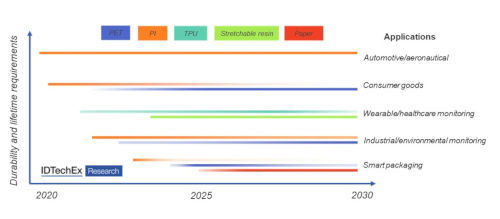
A schematic roadmap showing the evolution in substrate choice for various FHE applications. Cost-sensitive applications, such as smart packaging, are likely to experience the greatest shift from PI to PET. Paper is also an option for smart packaging substrates if electronic manufacturing equipment can be integrated into existing packaging lines.
A Comprehensive Overview of FHE:
The new IDTechEx report, "Flexible Hybrid Electronics 2020-2030: Applications, Challenges, Innovations and Forecasts," offers a comprehensive analysis of this emerging technological frontier. IDTechEx has been evaluating and tracking printed electronics technologies and markets for over a decade. This report is based on new primary research, including interviews and company visits with all the key players worldwide. It identifies and examines all the key innovation trends in materials and production systems, covering attachment materials, substrates, and metallization, as well as production techniques, including high-throughput pick-and-place and various S2S and R2R printing techniques. This report creates an application roadmap, showing how FHE will grow in complexity from today's simple RFID tags to the complex flexible hybrid electronics of the future, enabling applications in smart packaging, industrial monitoring, wearable devices, and more. It offers a detailed analysis of the application timeline, challenges, and innovation opportunities. Furthermore, it forecasts the growth of this enabling technology, demonstrating that the market can reach X by Y with the inflection point where rapid uptake occurs, likely arriving in 2025.
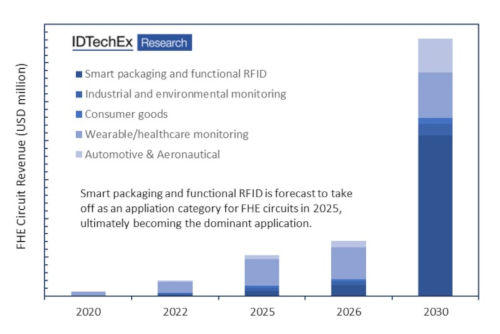 Market revenue forecasts for FHE adoption across various applications. These forecasts are based on granular analysis of over 20 subcategories, the benefits offered by FHE in each category, and price forecasts for application-specific components and assembly methods.













