Over the past decade, green technologies have experienced rapid growth. In the transportation sector, the share of global electric vehicle sales has grown from virtually nonexistent in 2010 to over two million in 2020, with projections indicating that by 2030 sales could reach nearly 30% of the global electric car market share. This radical shift is primarily driven by environmental targets aimed at reducing greenhouse gas emissions. While electric vehicles do not emit greenhouse gases during use, green technologies can impact manufacturing, reducing reliance on oil but potentially increasing dependence on other materials, known as critical raw materials.
The objectives of a study conducted by members of the Environmental Studies research group at the UPM (Technical University of Madrid) – within which María del Pilar Martínez Hernando's doctoral thesis is framed – were to analyze the critical raw materials required for permanent magnets and electric vehicle batteries (neodymium, lithium, cobalt); assess their supply risk through a materials flow analysis; and examine their environmental impacts using the Environmentally-Extended Multi-Regional Input-Output Analysis methodology. “Unlike conventional methodologies that only calculate global impacts, this methodology allows us to quantify the impacts and determine the country in which they are generated,” explains María del Pilar Martínez Hernando.
Most of the critical raw materials used in these vehicles have their production chain in China. In the case of neodymium, China has a monopoly on mining and processing, possessing the largest reserves of rare earth elements (which include neodymium) and controlling the use of the Bayan Obo process, an electrolysis process necessary for neodymium metallurgy. On the other hand, while China does not possess large reserves of lithium and cobalt (6.7% of lithium and 1% of cobalt), it controls the metallurgy stage and the production of permanent magnets (neodymium) and batteries (lithium). China manufactures 60.8% of the world's permanent magnets and 79% of the batteries for electric vehicles.
The localized production of materials means that consumers like Europe export the emissions produced by the materials they consume. Although Europe has 35% of the world's electric vehicles, only 1.2% of the greenhouse gas emissions generated in the supply chain are attributed to Europe. "This reflects how our continent is shifting the environmental impact of light transport from the consumer (Europe) to the manufacturer (mainly China)," the researchers state.
Despite the overall benefit of electric vehicles in reducing greenhouse gas emissions, Europe must be mindful of the emissions generated by the products it consumes. “One measure the European Union could take is to manufacture batteries in Europe, in countries like Hungary, which possess the necessary technology and is currently the world's third-largest battery producer. Furthermore, by using more environmentally friendly technologies in Europe, we have observed that greenhouse gas emissions associated with battery production could be reduced by 30.9%,” conclude the UPM researchers who conducted the study.
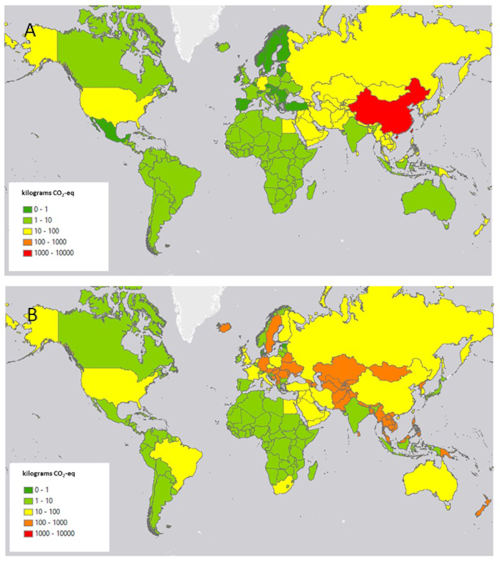
Localized greenhouse gas emissions from the production chain of an electric vehicle battery manufactured in China (top) and manufactured in Hungary (bottom). Source: UPM.
María Pilar Martínez Hernando, David Bolonio, Marcelo F. Ortega, Juan F. Llamas, María-Jesús García-Martínez. Material flow analysis and regional greenhouse gas emissions associated to permanent magnets and batteries used in electric vehicles. Science of The Total Environment. Volume 904, 15 December 2023, 166368. ISSN 0048-9697.