Proactive buyers in key sectors such as automotive and construction are moving from passive acquisition to actively shaping the market, providing the profitability needed to build the green steel plants of the future.
This article is based on research from the IDTechEx report "Green Steel 2025-2035: Technologies, Players, Markets, Forecasts," which provides an in-depth analysis of this evolving landscape and reveals how purchase commitments, along with policies and finance, are driving the green steel market.
Why early adoption by buyers is crucial for decarbonization
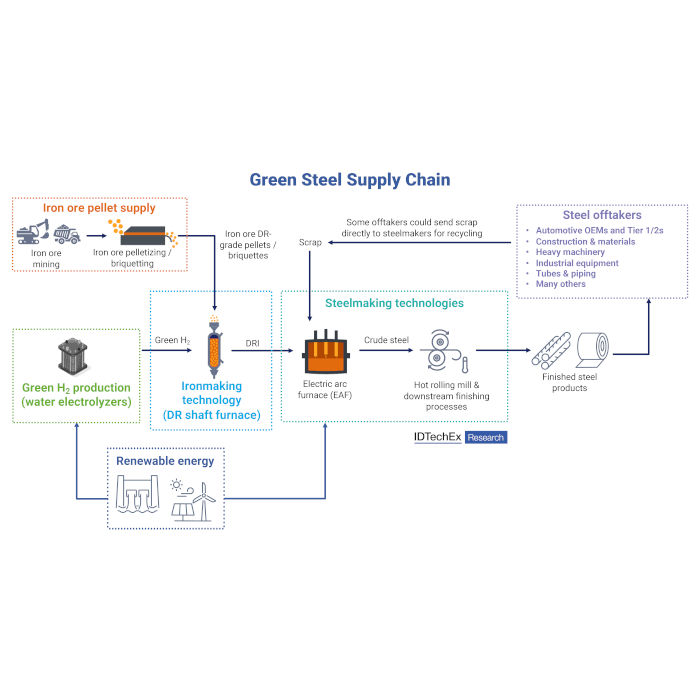
Switching from carbon-intensive blast furnaces to greener alternatives, such as hydrogen-based direct reduction iron (H2-DRI) combined with electric arc furnaces (EAFs), requires a massive upfront investment, with individual projects typically costing billions of dollars. For these projects to move from announcement to reality, producers need to guarantee long-term revenue certainty.
This is where buyers play a crucial role. Through long-term, binding purchase agreements, major steel consumers commit to acquiring future volumes of green steel, often at a price higher than that of conventional steel. These agreements form the financial basis of the green steel transition. They significantly reduce investment risk for producers and are a fundamental prerequisite for securing the necessary project financing from private investors and financial institutions. The success of emerging players like Stegra (H2 Green Steel), which has raised over €6.5 billion, is directly linked to their ability to sell more than half of their initial capacity in advance through these types of contracts.
Key factors: convergence of policy and business strategy
The growing demand for green steel is driven by converging regulations and companies' ambitious climate strategies. On the policy front, frameworks such as the EU Emissions Trading System (ETS) and the Carbon Border Adjustment Mechanism (CBAM) are increasing the cost of carbon-intensive production, creating an economic case for low-carbon steel. The CBAM is particularly noteworthy because it aims to prevent the relocation of production to countries with less stringent regulations, thereby reducing the risk of carbon leakage. Steel producers in China are already aligning themselves to comply with the CBAM. Furthermore, EU regulations such as the End-of-Life Vehicle (ELV) Regulation and the ESPR may also stimulate demand for green steel.
At the same time, companies are facing increasing pressure from investors and consumers to decarbonize their entire value chain, particularly their Scope 3 emissions, which include purchased materials. For an automaker or a construction company, steel constitutes a substantial portion of this embodied carbon. Committing to purchasing green steel is one of the most direct and effective ways for these companies to achieve their net-zero emissions targets.
Activities of the main players: the automotive sector leads and other sectors follow
The automotive sector has become the clear driving force behind the buyer movement. The willingness to absorb an "eco-premium" stems from the fact that even a significant increase in the cost per ton of steel translates into only a marginal increase (1-2%) in the final price of the vehicle. This allows automakers to enhance their sustainability credentials with minimal impact on consumer costs.
European original equipment manufacturers (OEMs), as well as Tier 1 and Tier 2 suppliers, are actively purchasing green steel. For example, the Swedish startup Stegra (H2 Green Steel) has secured purchase agreements with a list of automotive industry leaders, including Mercedes-Benz, Porsche, Scania, and ZF. Similarly, SSAB, a pioneer with its fossil-fuel-free steel project HYBRIT, has established partnerships with the Volvo Group. Established steel giants are also taking significant steps: ArcelorMittal supplies its recycled and renewable XCarb® steel to General Motors, indicating a growing push for green steel in North America.
Although the automotive sector grabs the headlines, demand is expanding. In the construction sector, Stegra (H2 Green Steel) has signed agreements with building solutions provider Kingspan and ventilation company Lindab. A very attractive circular economy model is also emerging in the energy sector, where utility Vattenfall will purchase fossil-free steel from its HYBRIT project partner, SSAB, for use in its own energy infrastructure. Industrial machinery and equipment manufacturers such as JCB, Alfa Laval, and Lindab are also interested in acquiring steel for their products. Interestingly, even Amazon Web Services (AWS) has used recycled steel in the construction of a data center in Sweden.
Outlook: a market driven by demand, but facing challenges
The path forward is defined by both immense opportunities and significant challenges. While buyer demand, government subsidies, and green finance create a powerful ecosystem, the supply side remains fragile. Buyers must navigate the risks of an emerging market, including potential project delays, price volatility linked to renewable energy costs, and the lack of universally accepted standards for what constitutes "green steel," creating a risk of greenwashing.
The structure of the industry itself may be about to be transformed. The concept of "green iron hubs" is gaining traction, in which iron is produced using green hydrogen in regions with abundant renewable energy (e.g., Australia, Brazil) and then shipped as hot iron briquettes (HBIs) to steel mills elsewhere. This decoupling of iron and steel production could reshape global supply chains.
Despite these complexities, the trajectory is clear. The demand signal from buyers has initiated the industry's gradual transition. The future of steel depends not only on the furnaces used to manufacture it, but also on long-term contracts signed by forward-thinking consumers.
IDTechEx forecasts that hydrogen-based green steel production will reach a significant 46 million tons by 2035. While this is still a fraction of the total needed to meet net-zero emissions targets by 2050, it represents a definite start.